

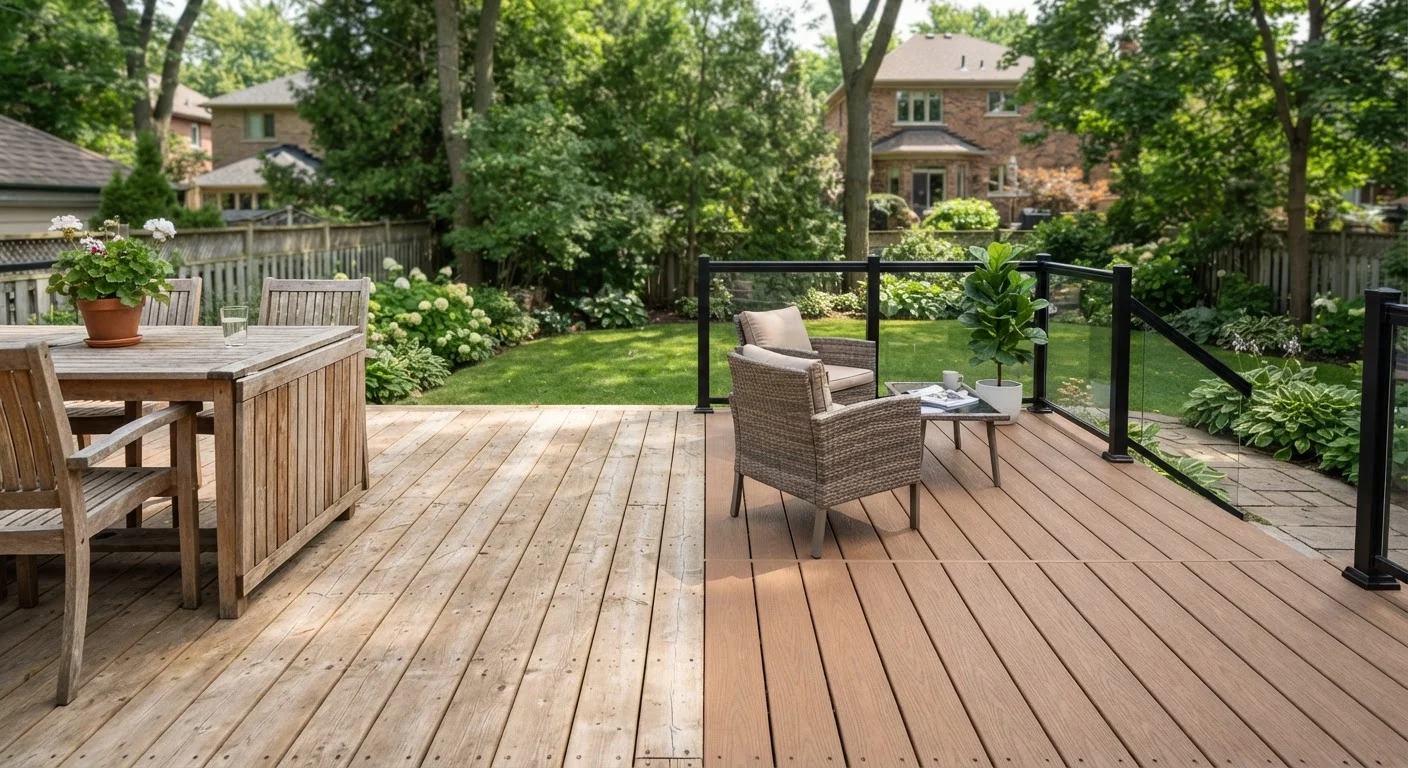
Key Takeaways
- Pressure-treated lumber costs less upfront but requires regular sealing, staining, and inspection.
- Composite decking has a higher initial price but dramatically lower ongoing maintenance demands.
- Both materials can last 25-30 years when properly installed and maintained.
- Pressure-treated wood uses chemical preservatives; composite uses recycled wood fiber and plastic.
- Climate and intended use can significantly affect which material performs better for your project.
Option A
Pressure-Treated Lumber
The time-tested, budget-accessible traditional choice.
Best for: Homeowners seeking a lower upfront cost who are comfortable with regular seasonal maintenance.
Option B
Composite Decking
The low-maintenance, engineered alternative for long-term convenience.
Best for: Homeowners who prioritize minimal upkeep and are prepared to invest more at installation.
If you want the lowest possible upfront material cost
Pressure-Treated Lumber
Pressure-treated wood consistently costs less per linear foot at purchase. For a tight initial budget, it's the more accessible starting point.
If you want to minimize weekend maintenance for years to come
Composite Decking
Composite boards don't need staining, sealing, or sanding. Occasional cleaning with soap and water is typically all that's required.
If you live in a high-humidity or consistently wet climate
Composite Decking
Composite is highly resistant to moisture-related damage like rot and warping, which are common failure points for untreated or poorly maintained wood.
If you want the look and feel of natural wood
Pressure-Treated Lumber
Real wood offers an authentic grain texture and natural appearance that most homeowners find difficult to replicate with engineered alternatives.
If environmental impact is a key consideration
Composite Decking
Most composite decking incorporates recycled content, and its longer service life with fewer treatments can reduce overall resource consumption over time.
Understanding What Each Material Actually Is
Before comparing performance, it helps to understand what you're working with.
Pressure-treated lumber is typically Southern yellow pine or similar softwood that has been infused with chemical preservatives - most commonly alkaline copper quaternary (ACQ) or copper azole - under high pressure. This treatment makes the wood resistant to rot, fungal decay, and insect damage that would otherwise compromise untreated wood outdoors.
Composite decking is an engineered product made from a blend of wood fiber (often recycled sawdust or reclaimed wood scraps) and plastic resins, typically polyethylene or polypropylene. Many products also incorporate a protective polymer cap layer around the outside to resist staining, fading, and moisture intrusion. The resulting board mimics the look of wood but behaves quite differently in real-world conditions.
For a deeper look at the structural side of deck construction - including what goes beneath the decking boards - see our guide to deck building from the ground up.
| Criterion | Pressure-Treated Lumber | Composite Decking |
|---|---|---|
| Upfront material cost | Lower per linear foot | Higher per linear foot |
| Maintenance frequency | Annual to biennial sealing/staining | Occasional cleaning only |
| Splinter risk | Yes, especially as wood ages | Minimal to none |
| Rot and moisture resistance | Moderate with proper sealing | High |
| Expected lifespan | 15-30 years (maintenance-dependent) | 25-30+ years |
| Natural appearance | Authentic wood grain and texture | Wood-like but engineered |
| Recycled content | None typically | Often contains recycled material |
| Heat retention in sun | Lower surface temperature | Can run hotter underfoot |
Cost: Upfront vs. Lifetime
Cost comparisons between these materials shift significantly depending on your time horizon.
Pressure-treated lumber generally runs lower per linear foot than most composite options at the time of purchase. However, that cost picture changes when you factor in the recurring expenses of ownership: sealers, stains, cleaning supplies, and replacement boards for sections that rot or warp add up over a deck's life. If you skip those maintenance steps, you risk accelerating deterioration and facing more expensive repairs.
Composite decking carries a higher purchase price - sometimes two to three times the cost of treated lumber - but its maintenance demands are minimal. There's no annual sealing required, no sanding rough splinters, and far less likelihood of replacing individual boards due to rot.
2-3×
Composite vs. lumber upfront cost
Industry cost guides generally place composite decking at roughly two to three times the per-board cost of pressure-treated pine at time of purchase.
1-3 yrs
Wood deck resealing interval
Most decking professionals recommend resealing or restaining a pressure-treated wood deck every one to three years depending on climate exposure.
25-30 yrs
Expected lifespan of quality composite
Manufacturers of capped composite products commonly cite warranties and expected service lives in the 25-to-30-year range under normal residential use.
For homeowners planning to stay in a home long-term, composite's total cost of ownership can compare more favorably than its sticker price suggests. For shorter horizons or tighter starting budgets, pressure-treated wood remains a genuinely practical choice.
Maintenance, Durability, and Lifespan
Maintenance is where the day-to-day experience of these two materials diverges most sharply.
Pressure-treated wood should be allowed to dry fully after installation - typically several weeks to a few months - before sealing. After that, most experts recommend reapplying a quality sealer or stain every one to three years to protect against moisture and UV damage. Without it, wood can crack, splinter, and gray out. Regular inspection for soft spots or loose fasteners is also important. Our article on weatherproofing a wood deck breaks down exactly how to approach that process.
Composite decking, by contrast, needs little beyond periodic cleaning. Most manufacturers recommend a simple wash with soap and water, and some suggest a composite-safe cleaner for stubborn stains. It won't splinter, doesn't require sealing, and resists fading better than raw wood - especially capped composite products.
Both materials can achieve lifespans of 25 years or more under good conditions. Pressure-treated lumber's lifespan is more variable and depends heavily on maintenance consistency. For a factual breakdown of what drives longevity in each, see The Real Lifespan of Common Decking Materials.
Watch for Moisture Around Fasteners
With pressure-treated lumber, the areas most vulnerable to early decay are where fasteners penetrate the board - these puncture the treated outer layer and can let moisture in. Using stainless steel or hot-dipped galvanized fasteners (required with modern copper-based treatments) and applying a wood preservative to cut ends during installation can meaningfully extend board life. Composite decking is less susceptible to this issue but still benefits from proper fastener spacing to allow for expansion.
Environmental and Safety Considerations
Both materials come with environmental trade-offs worth understanding.
Older pressure-treated wood used chromated copper arsenate (CCA), which raised legitimate health and disposal concerns. Modern residential lumber uses copper-based treatments that are considered safer - but the chemicals are still present, and cutting or sanding treated lumber produces dust that warrants protective measures like a respirator and safety glasses. Disposal is also regulated in many areas; treated wood should not be burned.
Composite decking often incorporates recycled plastic and reclaimed wood content, which can reduce landfill contributions. However, it's made from petroleum-based plastics that don't biodegrade and can be difficult to recycle at end of life. The overall environmental profile depends on the specific product and how far it has to be shipped.
Homeowners weighing outdoor surface options more broadly may also find it useful to compare concrete vs. paver patios as alternative outdoor surface approaches.