

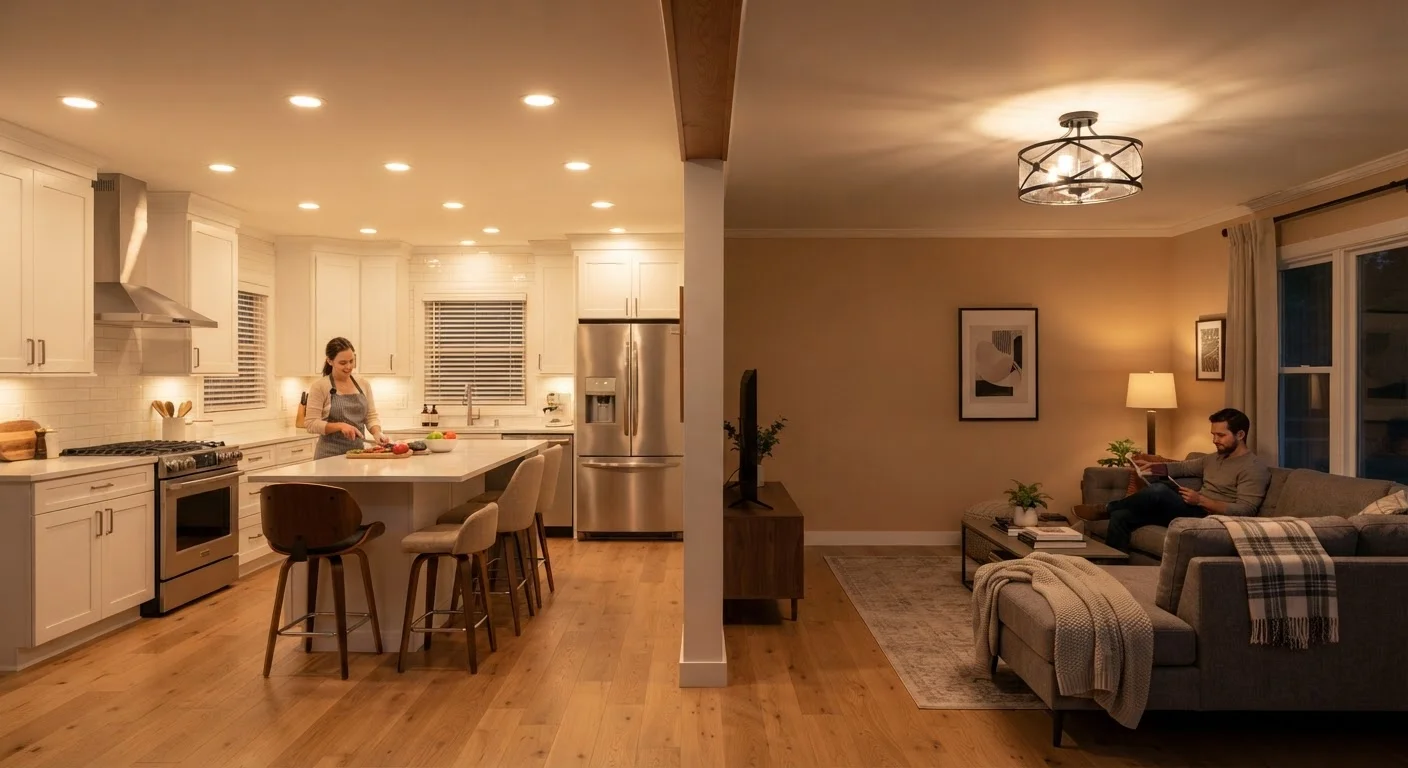
Key Takeaways
- Recessed lighting suits higher ceilings and task-heavy spaces like kitchens and home offices.
- Flush mount fixtures are ideal for low ceilings and rooms where a single ambient source works well.
- Installation complexity and electrical work differ significantly between the two options.
- Both types are available with dimmable, energy-efficient LED configurations.
- Room function, ceiling height, and existing wiring should all guide your final decision.
Our Verdict
Neither recessed lighting nor flush mount fixtures is universally superior - the right choice depends on ceiling height, room function, and how much control you want over light direction. Recessed lighting offers flexibility and a clean architectural look in larger or task-oriented spaces, while flush mount fixtures deliver simple, effective ambient lighting with easier installation in compact or low-ceiling rooms.
| Best for | Recommended |
|---|---|
| Kitchens, home offices, and open-plan spaces | Recessed lighting |
| Bedrooms, hallways, and rooms with ceilings under 8 feet | Flush mount fixtures |
| Homeowners who want layered, adjustable lighting schemes | Recessed lighting |
| Renters or those seeking simpler, lower-cost installation | Flush mount fixtures |
Understanding the Core Difference
Recessed lighting - sometimes called can lights or downlights - sits flush inside the ceiling cavity, with only a trim ring and bulb visible from below. Flush mount fixtures attach directly to the ceiling surface, with the housing resting flat against the drywall and the light projecting downward and outward.
The distinction matters beyond aesthetics. Recessed lights require adequate ceiling depth (typically at least 5-6 inches of clearance above the drywall) and are often installed in multiples to cover a room evenly. Flush mounts can work as a single centrally placed fixture and need no ceiling cavity at all. If you're new to lighting terminology like lumens, color rendering index (CRI), or trim types, our home lighting upgrade glossary covers the essentials before you shop.
| Recessed Lighting | Flush Mount Fixtures | |
|---|---|---|
| Ceiling height requirement | Best with 8+ feet and cavity depth | Works with ceilings as low as 7 feet |
| Installation complexity | Moderate to high; often needs new wiring | Low; typically replaces existing box |
| Coverage per fixture | Targeted; multiple cans needed | Broad ambient; one fixture often sufficient |
| Aesthetic impact | Clean, minimal, architectural | Visible design element; wide style range |
| Dimmer compatibility | Widely available with LED trim | Available; verify LED driver compatibility |
| Best room fit | Kitchen, office, open-plan spaces | Bedroom, hallway, small living rooms |
Room-by-Room Guidance
Kitchen
Kitchens benefit most from recessed lighting. Multiple cans positioned over countertops, islands, and prep areas deliver focused task lighting without casting shadows. Pair them with under-cabinet lighting for a fully layered effect. Flush mounts can supplement but rarely cover a kitchen's varied work zones on their own.
Living Room
Living rooms allow for either approach. Recessed lights work well in larger open-plan spaces or rooms where you also want a projector or large screen - controlling glare matters here, and directional recessed trim helps. See our comparison of projectors vs. large-screen TVs for how ambient light affects display choices. A single decorative flush mount can anchor a smaller living room with enough warmth and presence.
Bedroom
Bedrooms with standard 8-foot ceilings are natural fits for flush mount fixtures. A centrally placed flush mount with a warm color temperature (around 2700K) creates soft, relaxing ambient light. Recessed lights in bedrooms work best when dimmer-controlled and layered with bedside lamps.
Hallways and Entryways
Low-traffic transitional spaces like hallways rarely justify the cost and labor of multiple recessed cans. A well-placed flush mount provides adequate light without overwhelming a narrow corridor. In taller entryways, a single recessed or semi-flush fixture can make a clean first impression.
Layer Your Lighting for Best Results
In any room, a single light source - recessed or flush mount - rarely does the whole job. Combine your ceiling fixture with table lamps, floor lamps, or under-cabinet lights to create layers of illumination you can adjust by time of day or activity. This approach also reduces eye strain compared to one bright overhead source.
Installation Complexity and Safety Considerations
Flush mount fixtures generally replace an existing ceiling box - a straightforward swap most comfortable DIYers can handle with the power turned off at the breaker. Recessed lighting is more involved: you may need to cut ceiling openings, run new wiring, and confirm there's no insulation or structural framing in the way. In older homes, wiring may need to be brought up to current code before installation.
Don't Skip the Permit Check
Adding new recessed lighting often requires an electrical permit, especially when new wiring or a circuit is involved. Working without required permits can create issues when you sell your home or file an insurance claim. Contact your local building department before starting any new electrical installation.
Any work that involves running new circuits, modifying a panel, or working in an attic with insulation should be handled by a licensed electrician. Permits may be required depending on your municipality - always verify local requirements before starting.
If you're planning a broader room-by-room upgrade, pairing your lighting decisions with flooring choices can help you sequence projects efficiently. Our flooring upgrade checklist walks through a similar room-by-room decision framework.
Energy Efficiency and Long-Term Cost
Both fixture types are now widely available with LED-compatible or integrated LED configurations, making energy efficiency less a question of fixture style and more about the bulb or module you choose. Look for fixtures rated for LED use and check for dimmer compatibility if you plan to install dimmer switches - not all LED drivers work with every dimmer.
75%
Energy savings with LED vs. incandescent
The U.S. Department of Energy estimates LED bulbs use approximately 75% less energy than traditional incandescent bulbs for equivalent light output.
25,000+
Average LED bulb lifespan (hours)
According to the U.S. Department of Energy, quality LED bulbs can last 25,000 hours or more, far outlasting incandescent and CFL alternatives.
Recessed lighting installations that use multiple cans draw more total wattage than a single flush mount, but dimming capability can offset that gap significantly during everyday use. Whichever fixture type you choose, selecting a warm-white LED (2700K-3000K) helps maintain a comfortable, residential feel rather than a clinical one.
For exterior spaces, the same general principles around light placement and energy use apply - our guide to outdoor lighting layouts covers how to extend thoughtful lighting decisions beyond the interior.