

Key Takeaways
- Ambient light is the single biggest factor determining whether a projector works in your space.
- Large-screen TVs deliver consistent image quality with minimal setup, but cost more per inch at very large sizes.
- Projectors can achieve much larger images than TVs, but require a darker room and regular lamp or laser maintenance.
- Your room layout, ceiling height, and primary use cases should drive the decision as much as price.
Our Verdict
Neither projectors nor large-screen TVs are universally superior - the right choice depends on your room's light conditions, how you use the space, and what screen size you actually need. TVs win on convenience and reliability; projectors win on scale and immersion when the environment supports them.
| Best for | Recommended |
|---|---|
| Bright, multipurpose living rooms used throughout the day | Large-Screen TV |
| Dedicated home theater or media rooms with controlled lighting | Projector |
| Those who want a cinematic screen size without a major room overhaul | Projector (short-throw) |
| Renters or households needing a plug-in, wall-ready solution | Large-Screen TV |
The Core Difference: Fixed Panel vs. Projected Light
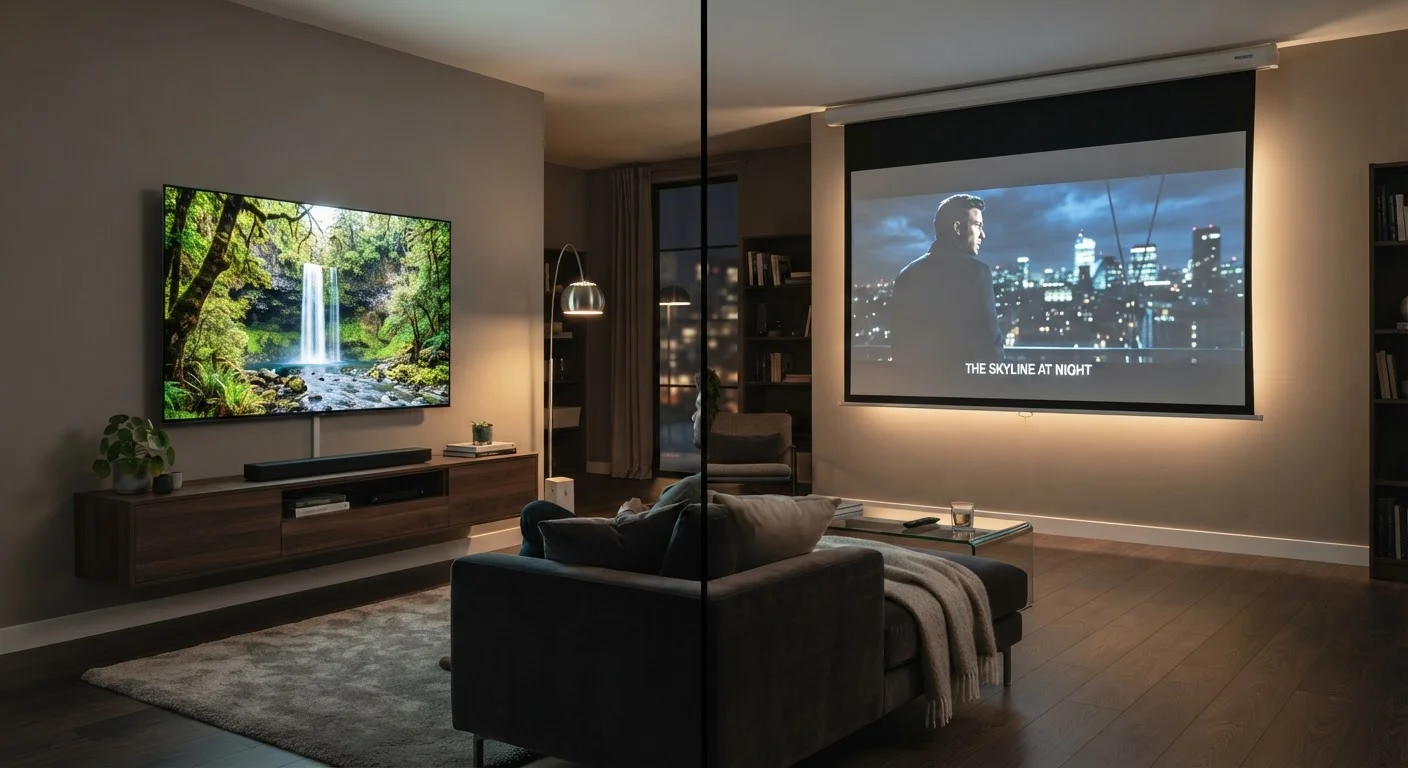
A large-screen TV produces its image directly on a self-illuminated panel - whether that panel uses LCD or OLED technology, the display itself is the source of light and color. A projector, by contrast, throws light onto a separate surface - usually a dedicated screen or a flat white wall - and the quality of that surface matters almost as much as the projector itself.
This fundamental difference cascades into nearly every practical consideration: how the image holds up in daylight, how much physical space is required, what kind of ongoing upkeep is involved, and how the viewing experience feels over a long session. Understanding the mechanism first makes every other comparison easier to evaluate honestly.
Ambient Light: The Make-or-Break Factor
Nothing exposes a projector's limitations faster than sunlight. Even a high-lumen projector - measured in ANSI lumens, the standard unit for brightness output - will produce a washed-out, low-contrast image if the room receives significant daylight. Blackout curtains or a fully dedicated media room largely solve this, but that requirement is a genuine constraint for many households.
Large-screen TVs have no equivalent weakness. Panel brightness, now commonly measured in nits, has improved dramatically, and modern sets maintain vivid, legible images even in brightly lit rooms. For a living room that doubles as a workspace, playroom, or general gathering space throughout the day, a TV simply performs more reliably across more conditions.
That said, lighting in a room is also a design choice. How you approach room lighting can meaningfully influence whether a projector becomes viable, especially in rooms where you have some control over fixture placement and dimming.
Test Your Room Before You Commit
Before investing in a projector, simulate the light conditions you'll actually watch in - not just an ideal evening setup. Hang a white sheet on the wall and use a flashlight or bright lamp to gauge how much ambient light your room realistically holds during typical viewing hours. If the image looks washed out under normal conditions, a projector will likely disappoint. This simple test can save a costly return.
Screen Size, Distance, and Room Geometry
Projectors scale far more economically at very large image sizes. A 100-inch or 120-inch projected image is achievable at a price point well below a TV of equivalent diagonal measurement, because manufacturing large TV panels is inherently more expensive than scaling projected light. If raw screen size is a priority, projectors hold a structural cost advantage at the high end.
However, traditional long-throw projectors require meaningful throw distance - often 10 to 15 feet between lens and screen for a 100-inch image. Short-throw and ultra-short-throw models reduce this dramatically, placing the projector just inches from the screen, which opens up more room configurations. Ceiling mounts can also preserve floor space, though professional installation is worth considering for permanent setups.
| Criterion | Large-Screen TV | Projector | |
|---|---|---|---|
| Ambient light performance | Excellent in any light | Requires dim or dark room | |
| Maximum practical image size | Typically up to ~98 inches | 100-150+ inches achievable | |
| Cost at very large sizes | Significantly higher per inch | More economical at scale | |
| Setup complexity | Minimal - wall mount or stand | Moderate to high - alignment, screen needed | |
| Ongoing maintenance | Low - largely maintenance-free | Lamp replacement or laser lifespan management | |
| Gaming response time | Strong - many panels under 10ms | Improving, but often slower | |
| Cinematic immersion | Good at large panel sizes | Excellent at 100+ inch scale |
For rooms under roughly 12 feet in depth, a large TV is often the more practical choice simply because the geometry doesn't favor projection. In a spacious room with a clear wall and controllable light, projectors become genuinely compelling.
Image Quality, Maintenance, and Longevity
Modern TVs, particularly those using OLED panels, deliver exceptional contrast - true blacks, vivid color accuracy, and consistent brightness across the entire screen without calibration effort. High-end projectors have narrowed this gap using laser light sources and advanced color processing, but in side-by-side conditions, a well-lit room still favors the TV panel for pure image fidelity.
Maintenance is where projectors carry a hidden cost. Lamp-based models require bulb replacement every 2,000 to 5,000 hours - a genuine recurring expense. Laser projectors last considerably longer (often rated at 20,000 hours or more) but carry higher upfront costs. TVs are largely maintenance-free beyond basic cleaning, though OLED panels can develop image retention with static on-screen elements over extended periods.
20,000 hrs
Typical laser projector light source rating
Laser-based projectors are commonly rated at 20,000 hours of use before significant brightness degradation, compared to 2,000-5,000 hours for traditional lamp models.
~$5,000+
Typical entry price for 100-inch flat-panel TV
Consumer flat-panel TVs at or above 100 inches remain a premium product category, while projector setups achieving similar image sizes can be assembled at lower total cost.
For households managing multiple screens and devices, the simpler operational profile of a TV tends to reduce friction. Managing inputs and connectivity is already complex enough without adding lamp schedules and screen alignment to the list.
Immersion, Experience, and When Projection Wins
There's a genuine perceptual difference between watching a 65-inch TV and sitting in front of a 110-inch projected image. At sufficient size and proper viewing distance, a projected image occupies more of the viewer's peripheral field, which is a meaningful part of what makes the cinema experience feel different from watching at home. The gap between home and theater viewing narrows considerably with a quality projection setup.
For households where movie nights are a genuine priority - and where the room can be configured to support it - a projector offers an experience that no TV below a certain (very expensive) size threshold can replicate. The immersion is real, and for the right viewer in the right space, it matters more than any spec comparison.
If your primary viewing is news, sports with mid-afternoon games, casual streaming, or gaming that requires fast response times, a large-screen TV is likely the more sensible everyday tool. Projector response times have improved, but many TV panels still hold an advantage in the low-latency performance that competitive gaming demands. Whichever display path you choose, how you feed content to the screen is a separate decision worth thinking through carefully.