

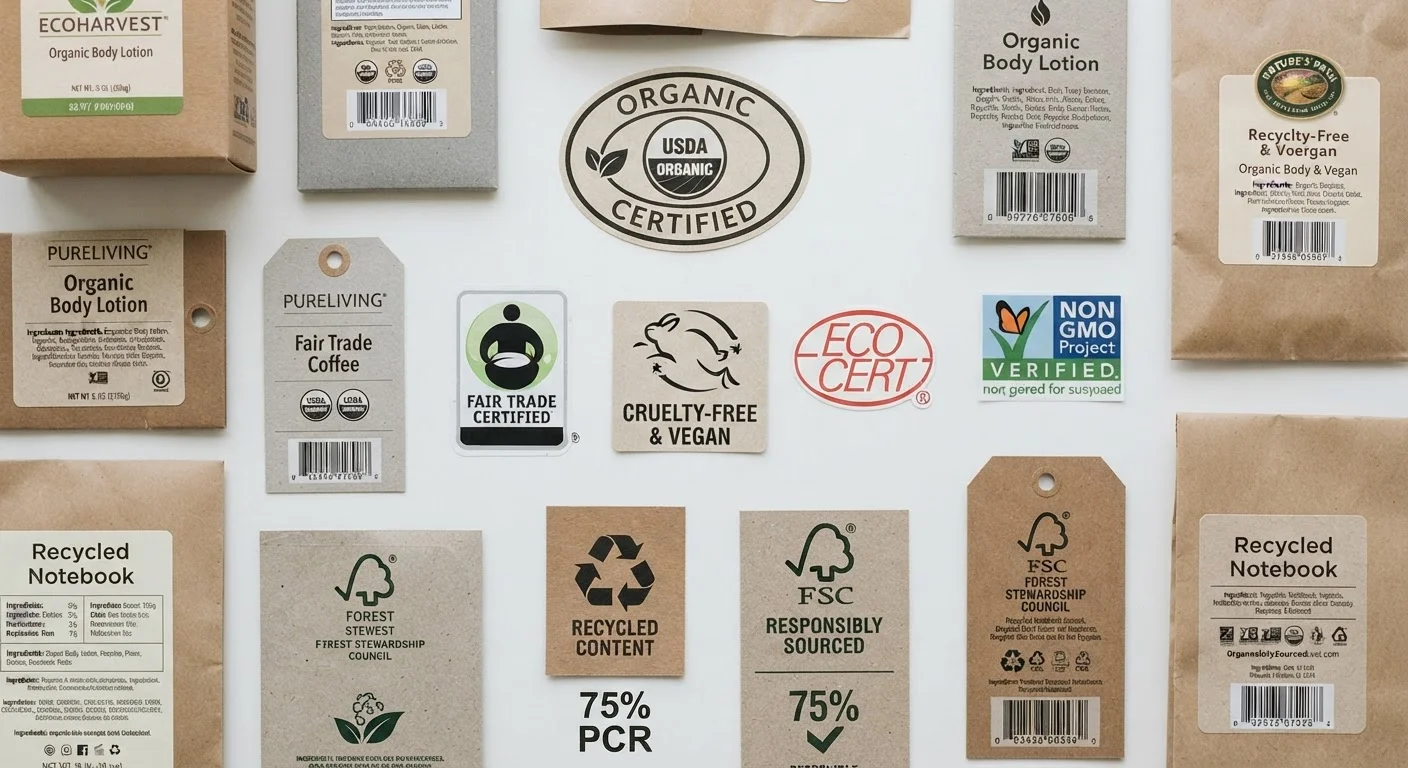
The Spectrum from Verified to Voluntary
Product labels fall along a spectrum of credibility, and the single most useful question to ask about any claim is: who checked this, and what did they check?
At one end are government-administered or government-backed certifications with defined standards, mandatory auditing, and legal consequences for misuse. USDA Organic is a clear example: farms and handlers must be certified by USDA-accredited agents, maintain documented records, and submit to on-site inspections. Using the seal without authorization can result in civil penalties.
At the other end are purely self-declared claims - words like natural, eco-friendly, or pure that manufacturers apply without any independent verification. The FDA has no legally binding definition of "natural" for most food products, which means the term communicates a feeling rather than a measurable standard.
In between sit third-party certifications of widely varying rigor. Some, like Energy Star (administered by the EPA), require laboratory testing and product verification before a mark is awarded. Others are trade-association marks where membership, not independent auditing, is the primary qualifier. Knowing which category a label falls into changes how much weight you should give it.
Common Labels and What They Actually Require
Energy Star - Products must meet efficiency specifications set by the EPA and, for many categories, pass independent testing. The mark is among the more auditable consumer certifications available.
USDA Organic - Requires that crops are grown without synthetic pesticides or fertilizers and that livestock are raised under specific welfare and feed standards. Multi-ingredient products must contain at least 95% organic content to display the full seal. Chain-of-custody documentation means the certification covers more than just the farm.
Cruelty-Free (e.g., Leaping Bunny, PETA) - No single federal standard exists. Voluntary programs like Leaping Bunny conduct supplier audits and require brands to confirm no animal testing at any production stage, including ingredients. PETA's certification is largely self-reported. These represent meaningfully different levels of verification behind the same-sounding phrase.
FSC Certified - The Forest Stewardship Council certifies that wood or paper products come from responsibly managed forests, with third-party auditing and chain-of-custody tracking. It is one of the more internationally recognized forestry marks.
For food-specific front-of-package claims like "low fat" or "multigrain," the FDA defines those terms precisely - see our breakdown of regulated food label terms for what those definitions actually require.
A Framework for Evaluating Any Label
When you encounter an unfamiliar certification, four questions cut through most of the confusion:
- Who issues the mark? A government agency, an accredited independent body, a trade association, or the company itself? Each carries a different level of inherent credibility.
- What standard does it certify? Look for a published, specific standard - not a vague mission statement. Legitimate certifiers document exactly what qualifies a product.
- How is it verified? Annual audits and unannounced inspections are more rigorous than one-time self-attestation. Ask whether the certifier has a public complaints or revocation process.
- Is the certification current? Certifications expire and can be revoked. The public databases maintained by credible certifiers let you confirm a brand's standing in real time.
Greenwashing remains a documented concern. European regulators found that a significant share of online green claims were exaggerated or false, and U.S. regulators have signaled increasing attention to the same issue.
Understanding price signals is a related consumer skill; our guide on what retailers communicate through price tags covers another layer of retail transparency. For environmental claims in the tech sector, our piece on what carbon-neutral claims from tech companies actually mean applies the same skeptical lens to corporate sustainability statements.