

Key Takeaways
- Price tag colors often indicate where a product stands in a retailer's markdown cycle.
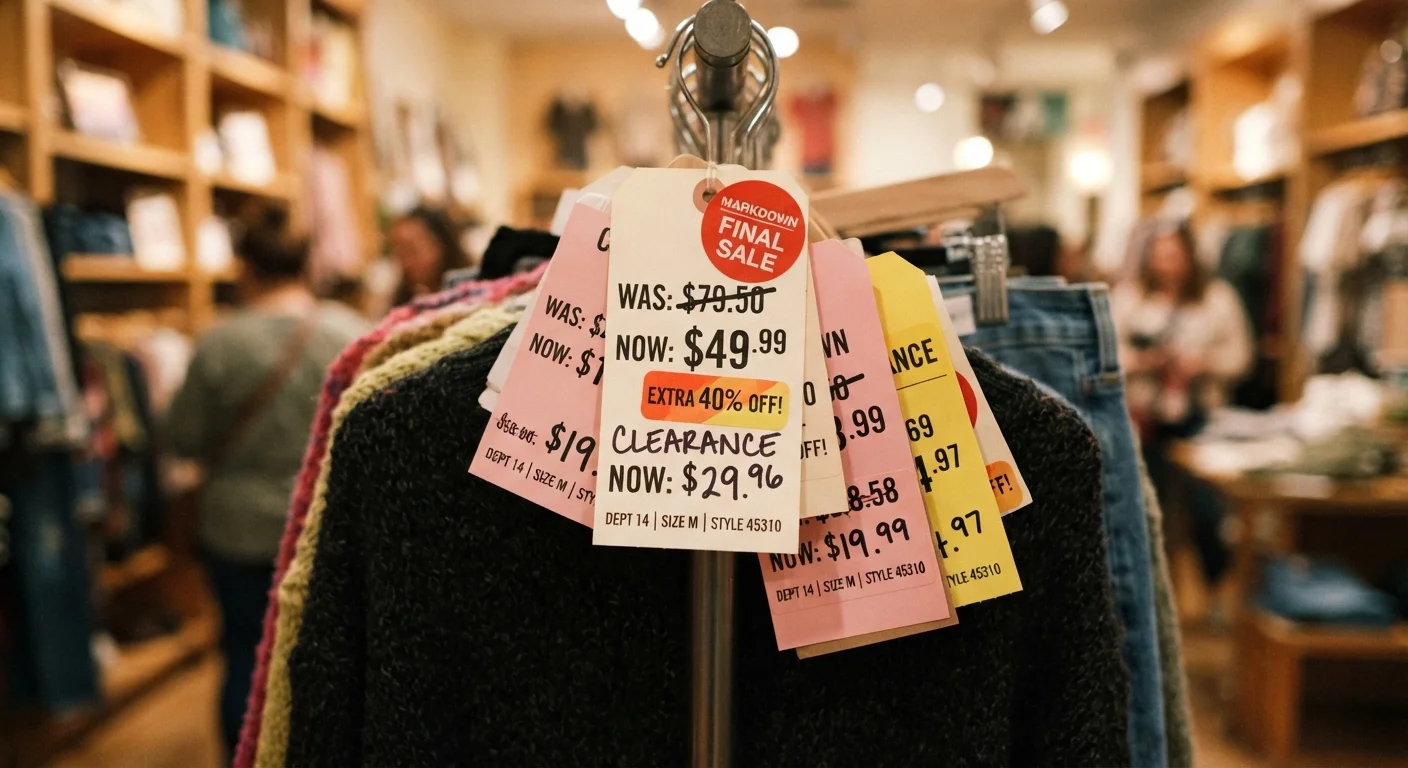
- Prices ending in .99 typically signal full or near-full retail, while .97 or .00 endings often mean a markdown.
- Small letter or number codes on tags can reveal how many times a price has been reduced.
- Knowing these conventions helps shoppers assess whether a discount is genuine or cosmetic.
- Markdown schedules vary by retailer, so the same signal can mean different things in different stores.
Retail Price Tag Signaling
Retail price tag signaling refers to the deliberate use of colors, numbers, codes, and formatting on price tags to communicate information beyond the selling price itself. Retailers use these signals to indicate markdown history, clearance status, or promotional timing. Once you know what to look for, a price tag can tell you a great deal about a product's pricing journey.
Many large retailers use internal markdown codes printed on tags - often a letter or number suffix - that correspond to a specific phase in their markdown schedule, such as an initial reduction, a secondary cut, or final clearance.
Why Retailers Pack Information Into Price Tags
A price tag's primary job is to communicate a selling price. But for retailers managing thousands of SKUs across complex seasonal cycles, the tag also serves as an internal tracking tool. Markdown schedules, inventory phases, and promotional tiers all need to be legible to store staff - and that same information is visible to anyone who knows how to read it.
Understanding these signals doesn't require insider knowledge. It requires knowing a few widely observed conventions and applying healthy skepticism. As the retail pricing tactics that shape perceived value become better understood by shoppers, familiarity with tag conventions is a natural complement.
~65%
Shoppers influenced by price presentation format
Consumer research consistently shows that how a price is displayed - not just the number itself - influences purchase likelihood, according to behavioral economics literature.
4-8 weeks
Typical markdown cycle length for apparel
Apparel retailers generally move items through markdown phases over a period of weeks, with clearance pricing typically reached within one to two full cycles after initial introduction.
The Language of Ending Digits
Charm pricing - the practice of ending prices in .99 - is one of the most studied phenomena in consumer behavior research. Prices like $29.99 are perceived as meaningfully lower than $30.00, even when the difference is a single cent. Retailers have long exploited this rounding effect.
But the digits after the decimal do more than anchor perception. Many retailers use specific endings as internal signals:
- .99 - Typically indicates a full-price or near-full-price item, standard retail.
- .97 or .96 - Commonly used by major discount retailers to flag a markdown from original retail.
- .00 or .88 - Often signals a clearance or final-sale price, particularly in department and big-box stores.
These are widely observed patterns, not universal rules. The same retailer may use different endings across product categories, and conventions shift over time. The key is to notice when an ending digit departs from a store's norm - that departure often signals a pricing transition.
For a broader look at how shelf tag information is structured, see our article on unit pricing conventions, which covers a similarly underread element of retail signage.
Color Codes and Sticker Systems
Large apparel and home goods retailers frequently use colored price tags - or colored stickers applied over original tags - to communicate markdown stages. A common structure looks something like this:
- Original tag color (often white or cream): full retail price.
- First markdown sticker (commonly yellow or orange): initial promotional reduction.
- Second markdown sticker (commonly red): deeper clearance cut.
The practical implication: a tag buried under two sticker layers is likely at or near its floor price. A single sticker suggests there may be further reductions ahead if the item doesn't sell.
Color systems are not industry-standard
There is no universal retail standard governing price tag colors. A red tag means clearance at some stores and a routine promotional price at others. Always look for in-store explanations of a color system before drawing conclusions, and when comparing across retailers, treat each store's conventions independently.
Importantly, the color systems are retailer-specific and not standardized across the industry. Some stores publish their color key on in-store signage; others leave it unstated. If you shop a particular store regularly, observing the pattern over time is the most reliable way to decode it.
Internal Markdown Codes and What They Reveal
Beyond colors and digits, many retailers print alphanumeric codes directly on price tags - codes intended for inventory management but readable by shoppers who know what they indicate. A suffix letter or number often tracks how many markdown phases an item has passed through.
For example, a code sequence might progress from 'A' (original price) through 'B' and 'C' as prices drop. Reaching 'D' or beyond may indicate final clearance - the point at which the retailer would rather recover any remaining value than carry inventory further. This aligns with how retailers plan and execute markdowns across seasonal cycles.
Not every retailer uses a letter system, and some use numeric codes that are harder to parse without store-specific context. When in doubt, staff members who work the floor during markdown days can often explain the system - many are happy to do so.
Putting It Together: Reading Tags at the Register
The value of reading price tags critically lies in combining signals, not relying on any single one. A red sticker, a .00 ending, and a two-letter suffix code together paint a clearer picture than any element alone.
That said, tag literacy is one tool among several. Price history tools, unit pricing displays, and familiarity with a retailer's seasonal patterns all contribute to a more complete picture. The retail terminology glossary is a useful reference if you encounter terms like 'keystone markup' or 'SKU rationalization' as you dig deeper.
Track the pattern across visits
If you shop a store regularly, note how tag colors and suffix codes change between visits on the same items. Two or three observations will quickly reveal that retailer's markdown rhythm, making it far easier to time future purchases.
Finally, remember that even well-read price tags don't tell you everything. A 'clearance' label reflects inventory pressure, not necessarily a product defect or inferior value. And a full-price tag doesn't mean the item isn't available elsewhere at a lower price. Before completing any significant purchase, it's worth checking the return policy - because knowing you can reverse a decision is part of shopping with confidence.