

Key Takeaways
- A reference price on a tag shapes how large a discount feels, regardless of whether that price was ever widely charged.
- Anchoring works because the human brain evaluates value relatively, not absolutely.
- Retailers can set anchors through original prices, competitor comparisons, or premium product placement.
- Checking a product's actual price history is more reliable than trusting displayed "was" prices.
- Understanding the tactic doesn't eliminate its effect - but it does create useful friction before you buy.
Price Anchoring
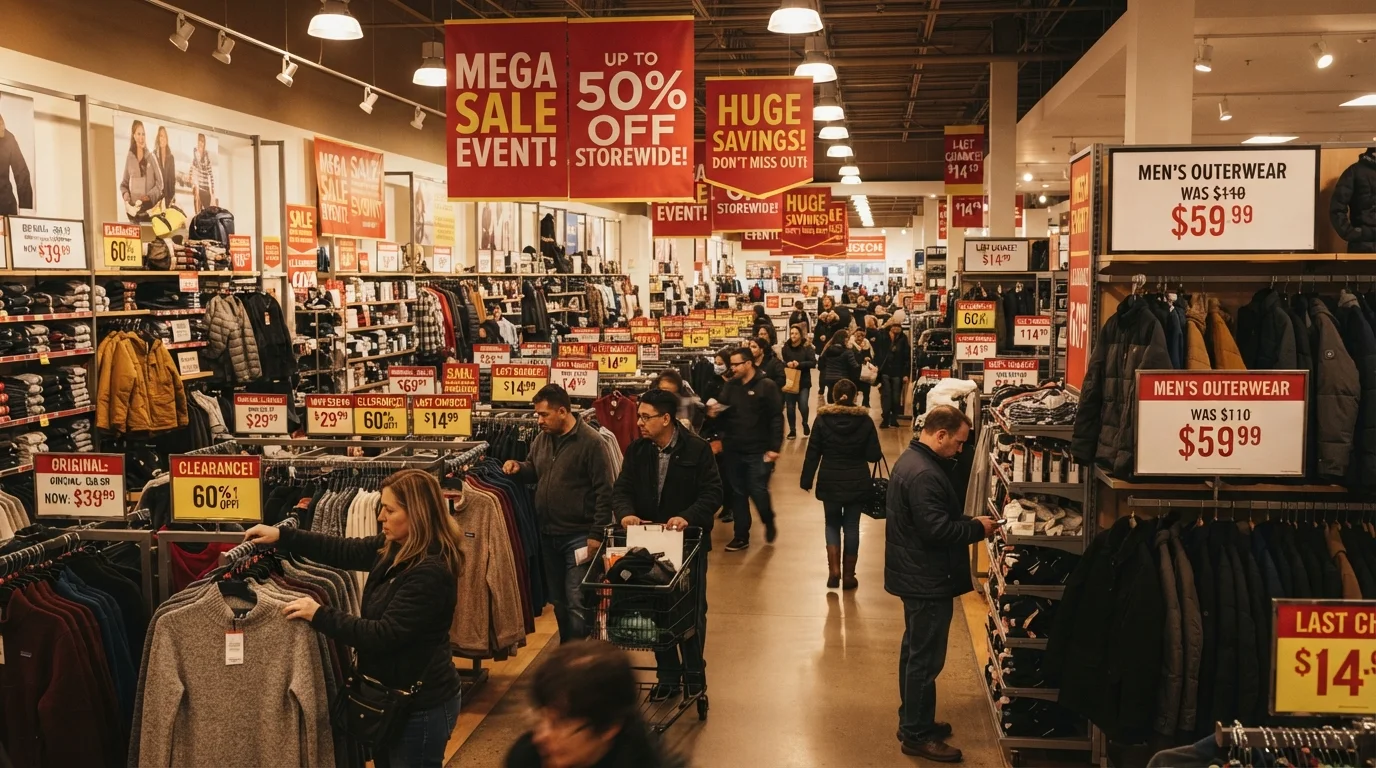
Price anchoring is a retail strategy where a higher reference price - often labeled "original," "was," or "MSRP" - is displayed alongside the selling price to make a discount appear more significant. The first number a shopper sees becomes a mental benchmark, and everything after is judged relative to it. The anchor doesn't need to reflect what anyone actually paid for the item; its job is purely to shape perception.
In behavioral economics, anchoring is a cognitive bias documented extensively since Tversky and Kahneman's foundational research in the 1970s. It describes how initial numerical information disproportionately influences subsequent judgments, even when that information is arbitrary.
Why the First Number You See Controls Everything
When you scan a price tag, you're rarely evaluating a product in isolation. You're comparing it to the number next to it - the one that's crossed out, grayed out, or labeled "original price." That comparison is the anchor, and it's doing most of the persuasive work.
The brain evaluates price the same way it evaluates temperature: relative to a reference point. A $60 jacket feels expensive on its own. It feels like a bargain next to a crossed-out $120. The product hasn't changed. The cost hasn't changed. Only the frame around it has.
This is anchoring in its most straightforward form: establishing a high number first so that whatever follows reads as favorable. Retailers understand that shoppers don't have memorized prices for most items, which makes the reference price on the tag the easiest available benchmark - and therefore the one most likely to be used.
“The basic finding is that people anchor on the first piece of numerical information they encounter and adjust insufficiently from that starting point - even when the anchor is clearly arbitrary.”
— Dan Ariely, Behavioral economist and author of 'Predictably Irrational'
The Different Forms Anchoring Takes in Retail
The crossed-out original price is the most recognizable version, but it's not the only one. Anchoring shows up across retail in several less obvious forms:
- Suggested Retail Price (MSRP or SRP): A manufacturer-suggested figure that may never reflect what the market actually charges. Displaying it creates the impression of savings that may not be real.
- Competitor price comparisons: "Lower than Store X" claims establish an external anchor. The comparison may involve different product specs, warranty terms, or service conditions.
- Decoy pricing: A premium tier - say, a $90 version of a product - makes the $60 version feel moderate, even if $60 is the price at which profit margin is maximized. The $90 option exists partly to reframe the $60 one.
- Bundle "value" framing: Stating that bundled items are "worth $200, sold together for $129" invites the consumer to accept the retailer's valuation of each component without independent verification.
Each of these variations uses the same underlying mechanism: introduce a number that makes what you're actually charging feel comparatively reasonable. For a fuller look at how markdowns are planned, see how retailers structure discounts.
~60%
Shoppers who report reference prices influence purchase decisions
Consumer research consistently shows a majority of shoppers factor displayed original prices into their sense of whether a current price is fair.
4-5x
Uplift from anchoring in experimental pricing studies
Academic pricing experiments have found that high anchor prices can increase a buyer's willingness to pay by multiples compared to no anchor, even when participants know anchors may be arbitrary.
What Shoppers Can Actually Do About It
Awareness helps, but it's not a complete solution. Anchoring is a cognitive shortcut the brain uses automatically - knowing the tactic exists doesn't fully override it. More practical steps involve changing the information environment rather than just your mindset.
Build In a One-Day Delay
If a "sale" price feels urgent, that urgency is often part of the frame the anchor creates. Waiting 24 hours and checking the item's price history on a third-party tracking tool frequently changes how compelling the deal looks. The pause itself is a useful counter to time-pressure anchoring.
Check historical prices. Multiple browser tools and price-comparison services track what a product actually sold for over time. If a "sale" price has been the standard price for six months, the anchor above it loses most of its credibility.
Evaluate absolute value, not relative value. Before focusing on the discount percentage, ask whether the actual price - the one you'll pay - is reasonable for what you're getting. Would this feel like good value if there were no reference price next to it?
Compare using unit pricing. For consumable goods especially, unit price labels cut through anchoring by reducing the question to a single standardized number: cost per ounce, per sheet, per count.
For a broader set of tactics retailers use alongside anchoring, this overview of retail pricing tactics is worth reading alongside this one. And if you want to build consistent habits around pricing awareness, these deal-hunting habits are designed for low effort over time.