

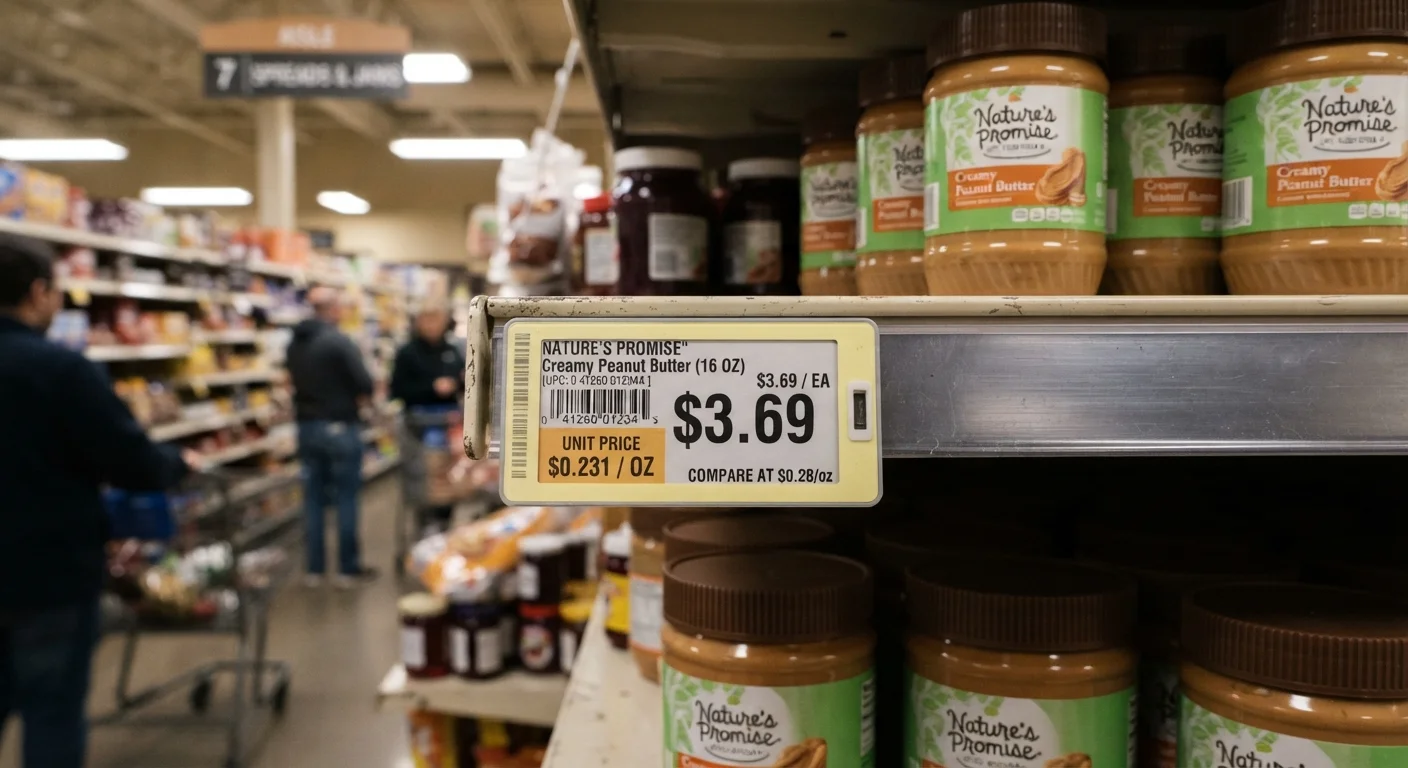
Key Takeaways
- Unit price shows cost per standard measure, making size and brand comparisons accurate and immediate.
- Bigger packages are not always cheaper per unit - bulk sizing can carry a unit-price premium.
- Sale prices don't always beat the everyday unit price of a competing size or store brand.
- Unit pricing laws vary by state, so displays aren't universally consistent in format or availability.
- A simple phone calculator is all you need when unit prices are absent or use different base units.
What you will need
What Unit Price Actually Tells You
Every shelf tag in a US grocery or mass-market retailer carries at least two numbers: the total price and, usually in smaller print, the unit price - cost expressed per ounce, per 100 sheets, per fluid ounce, or whatever standard measure applies to that category. That second number is the one that matters most when you're comparing options.
Total price tells you what leaves your wallet at checkout. Unit price tells you what you're actually paying for the product itself, stripped of packaging decisions. A 32-oz bottle priced at $4.48 and a 20-oz bottle at $3.00 look close in total cost. Their unit prices - $0.14/oz vs. $0.15/oz - confirm the larger size is marginally more economical, but not by as much as the price gap implies.
Understanding this distinction connects directly to a broader skill: spotting the costs that don't announce themselves. See our guide to overlooked shopping costs for the full picture of what sticker prices leave out.
Unit Price as a Baseline, Not a Rule
Unit price is a tool, not an absolute verdict. Quality differences, packaging convenience, and actual consumption habits all affect whether the cheaper-per-unit option is genuinely the better value for your household. Use it as your starting point, then apply context.
When Unit Pricing Can Mislead You
Unit pricing is reliable, but it has traps worth knowing.
- Different base units on the same shelf. Retailers aren't always consistent - one product may show price per ounce, another per pound, a third per 100g. You can't compare them without converting first.
- Bulk isn't always cheaper. Warehouse clubs and large-format stores sometimes price oversized packages at a unit-price premium over mid-size versions at a conventional supermarket. Always check, don't assume.
- Sale math can distort the comparison. A "sale" price on a name-brand large size may still carry a higher unit price than the everyday price on a store-brand medium size. Retailers lean on anchoring and sale framing to shape perceived value - a dynamic explored in detail in our article on retail pricing tactics that shape what feels like a deal.
- Perishables require waste math. If a larger quantity will spoil before you use it, the lower unit price is theoretical - the real cost is higher once waste is factored in.
Don't Assume the Large Size Wins
The intuition that bigger packaging means better value is common enough that some retailers price large sizes at a slight unit-price premium, knowing many shoppers won't check. Verify unit price on every size before placing anything in the cart - assumptions here are where money leaks out consistently.
How to Use Unit Pricing at the Shelf
The process takes under a minute once it's habit. Here's how to do it reliably.
Locate the unit price on the shelf tag
Look for the smaller figure, typically in the lower-left corner of the tag. It will be labeled with a unit - oz, lb, 100 ct, qt, etc. If no unit price is shown (some specialty or non-grocery retailers omit it), move to Step 3.
Confirm all options use the same base unit
Before comparing, verify that the unit prices you're reading use identical measures. If one tag shows per ounce and another shows per pound, multiply the per-ounce price by 16 to convert, or divide the per-pound price by 16 - then compare.
Calculate manually when unit prices are missing
Divide the total price by the number of units (ounces, count, liters) shown on the package. Your phone's calculator handles this in seconds. For example: $5.49 ÷ 36 oz = $0.1525/oz. Write it down or keep it on screen while you check the competing option.
Factor in realistic usage before committing to bulk
If the lower unit price comes from a larger package, ask whether you'll use all of it before it expires or degrades. For non-perishables with long shelf lives, bulk savings are real. For fresh, refrigerated, or time-sensitive items, model your actual weekly use against the package size.
Make the call - then note it for next time
Select the option with the lowest unit price that fits your usage reality. Consider keeping a simple note - a list in your phone or a notes app - of the winning unit prices for items you buy regularly. This turns a per-trip calculation into a pattern you'll recognize on sight.
For a broader look at what shelf tags are communicating - beyond unit price - see our guide to reading retail price tags. And if you shop across channels, note that unit pricing is rarely displayed online the same way it is in-store - a gap covered in our piece on online vs. in-store pricing differences.