

| Typical post-purchase adjustment window | 7-30 days (varies by retailer) |
| Common excluded sale events | Black Friday, Cyber Monday, Doorbusters |
| Marketplace sellers typically accepted | Rarely - third-party listings usually excluded |
| Proof format usually accepted | Current public webpage or print ad |
| Item match standard | Exact model, SKU, color, and configuration |
| Membership club prices | Almost always excluded from standard policies |
How Price Matching Actually Works
Price matching is straightforward in concept: if a qualifying competitor sells the same item for less, the retailer agrees to honor that lower price. In practice, the process involves several eligibility checkpoints that determine whether your request succeeds.
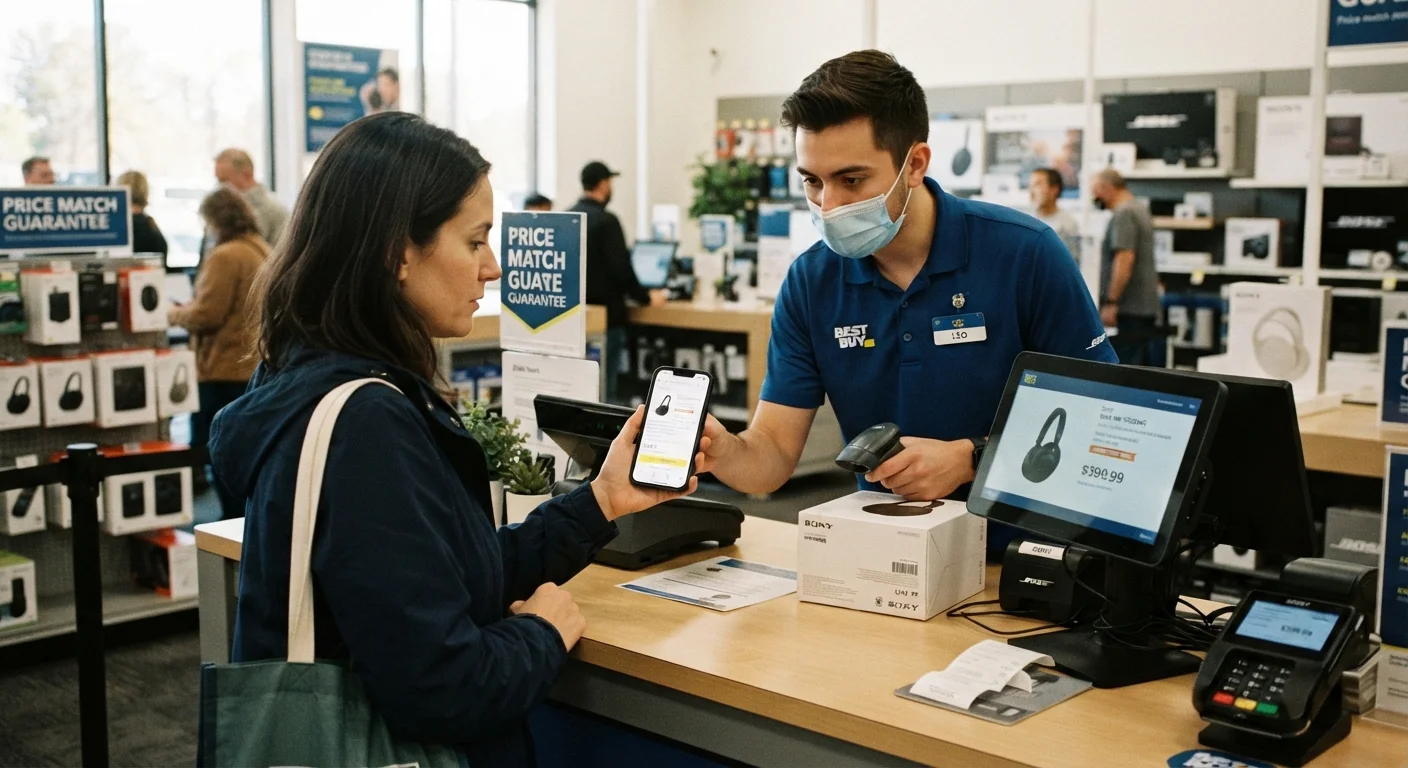
Most policies require you to present proof of a current, publicly available price at the time of purchase or return to the store within a specified window after buying. That proof typically means a live webpage - not a screenshot, not a cached page, and not a price from a third-party marketplace seller listed on a competitor's platform.
| Typical post-purchase adjustment window | 7-30 days (varies by retailer) |
| Common excluded sale events | Black Friday, Cyber Monday, Doorbusters |
| Marketplace sellers typically accepted | Rarely - third-party listings usually excluded |
| Proof format usually accepted | Current public webpage or print ad |
| Item match standard | Exact model, SKU, color, and configuration |
| Membership club prices | Almost always excluded from standard policies |
Understanding why online and in-store prices can differ is also relevant here: some retailers will match their own website price in-store but won't apply that in reverse, and competitor comparisons are often limited to matching channel - store-to-store or online-to-online.
What Most Policies Exclude
Exclusions are where price match policies get complicated, and missing them is the most common reason a request gets denied.
Price match
A retailer's agreement to honor a lower price found at a competing store or on the retailer's own site. The customer typically must present proof of the lower price at the time of purchase or within a defined post-purchase window.
Price adjustment
A refund of the difference when an item you've already purchased drops in price at the same retailer. This is distinct from price matching a competitor and is governed by its own set of rules.
Eligible competitor
A retailer explicitly named or categorized as acceptable for comparison in a store's price match policy. Third-party marketplace sellers, auction sites, and membership-only clubs are commonly excluded.
Proof of price
Documentation required to validate a price match request - typically a current, publicly accessible webpage, print ad, or app listing clearly showing the item, price, and seller.
Exclusion window
A defined period during which price match requests are not accepted, such as major sale events like Black Friday, Cyber Monday, or promotional holidays.
Identical item requirement
Most policies require that the competitor's product match the retailer's item exactly - same brand, model number, color, and configuration. Minor differences in bundled accessories or regional SKUs can disqualify a request.
Competitor type: Most policies only accept comparisons from a defined list of national or major regional retailers. Warehouse clubs like Costco or Sam's Club - which require paid memberships - are almost universally excluded. So are auction platforms, flash-sale sites, and third-party sellers on any marketplace.
Sale events: Black Friday, Cyber Monday, and similar high-volume promotional periods are routinely carved out. Items sold as limited-time doorbusters almost never qualify, even when a price appears publicly online.
Item condition and bundling: Refurbished, open-box, clearance, or bundled configurations typically do not qualify. The item must match exactly - same model number, color, capacity, and any included accessories.
Price Match vs. Price Adjustment: Not the Same
A price match applies to a lower price found at a competitor, while a price adjustment applies when the same retailer lowers its own price after your purchase. Each has a separate policy, separate window, and often separate documentation requirements. Confirm which type you're requesting before approaching a customer service desk.
If you want to verify whether a competitor's price has been consistent over time before requesting a match, price history tools can help clarify the trend - though they have real limitations worth understanding first.
How to Make a Request Without Getting Rejected
A few practical habits reduce the chance of a denial:
- Read the policy first. Most retailers publish their price match terms online. Check the specific list of approved competitors and the exact window for post-purchase adjustments.
- Use a live URL, not a screenshot. Staff typically need to verify the price in real time. Screenshots can be disputed; a live page generally can't.
- Check the item details carefully. Confirm your model number matches exactly. One digit off in a SKU - or a different memory configuration - will typically disqualify the request.
- Note the timing. Post-purchase adjustment windows are often shorter than shoppers expect. A 7-day window closes fast, especially during the holiday shopping season.
Price match policies exist alongside return policies, and understanding both together shapes the real value of a purchase. A low price paired with a restrictive return policy can be less favorable than a slightly higher price with full return flexibility. Similarly, parsing a return policy before you buy often reveals overlap with price adjustment eligibility that's worth knowing in advance.