

Key Takeaways
- Door-busters are deliberately priced to generate foot traffic, not profit on the item itself.
- Retailers recover the discount by counting on additional full-price purchases during the same trip.
- Quantity limits on door-busters are intentional - scarcity amplifies urgency and draws larger crowds.
- Understanding the strategy lets you decide whether the door-buster alone justifies the trip.
- Shoppers who stick to a list are less likely to fund the margin retailers lose on the lead item.
Loss Leader
A loss leader is a product sold at or below cost - meaning the retailer makes little or no profit on it - specifically to attract customers into a store or onto a website. The discount on that item is intentional, not accidental. The underlying expectation is that most shoppers will purchase additional, full-margin items during the same visit.
In retail economics, the loss leader is calculated as a customer acquisition cost rather than a product margin. The profitability is measured at the basket level, not the item level.
The Real Purpose of the Door-Buster
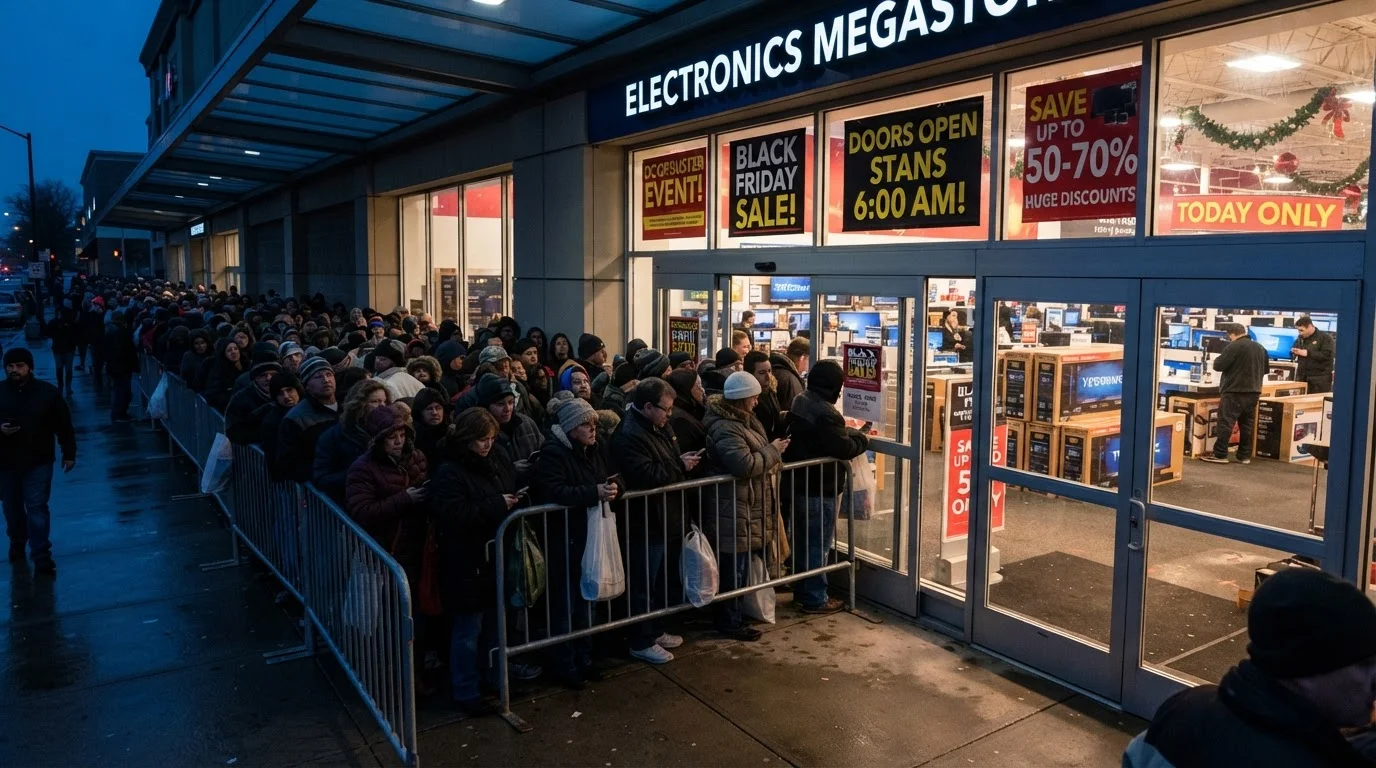
The television priced at $199 in a Black Friday circular. The coffee maker at 80% off the morning after Thanksgiving. These items share something important: they are not meant to make money. They are meant to move bodies through a door.
The door-buster - sometimes called a loss leader - is one of retail's most durable and deliberate tactics. A single product is priced at or below wholesale cost, generating no meaningful profit margin and sometimes an outright loss per unit sold. The calculation that makes this rational for a retailer is straightforward: the average customer who comes in for the $199 TV does not leave with only the $199 TV. They leave with cables, a streaming subscription, a holiday gift they had been meaning to buy anyway, and perhaps a second item grabbed near the checkout. The basket, not the headline item, is where the retailer recovers - and often exceeds - what it lost on the lead product.
This is why understanding the loss-leader strategy matters. The door-buster is not a gift from a retailer feeling generous. It is an investment in acquiring your attention and physical presence, with the reasonable expectation that your spending will not stop there. For more on how retailers design markdown events overall, see how retail sales are actually structured.
~60%
Shoppers who make unplanned purchases during sale events
Consumer behavior research consistently finds that a majority of sale-event shoppers purchase at least one item not on their original list, according to retail industry studies on promotional shopping behavior.
2-3x
Typical basket size increase over the door-buster item alone
Retail analysts commonly observe that promotional shoppers spend two to three times the cost of the advertised item during the same visit, which is the margin-recovery mechanism the loss-leader strategy relies on.
Why Scarcity Is Built Into the Design
Door-busters almost always come with quantity limits - "while supplies last," "first 50 customers," "limit two per household." These constraints serve a dual function that is easy to miss.
First, they cap the retailer's financial exposure. Selling 10,000 units at a $40 loss per unit is a $400,000 investment in customer acquisition. Limiting availability to 200 units makes that math far more controllable. Second, and equally important, the quantity limit manufactures urgency. When shoppers believe an item is scarce, they make faster, less deliberate decisions. The anxiety of potentially missing out overrides the slower, more careful reasoning that might lead a person to ask: do I actually need this?
This is not a side effect - it is part of the architecture. The crowd forming outside a store before opening functions as social proof, signaling to later arrivals that something genuinely valuable is at stake. The combination of a dramatic price, a strict limit, and visible demand is a precision tool for accelerating purchase decisions. Time-pressure tactics like these have well-documented effects on how people evaluate options.
Check Prices Before the Sale Opens
The easiest way to evaluate a door-buster is to look up the item's price at multiple retailers in the week or two before the sale. If the "original" price is inflated or the item has been widely available at or near the sale price, the discount is less meaningful than advertised. Historical price tracking tools - available for free through several browser extensions - can show you price trends over time without requiring any in-store commitment.
What Happens to Your Spending Once You're Inside
Getting customers through the entrance is only step one. Retail store layouts during major sale events are rarely accidental. The door-buster item is frequently positioned at the back of the store or deep within a category section, ensuring shoppers walk past a significant amount of full-margin merchandise before reaching it.
Once inside, additional psychological levers activate. Sale signage throughout the store creates a generalized sense of opportunity, making shoppers more likely to make purchases they had not planned. End-cap displays near high-traffic paths surface items at regular prices that feel congruent with a shopping trip already framed around deals. Checkout areas present last-minute additions at low price points that feel trivial compared to the large purchase already in the cart.
The result is that the door-buster shopper who spends $199 on the lead item frequently exits having spent $400 or more. The retailer's margin on the additional $200 more than covers the loss taken on the TV. This basket-building dynamic is directly connected to how impulse buying works at a psychological level - the same mechanisms that make unplanned purchases feel reasonable in the moment.
Shopping Loss Leaders More Deliberately
None of this means door-busters are without value for shoppers. A genuinely below-cost item on something you already planned to buy is a real financial benefit. The question is whether you can capture that benefit without funding the margin recovery the retailer has planned around it.
A few concrete habits help. Verify the price before the event - a "$400 value" claim is only meaningful if the item was actually selling at $400 in the weeks prior. Make a list before entering the store or opening the website, and treat it as a constraint rather than a suggestion. If the door-buster item is out of stock, leave rather than substituting. The substitute is almost certainly a full-margin item the retailer is happy to sell you.
It's also worth knowing that the psychological residue of deal-seeking doesn't disappear when the specific sale does. Shoppers who regularly chase promotions can develop a distorted baseline for what things should cost - a phenomenon explored in the context of deal fatigue and how it affects purchasing judgment. The door-buster is not the enemy of a thoughtful shopper. The assumptions it quietly installs are.