

Key Takeaways
- Curbside pickup surged during the pandemic and has maintained meaningful adoption, particularly for groceries.
- Home delivery commands a larger overall share of e-commerce fulfillment volume across most retail categories.
- Curbside typically avoids delivery fees but requires the shopper to own or access a vehicle and be present.
- Delivery windows and missed-drop issues remain the most common friction points with home delivery.
- Consumer choice between the two often comes down to category, household size, and schedule flexibility.
Option A
Curbside Pickup
The speed-and-control option for shoppers on the go.
Best for: Shoppers who want same-day availability without paying delivery fees or waiting at home for a driver.
Option B
Home Delivery
The hands-off fulfillment method for maximum convenience.
Best for: Shoppers who prioritize not leaving home, especially for heavy, bulky, or non-time-sensitive orders.
If you need groceries same-day without paying a delivery fee
Curbside Pickup
Most major grocery chains offer free curbside pickup with a minimum order, and same-day slots are often available when delivery windows are full.
If you're ordering heavy or bulky items and can't transport them yourself
Home Delivery
Large appliances, furniture, and multi-box orders are impractical for curbside - scheduled home delivery with white-glove options covers this gap.
If you work from home and want maximum hands-off convenience
Home Delivery
Delivery requires no specific pickup window and suits flexible schedules where someone is reliably home to receive packages.
If you want to verify perishable or fragile items before leaving the lot
Curbside Pickup
Curbside lets you inspect produce or check for damage immediately, with staff on hand to swap out problem items on the spot.
How Each Model Actually Works
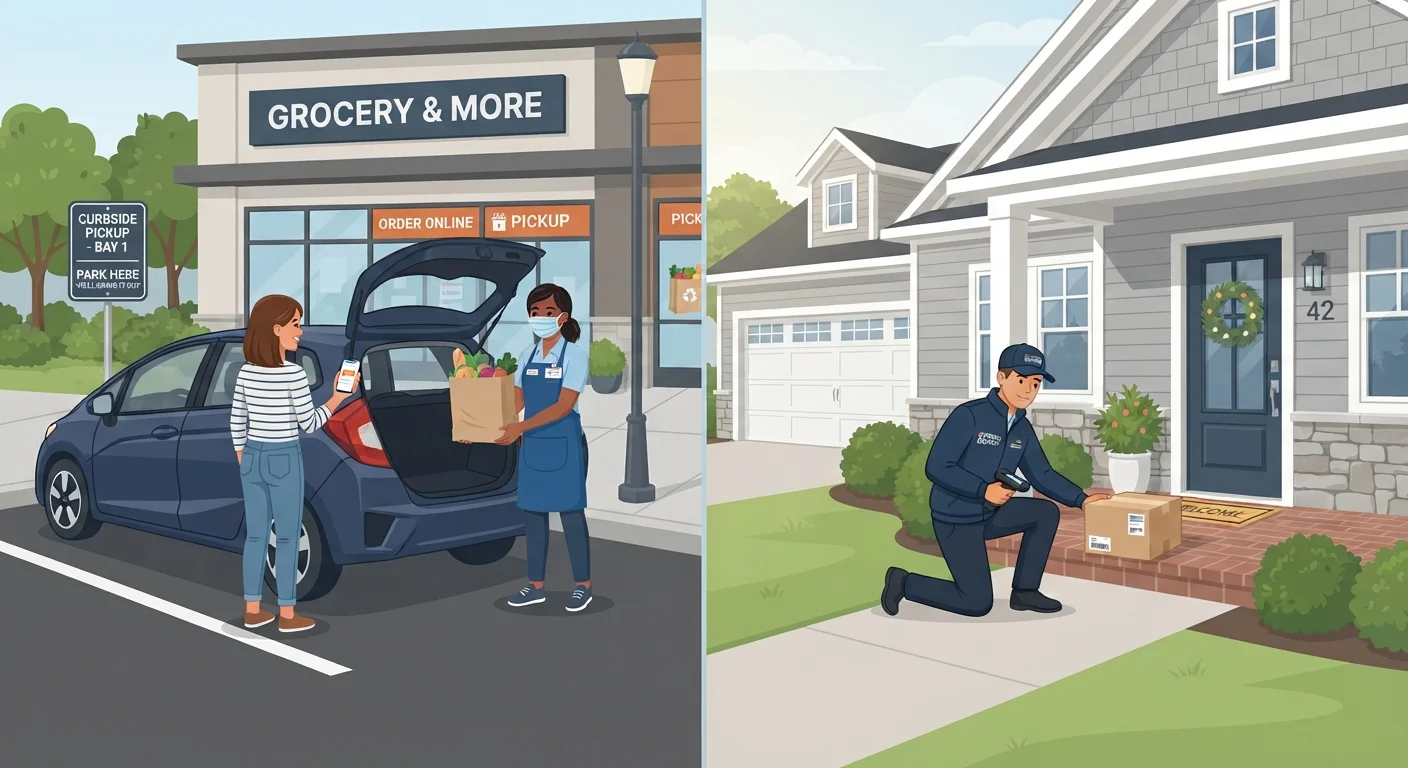
Curbside pickup - sometimes called BOPUC or click-and-collect - lets a shopper place an order online or via app, then drive to the store at a scheduled window. A store employee brings the order out to the vehicle. No parking lot navigation, no checkout line. The retailer handles inventory fulfillment; the shopper handles the final mile.
Home delivery, by contrast, routes the order through a carrier or retailer-operated logistics network directly to the shopper's door. The shopper has no role in the physical pickup. Delivery timelines range from two-hour windows with same-day services to standard 3-5 business day shipping for non-priority orders.
The structural difference matters: curbside keeps last-mile cost with the shopper (their fuel, their time), while home delivery shifts that cost to the retailer or a third-party carrier - which is why delivery fees and minimum order thresholds are common. For a deeper look at how channel choice interacts with purchase type, see when each channel gives you a real advantage.
What Consumer Data Reveals About Adoption
Curbside pickup saw dramatic adoption acceleration during 2020 and 2021, with U.S. click-and-collect sales more than doubling in a single year according to eMarketer estimates. Grocery was the standout category - shoppers who tried curbside for the first time during pandemic restrictions showed high retention rates afterward.
Home delivery, however, still accounts for the majority of e-commerce fulfillment volume across most non-grocery retail categories. Electronics, apparel, and household goods skew heavily toward doorstep delivery. The convenience premium consumers accept - expressed as delivery fees, membership subscriptions, or longer waits - is substantial at the aggregate level.
$128B+
U.S. click-and-collect sales (2023 estimate)
eMarketer estimated U.S. click-and-collect e-commerce exceeded $128 billion in 2023, reflecting sustained post-pandemic demand.
~50%
Grocery curbside retention post-pandemic
Industry research consistently finds roughly half of consumers who first tried grocery curbside pickup during 2020 continued using it afterward.
3 in 10
Shoppers cite missed delivery as top pain point
Consumer satisfaction surveys from major logistics research firms indicate missed or failed delivery attempts are the most frequently cited home delivery frustration.
Notably, many shoppers now use both methods situationally rather than picking one exclusively. A household might use curbside for weekly grocery restocking and home delivery for electronics or clothing. How consumer preferences have shifted across channels provides broader context on this blended behavior.
Cost and Friction: A Side-by-Side Look
Understanding the real cost of each method requires looking beyond the sticker price of a delivery fee.
| Criterion | Curbside Pickup | Home Delivery |
|---|---|---|
| Typical fee | Often free above minimum | Delivery fee or subscription |
| Same-day availability | Common at major retailers | Available but often premium-priced |
| Vehicle required | Yes | No |
| Shopper time investment | Drive + brief wait | Must be home for some orders |
| Porch theft risk | None | Present for unattended drops |
| Item inspection at pickup | Possible on the spot | After delivery only |
| Best category fit | Grocery, pharmacy, everyday goods | Electronics, apparel, bulky items |
Curbside friction tends to cluster around scheduling (pickup windows fill quickly on weekends), vehicle dependency, and the time cost of the trip itself. Home delivery friction shows up as missed deliveries, porch theft concerns, and unpredictable arrival windows. Common shipping myths consumers still believe breaks down the most persistent delivery misconceptions.
The hidden infrastructure behind rapid home delivery is also worth understanding - many same-day services rely on dark store networks rather than traditional retail locations. How dark stores power ultrafast fulfillment explains how that model works.
Which Method Fits Your Situation
Neither model is universally superior - the right choice is situational. Households without reliable vehicle access will find home delivery more practical almost by definition. Those who make frequent, planned grocery runs often find that curbside eliminates impulse purchases and reduces total spend, a dynamic explored in detail in how Americans weigh convenience against cost.
For grocery specifically, the comparison has its own nuances. Grocery delivery apps vs. click-and-collect goes deeper on that category's specific tradeoffs. And if you want a broader framework for matching fulfillment method to purchase type, practical buying strategies across categories is a useful starting point.
Retailer Incentives Can Shift the Math
Many retailers actively promote curbside pickup because it reduces last-mile logistics costs. As a result, some chains offer loyalty points, order minimums that are lower than delivery thresholds, or faster availability for curbside slots versus delivery windows. It's worth checking both options at checkout - the default selection isn't always the better one for your situation.
The fulfillment landscape continues to evolve, with retailers investing in both directions simultaneously. What's most useful for consumers isn't picking a team - it's knowing which method serves a specific shopping task, and building the habit of making that call deliberately rather than by default.