

Key Takeaways
- Grocery delivery apps charge fees and markups that click-and-collect typically avoids.
- Click-and-collect gives shoppers more direct control over substitutions and item quality.
- Delivery windows and inventory accuracy vary significantly between services and markets.
- Both methods reduce impulse buying compared to in-store shopping, though in different ways.
- Your location, schedule flexibility, and budget are the biggest factors in choosing between them.
Option A
Grocery Delivery Apps
Doorstep convenience at a premium price.
Best for: Shoppers who prioritize time savings and have limited ability to travel to a store.
Option B
Click-and-Collect
The cost-conscious middle ground between in-store and delivery.
Best for: Shoppers who want to skip browsing aisles but already make regular trips past a store.
If you have limited mobility or no reliable transportation
Grocery Delivery Apps
Doorstep delivery removes the need to travel entirely, making it the only practical option for many households.
If keeping grocery costs predictable matters most
Click-and-Collect
Click-and-collect generally reflects in-store pricing with no delivery fee or service surcharge added on top.
If you need groceries within the next hour or two
Grocery Delivery Apps
Many delivery platforms offer same-day or rapid fulfillment windows that click-and-collect slots may not match.
If fresh produce and perishable quality are a top concern
Click-and-Collect
Picking up in person lets you inspect and reject substitutions before leaving the parking lot.
How Each Model Actually Works
Grocery delivery apps and click-and-collect both let you order groceries without walking every aisle - but the back-end mechanics are quite different, and those differences ripple into your experience as a shopper.
With a delivery app, you place an order through a platform (either the retailer's own app or a third-party intermediary). A personal shopper or warehouse picker assembles your items, and a driver delivers them to your address. Some services fulfill from a conventional supermarket; others ship from purpose-built fulfillment centers - a model explored in detail in our look at dark stores and ghost retail.
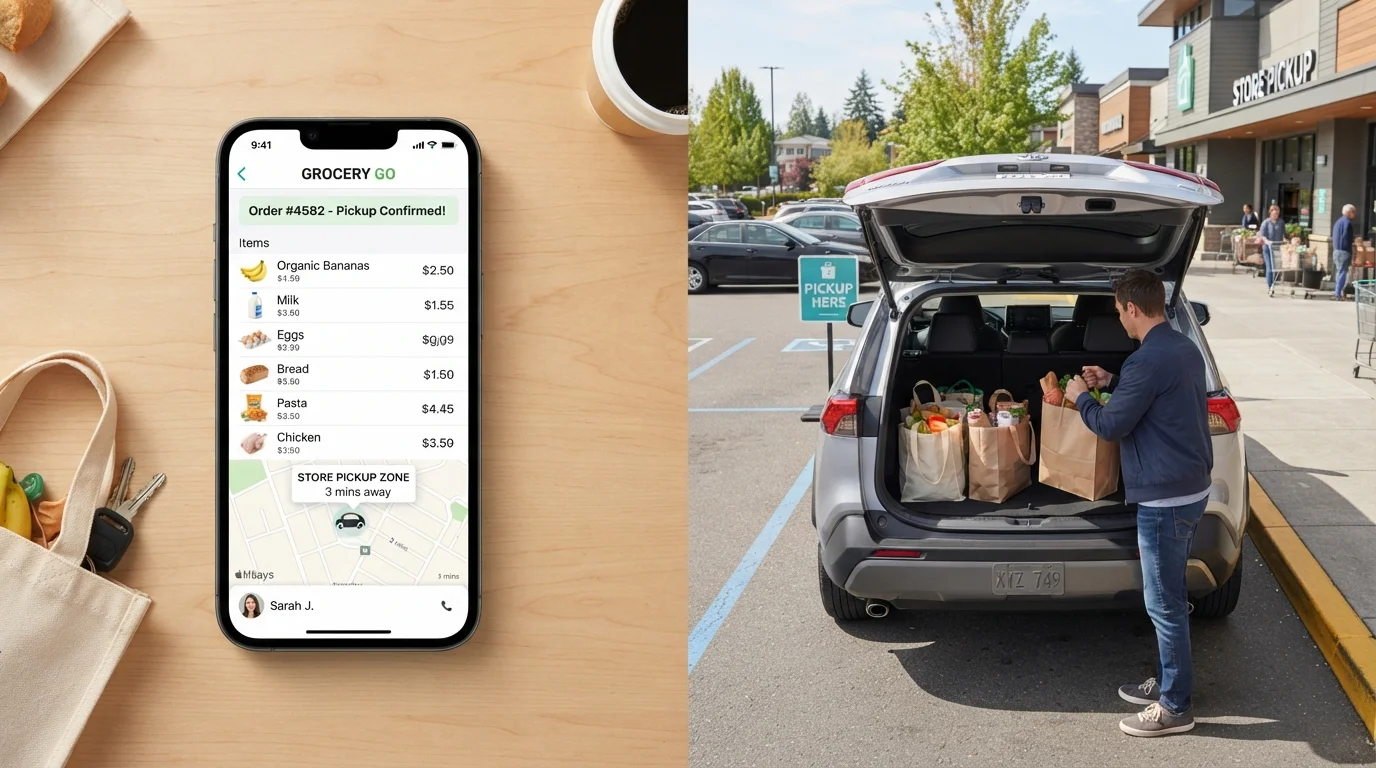
Click-and-collect - sometimes called BOPIS (Buy Online, Pick Up In-Store) - works differently. You build a cart online, choose a pickup window, and drive to a designated area where store staff load your order. You never leave your car in most cases. The store's own employees pick the items from the same shelves available to walk-in customers, which has implications for both pricing and product availability.
Understanding the full lifecycle of an online order helps explain why errors - wrong items, out-of-stocks - tend to surface differently under each model.
Cost Breakdown: What You Actually Pay
This is where the two models diverge most sharply for budget-conscious shoppers.
| Criterion | Grocery Delivery Apps | Click-and-Collect |
|---|---|---|
| Pricing | Markups + fees common | Typically in-store prices |
| Delivery/service fee | Yes, often $3-$10+ | Usually none or minimal |
| Driver tip expected | Yes | No |
| Speed (fastest option) | As fast as 30-60 minutes | Same day, scheduled window |
| Substitution control | Limited; post-delivery only | Review on arrival |
| Perishable quality control | Low - shopper selects | Higher - inspect at pickup |
| Requires travel | No | Yes |
| Availability by location | Urban/suburban focus | Widely available nationally |
Delivery apps layer on multiple charges: a delivery fee, a service fee, and - less visibly - item-level markups that can run 10-15% above in-store prices on many platforms. Tips for drivers are a separate, socially expected cost. Those amounts add up quickly on a typical weekly shop.
Click-and-collect almost universally charges in-store prices. Many major grocery chains offer the service at no additional fee, though some retailers charge a small order-assembly fee for smaller baskets. There's no driver tip involved. The main cost you absorb is fuel and time for the pickup trip - costs that may already be priced into your routine if you pass the store anyway.
For a broader look at how digital and physical channels affect total spend, see how consumer preferences have shifted between in-store and online shopping.
Convenience, Control, and the Substitution Problem
Both models transfer item selection from you to someone else - and that's where friction often enters the picture.
Delivery apps handle out-of-stock items through automated or shopper-driven substitutions. You can set preferences in advance, but you won't see the actual replacement until it's already on its way to your door. Returning a wrong substitution means scheduling a separate process. Perishable quality is also outside your hands - item selection happens well before you can inspect it.
Click-and-collect gives you a window to intervene. When you arrive, staff typically inform you of any substitutions before the order is finalized. You can accept, reject, or quickly grab an alternative yourself. This makes it meaningfully more predictable for high-stakes purchases like ripe produce or specific cuts of meat.
A Note on Inventory Accuracy
Both models depend on the retailer's inventory data being current, and both can fail when it isn't. Out-of-stock errors tend to be more disruptive for delivery orders, since you have no chance to adapt in the moment. Click-and-collect shoppers can grab an alternative from the shelf if a substitution doesn't work for them - a small but real advantage for households with specific dietary requirements or brand preferences.
It's worth noting that app-based grocery shopping - whether delivery or collect - tends to reduce unplanned purchases compared to in-store browsing, since you're working from a list. The degree of that effect varies by platform and individual habits, but it's a consistent pattern in consumer research on digitally mediated grocery shopping.
If you're weighing whether to use a retailer's dedicated app versus ordering through a mobile browser, a balanced look at app vs. website shopping covers that tradeoff specifically.
Which Method Fits Which Shopper?
Neither model is universally superior - the right choice depends on your household's specific constraints.
~28%
US adults using click-and-collect
FMI - The Food Industry Association reported that roughly 28% of US grocery shoppers used click-and-collect services in a recent annual survey period.
10-15%
Typical delivery app item markup above in-store price
Consumer advocacy research and platform price audits have repeatedly found item-level markups in this range on major third-party grocery delivery platforms.
2x
Growth in online grocery fulfillment since 2019
Industry analysts including those at McKinsey & Company have documented roughly a doubling of digitally fulfilled grocery volume in the US between 2019 and the mid-2020s.
Delivery makes the most practical sense when transportation is a genuine barrier, when a schedule leaves no margin for store trips, or when the time saved has clear monetary value. It's also the only real option during mobility-limiting circumstances like illness or severe weather.
Click-and-collect tends to serve households that are already mobile but want to cut down on time spent inside the store. Parents managing school pickup logistics, workers with predictable commute routes past a grocery anchor, and shoppers who find digital browsing more efficient than in-person browsing all tend to find it a good fit.
For readers thinking about how recurring grocery needs might be served by subscription-style fulfillment instead, the mechanics of subscription box delivery offers a useful contrast. And if you're specifically weighing curbside vs. home delivery with data behind the comparison, the data on curbside vs. home delivery habits goes deeper on consumer adoption patterns.
The honest answer for most households: use both selectively. Delivery for urgent or mobility-constrained shops; click-and-collect as the default when circumstances allow.