

Key Takeaways
- Neuromorphic chips mimic the brain's neuron-and-synapse structure rather than traditional sequential logic.
- They use spiking neural networks that only activate on meaningful signals, dramatically reducing energy use.
- These chips excel at sensory and pattern-recognition tasks but are not general-purpose replacements for conventional processors.
- Energy efficiency is their primary near-term advantage over standard AI accelerator chips.
- The field remains largely in research and specialized deployment stages, not mainstream consumer hardware.
Neuromorphic Computing
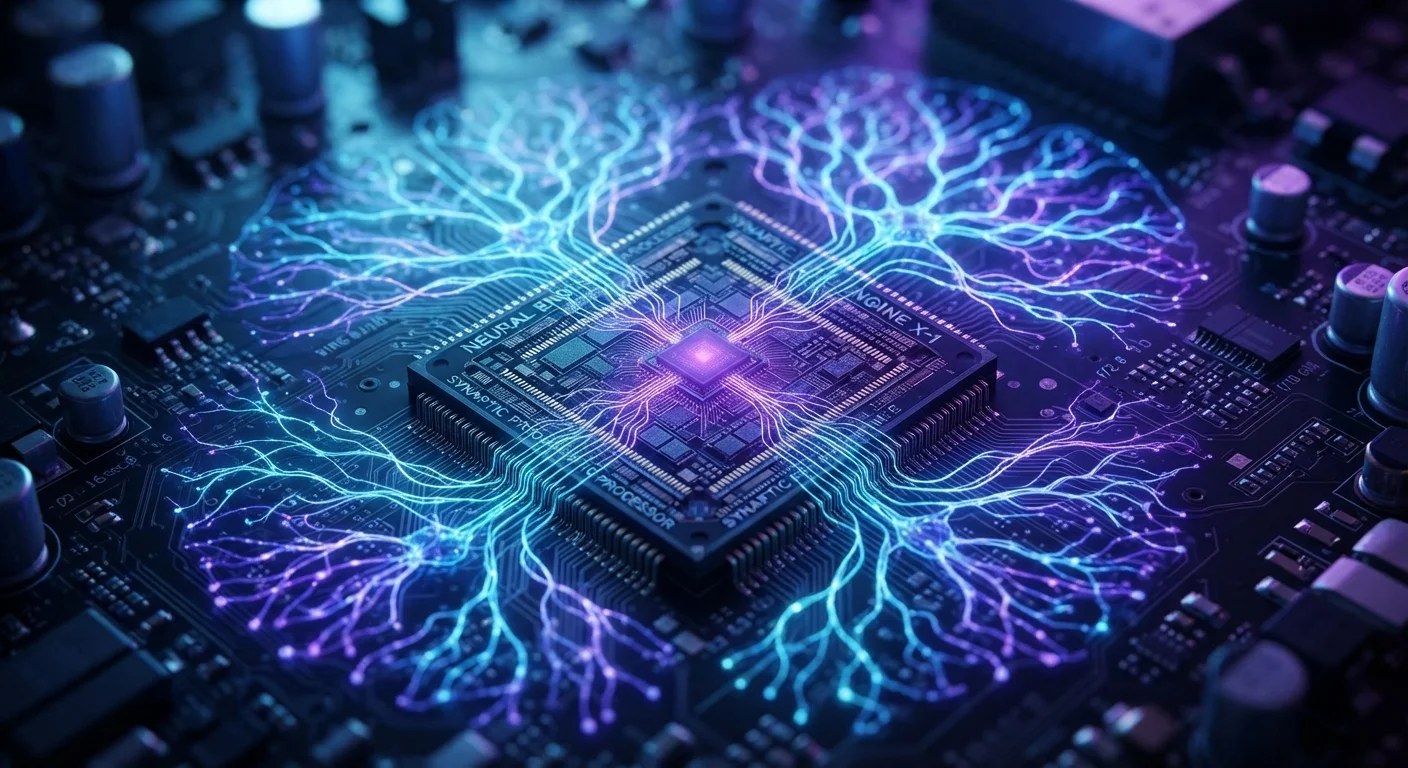
Neuromorphic computing is a field of chip design that models the structure and behavior of biological brains rather than following the traditional logic of conventional processors. Instead of executing instructions in sequential steps, neuromorphic chips use artificial neurons and synapses to process information in parallel, event-driven bursts - much like the human nervous system does. The goal is hardware that learns and adapts more efficiently, particularly for tasks like pattern recognition and sensory processing.
Most neuromorphic architectures use spiking neural networks (SNNs), where artificial neurons only fire - and consume energy - when a meaningful signal threshold is crossed, closely approximating biological spike-based communication.
Why Brain-Inspired Hardware Is Being Explored
Today's computers are extraordinarily powerful, yet they remain surprisingly inefficient compared to the human brain at certain tasks. The brain consumes roughly 20 watts while recognizing faces, interpreting speech, and coordinating movement simultaneously. A data center running a comparable AI workload might consume megawatts. That gap has motivated researchers to ask a provocative question: what if chips were designed to work like neurons rather than like transistor logic gates?
Neuromorphic computing emerged from that question. Pioneered in concept by Caltech researcher Carver Mead in the 1980s, the field draws directly on neuroscience - specifically how biological neurons communicate through brief electrical spikes - to design hardware from the ground up. Understanding why this matters starts with knowing how conventional chips differ. See how standard processor components work for useful context.
~20W
Estimated power used by the human brain
Neuroscience researchers broadly cite approximately 20 watts as the brain's average power consumption during active cognition, a benchmark that motivates neuromorphic efficiency research.
1,000x
Potential energy efficiency gain over conventional AI chips
Intel's research publications on its Loihi neuromorphic chip have suggested energy efficiency improvements of this magnitude for specific sparse, event-driven workloads compared to traditional processors.
86 billion
Neurons in the human brain
This figure, widely cited in neuroscience literature, underscores the immense scale of biological neural networks that neuromorphic engineers are attempting to approximate in silicon.
How Spiking Neural Networks Actually Work
The core innovation is the spiking neural network (SNN). In a biological brain, a neuron only fires when incoming signals accumulate past a threshold - otherwise it stays quiet. Neuromorphic chips replicate this with artificial neurons that do the same: they accumulate input, and only when that input crosses a set level do they emit a spike and consume meaningful power. Between spikes, the circuit is essentially dormant.
This contrasts sharply with conventional processors - and even most modern AI accelerators - which operate on a fixed clock and perform calculations continuously regardless of whether useful data is arriving. The spiking model means computation is inherently asynchronous and event-driven, which maps naturally onto problems involving continuous sensory streams like audio or motion data.
Synaptic weights - the strength of connections between artificial neurons - can also be adjusted over time, giving these chips a form of on-chip learning without requiring data to be sent back to a central server. This is a meaningful distinction from how most AI models are trained today, where learning happens on large GPU clusters and results are then deployed statically. Researchers exploring efficient AI broadly are working on complementary approaches - see what's driving the push for smaller, more efficient AI models.
Spiking vs. Standard Neural Networks
When you hear about neural networks in everyday AI products - image recognition, voice assistants, recommendation engines - those typically use standard artificial neural networks running on GPUs, not spiking neural networks. The two are conceptually related but architecturally distinct. Spiking networks are closer to biological reality but harder to train using today's dominant machine learning methods, which is one reason neuromorphic computing remains a specialized research area rather than a mainstream AI tool.
Where Neuromorphic Chips Fit - and Where They Don't
Neuromorphic hardware is not a universal replacement for existing chips. It has a distinct niche. Tasks involving real-time, sparse sensory data - detecting a sound event, tracking motion from a camera that only registers pixel changes, or processing tactile signals from a robotic limb - align well with spiking architectures. Energy-constrained edge devices, where a battery-powered sensor must operate for months, are another promising application area.
General-purpose computing and large-scale AI model training are a different matter. The dense, regular matrix arithmetic that powers training runs on tools like GPUs and tensor processing units isn't well served by event-driven designs. Neuromorphic chips sit alongside, not above, the broader chip landscape that continues to evolve - including ongoing debates about processor architecture covered in discussions like the RISC vs. CISC design tradeoffs and the advances described in the push toward smaller transistors.
The Road Ahead for Neuromorphic Technology
Research programs at universities and major technology laboratories have produced functional neuromorphic prototype chips that demonstrate the efficiency advantages in controlled settings. However, scaling these systems, developing compatible software frameworks, and programming them effectively remain significant challenges. Unlike conventional processors, which benefit from decades of mature tooling and programming languages, neuromorphic platforms require developers to think in spike-based time steps - a fundamentally different programming model.
The trajectory is one of gradual specialization rather than sudden disruption. Neuromorphic principles may find their first durable footing in low-power sensors, hearing aids, autonomous robotics, and scientific instruments - applications where the energy and latency advantages outweigh the programming complexity. As the field matures, its techniques may also influence mainstream chip design, even if full neuromorphic architectures remain a specialized tool. The shift toward more efficient computing on the edge - covered in the context of ARM's expansion into everyday computing - signals an industry appetite for exactly the kind of efficiency neuromorphic research is chasing.
“The brain is the most energy-efficient computing system we know of. If we can understand its principles well enough to replicate them in hardware, we open up entirely new categories of what machines can do at the edge.”
— Carver Mead, Pioneer of neuromorphic engineering, Professor Emeritus at California Institute of Technology