

Key Takeaways
- RISC processors use a small set of simple instructions, executing tasks faster with lower power consumption.
- CISC processors support complex, multi-step instructions in hardware, prioritizing computational versatility.
- ARM, a RISC-based architecture, now powers most smartphones, tablets, and increasingly laptops.
- x86, the dominant CISC architecture, remains the standard for most desktop PCs and data center servers.
- Modern processors blur the RISC/CISC boundary by translating complex instructions into simpler micro-operations internally.
- The right architecture depends on the use case - neither design is universally superior.
Option A
RISC (Reduced Instruction Set Computing)
The lean, efficient architecture built for speed.
Best for: Devices where battery life, thermal efficiency, and mobile performance are the top priorities.
Option B
CISC (Complex Instruction Set Computing)
The powerful, versatile architecture built for compatibility.
Best for: Desktop and enterprise computing where raw computational power and software legacy compatibility matter most.
If you prioritize battery life and mobile performance
RISC (Reduced Instruction Set Computing)
RISC-based chips like ARM consume significantly less power per operation, making them the dominant choice in smartphones, tablets, and thin laptops.
If you rely on legacy software and maximum desktop performance
CISC (Complex Instruction Set Computing)
x86 CISC processors maintain broad backward compatibility with decades of software, and remain the standard in workstations and servers demanding sustained heavy workloads.
If you want to understand why your laptop runs cooler than your desktop
RISC (Reduced Instruction Set Computing)
The efficiency-first design of RISC architectures means less heat generated per computation, a key factor in fanless and slim devices.
If you run professional software requiring high single-thread performance
CISC (Complex Instruction Set Computing)
CISC processors, particularly modern x86 designs, have been optimized over decades for demanding single-threaded workloads common in creative and engineering software.
Two Philosophies Behind Every Processor
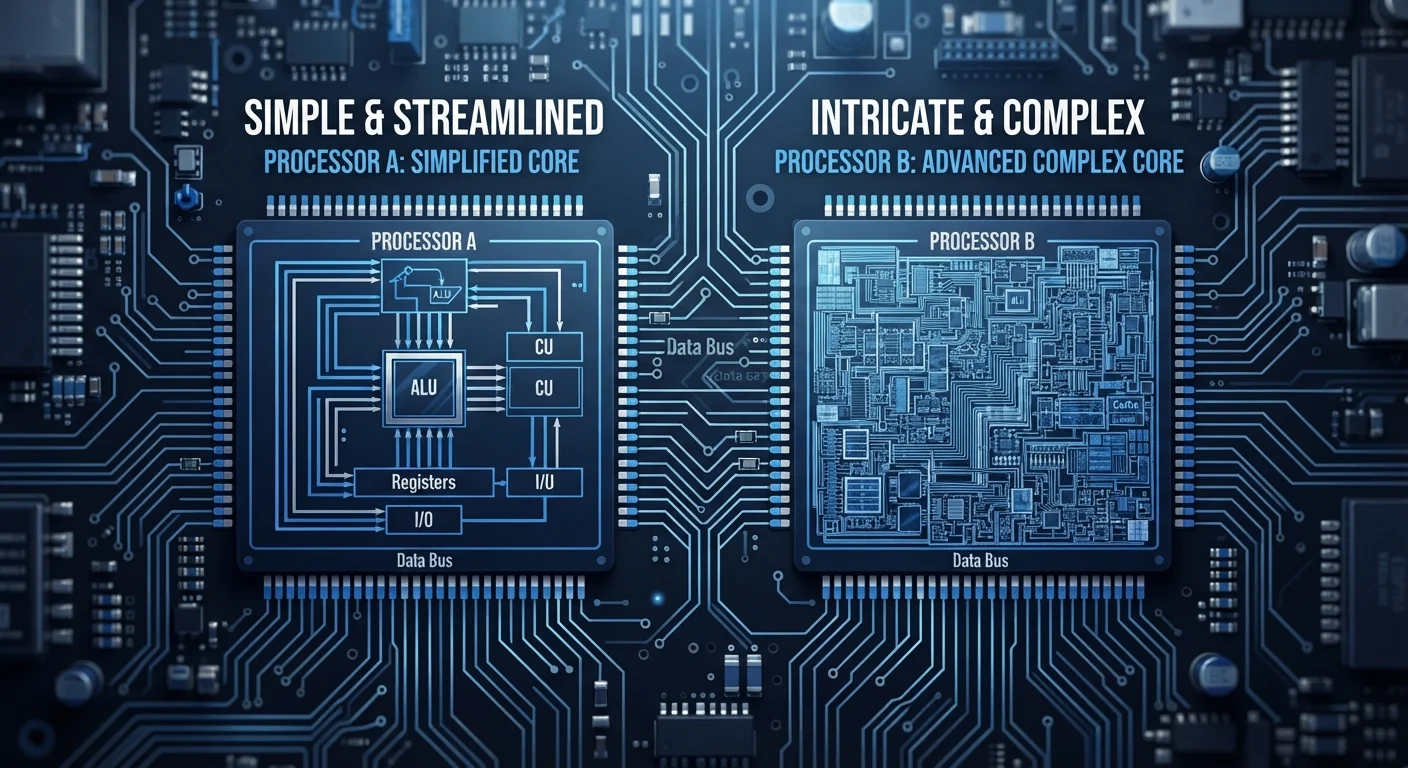
Every processor your devices rely on was built around a fundamental design choice: how many instructions should the chip be able to understand, and how complex should each one be? That question split computer engineers into two camps decades ago, producing two distinct philosophies - RISC (Reduced Instruction Set Computing) and CISC (Complex Instruction Set Computing).
RISC takes a minimalist approach. Its processors understand a small set of simple instructions, each designed to execute in a single clock cycle. The idea is that doing fewer things faster, with greater predictability, ultimately yields better overall performance and efficiency. CISC takes the opposite view: give the processor a rich vocabulary of complex instructions, some of which can accomplish in one step what would take RISC multiple steps to complete. This shifts complexity from software into hardware.
To use a rough analogy: RISC is like a kitchen with three sharp, specialized knives - fast, precise, purpose-built. CISC is like a kitchen with a Swiss Army knife - it handles more scenarios, but each tool is a slight compromise. Neither is wrong. They're answers to different questions.
To understand how these architectures power the chips in your actual devices, see our breakdown of smartphone chip components.
How RISC and CISC Differ in Practice
The practical differences between RISC and CISC show up in three key areas: instruction complexity, power draw, and how work gets divided between hardware and software.
| Criterion | RISC | CISC |
|---|---|---|
| Instruction set size | Small, simple set | Large, complex set |
| Instruction execution time | Typically one clock cycle | Variable, often multiple cycles |
| Power efficiency | High - fewer transistors active | Lower - more hardware complexity |
| Hardware complexity | Simpler chip design | More complex chip design |
| Software compiler burden | Higher - compiler does more work | Lower - hardware handles complexity |
| Primary modern example | ARM (smartphones, tablets) | x86 (PCs, servers) |
| Typical use environment | Mobile and embedded devices | Desktops, workstations, servers |
In a RISC processor, the compiler - the software tool that translates human-written code into machine instructions - carries more responsibility. It must break complex tasks into sequences of simple instructions. This places more demand on software but keeps the chip itself simpler, faster, and more power-efficient.
In a CISC processor, the hardware handles more of that complexity directly. A single CISC instruction might load data from memory, perform a calculation, and write the result back - all in one command. This can reduce code size and, historically, was important when memory was expensive and limited.
~99%
Smartphones using ARM (RISC) processors
ARM Holdings has reported that ARM-based processor designs appear in the vast majority of mobile phones shipped globally each year.
~70%+
Server market share held by x86 chips
Industry analyst estimates consistently place x86 architecture as the dominant platform in enterprise data centers, though ARM-based server adoption is growing.
1978
Year Intel's x86 CISC architecture was introduced
The x86 instruction set debuted with the Intel 8086 processor and has maintained backward compatibility continuity ever since, underpinning decades of PC software.
Crucially, the line between RISC and CISC has blurred significantly in modern processors. Today's x86 chips - technically CISC - internally decode complex instructions into simpler micro-operations that execute in a RISC-like manner. The CISC instruction set is largely a compatibility layer now, not a reflection of how the silicon actually computes.
Where Each Architecture Lives Today
ARM, the most widely deployed RISC architecture, powers virtually every smartphone and tablet on the market. Its instruction set's efficiency translates directly into the battery life and slim form factors consumers expect from mobile devices. ARM chips have since expanded into laptops and even servers, a shift worth understanding in detail - see what the move to ARM-based chips means for consumers.
x86, the dominant CISC architecture developed in the late 1970s, remains the backbone of desktop PCs, mainstream laptops, and enterprise data centers. Decades of software written for x86 creates a powerful compatibility incentive that keeps it firmly entrenched in those markets.
RISC-V: The Open-Source Wildcard
RISC-V is an open-standard RISC instruction set architecture that anyone can implement without licensing fees. Unlike ARM - which requires licensing from ARM Holdings - RISC-V is freely available, making it attractive for custom chip development in academia, embedded systems, and emerging markets. While not yet mainstream in consumer devices, RISC-V represents a meaningful third path in the architecture landscape and is worth watching as adoption grows across the industry.
Other RISC architectures also play important roles: MIPS powered networking hardware for years, RISC-V is an emerging open-source alternative gaining traction in embedded systems and research, and Apple's own ARM-based silicon has demonstrated that RISC designs can match or exceed x86 performance in consumer computing. Meanwhile, as chip makers refine both architectures at ever-smaller scales, the push toward 2-nanometer manufacturing is reshaping what either design can deliver.
Why the Debate Still Matters
For everyday consumers, the RISC vs. CISC distinction rarely surfaces as a direct choice. You don't pick an architecture when you buy a device - but architects made that choice for you, and it shapes everything from your phone's battery life to whether your legacy software runs without issues.
The debate also serves as a window into how computing evolves. The trend toward more diverse, specialized silicon - including AI accelerators and neuromorphic processors - reflects the same underlying tension between doing more in hardware versus more in software. Neuromorphic chips represent perhaps the most radical departure yet from both RISC and CISC assumptions, treating computation itself differently.
Understanding RISC and CISC equips you to make sense of headlines about chip performance, battery efficiency, and the ongoing platform shifts in computing - because those stories are, at their core, about which architectural philosophy wins in each new context.