

Key Takeaways
- Match highway traffic speed before merging - never stop at the end of an on-ramp.
- Stay right for cruising; use the left lane only to pass, then move back.
- Keep at least a three-second following distance at highway speeds, more in poor conditions.
- Check mirrors and blind spots before every lane change - signal first, move second.
- Read exit signs early and position yourself in the correct lane well in advance.
Start here
What Makes Interstate Driving Different
Core skill
Using the On-Ramp to Merge Safely
Build on it
Lane Discipline at Highway Speeds
Next step
Changing Lanes and Maintaining Space
Finish strong
Exiting the Highway Without Last-Minute Scrambles
What Makes Interstate Driving Different
Interstate highways are engineered for continuous, high-speed travel between cities and regions. Unlike city streets, they have no traffic lights, no cross-traffic, and no pedestrians - but they introduce a different set of demands: higher speeds, longer stopping distances, and the need to merge with fast-moving traffic.
The most important mental shift is understanding that every action takes longer at highway speeds. A car traveling at 65 mph covers roughly 95 feet per second. That physical reality shapes everything from how early you need to signal to how much room you need to stop.
If you're new to vehicle ownership generally, our First-Time Car Owner's Starter Guide covers the fundamentals - including insurance and mechanical basics - that are good to have sorted before your first highway trip.
Acceleration lane
The extra lane at the end of an on-ramp that gives drivers space to reach highway speed before merging into traffic.
Blind spot
The area alongside and slightly behind a vehicle that cannot be seen in the side or rearview mirrors - requiring a physical shoulder check.
Following distance
The gap between your vehicle and the one directly ahead, measured in time (seconds) rather than car lengths at highway speeds.
Deceleration lane
The dedicated lane adjacent to an exit ramp where drivers reduce speed before leaving the highway.
Keep right law
A statute found in most US states requiring drivers to stay in the right lane except when actively passing another vehicle.
Using the On-Ramp to Merge Safely
The on-ramp, also called an acceleration lane, exists specifically to give you room to reach highway speed before joining traffic. Use all of it. Begin accelerating smoothly and progressively as you enter the ramp, check your mirrors and blind spot for a gap in the right lane, signal your intent, and aim to be at or near traffic speed by the time you reach the merge point.
Never stop at the end of the on-ramp unless traffic is completely gridlocked. A stopped vehicle on a high-speed ramp creates a serious collision risk for drivers behind you.
Never Stop at the End of an On-Ramp
Stopping or near-stopping at an on-ramp merge point is one of the most dangerous things a driver can do on the highway. Vehicles behind you on the ramp have no time to react, and drivers on the highway don't expect stationary objects at that point. Only stop if traffic ahead is completely halted and there is absolutely no safe gap.
In most US states, entering drivers must yield to highway traffic - the right-of-way belongs to vehicles already on the road. For a deeper look at how merging laws vary by state, see Merging on the Highway: Who Has the Right.
Lane Discipline at Highway Speeds
US interstates follow a straightforward convention: right lanes for traveling, left lanes for passing. On a three-lane highway, the rightmost lane is typically for slower traffic and trucks; the middle lane is where most passenger vehicles cruise; the left lane is for overtaking and should be vacated once you've passed.
This matters legally and practically. Most states have "keep right except to pass" statutes, and staying in the left lane unnecessarily disrupts traffic flow and can provoke unsafe reactions from other drivers. Lane Discipline on Multi-Lane Roads explains what the law specifically says and why the rule exists.
Pick Your First Trip Deliberately
Your first few highway drives will be most manageable during light traffic hours - mid-morning on a weekday is often ideal. Start with a short, familiar stretch rather than a long unfamiliar route, and if possible, take an experienced driver along for the first run. Confidence builds quickly once the basics become routine.
Changing Lanes and Maintaining Space
Lane changes on the highway follow a clear sequence: check mirrors, check blind spot, signal, then move - in that order, every time. Signaling after you've already started moving gives other drivers no warning. Keep the signal on until the lane change is complete.
Blind spots - the areas on either side that your mirrors don't cover - are larger than most new drivers expect. A brief glance over your shoulder before committing to a lane change takes less than a second and can prevent a serious collision.
Equally important is the space in front of you. At 65 mph, the three-second rule is the baseline: pick a fixed point, watch the car ahead pass it, and count three seconds before you reach it. In rain or low visibility, extend that gap further. As your highway experience grows, you'll also start reading the road further ahead - a skill experienced drivers develop deliberately.
Exiting the Highway Without Last-Minute Scrambles
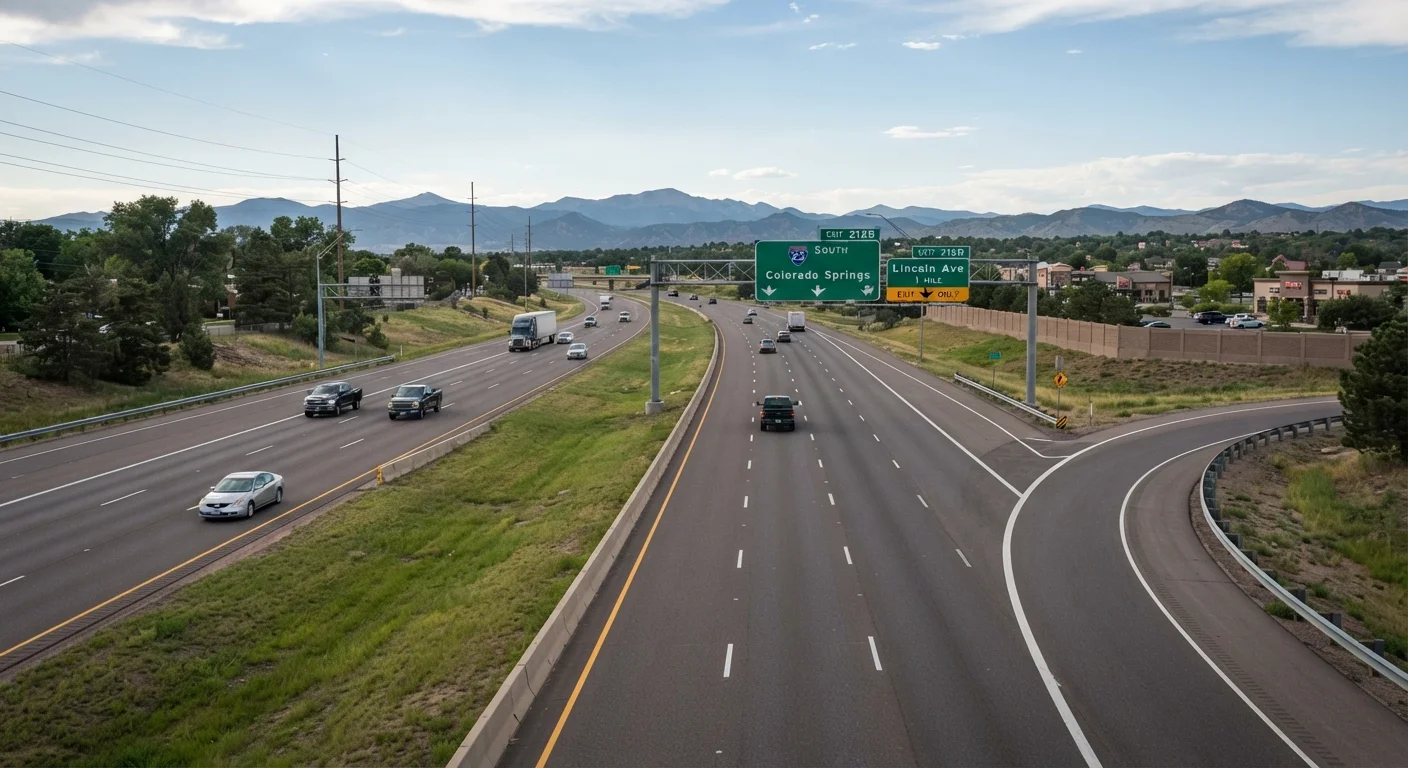
Interstate exits are marked well in advance - typically at one mile and then half a mile. As soon as you see the first sign for your exit, begin positioning yourself in the correct lane. Gradual, early lane changes are far safer than cutting across multiple lanes at the last second.
Once in the exit lane, reduce speed progressively. The deceleration lane is designed for exactly this - use it rather than slowing down in the main travel lanes. Exit ramps often have their own posted speed limits that are significantly lower than highway speeds; follow them, as ramp curves are designed for those limits.
If you miss your exit, proceed to the next one and re-route. Reversing or stopping on the highway or shoulder to backtrack is illegal and extremely dangerous. For situations where unfamiliar road layouts add stress, Driving on Unfamiliar Roads: How to Navigate Without Panicking offers practical strategies for staying calm and oriented.