

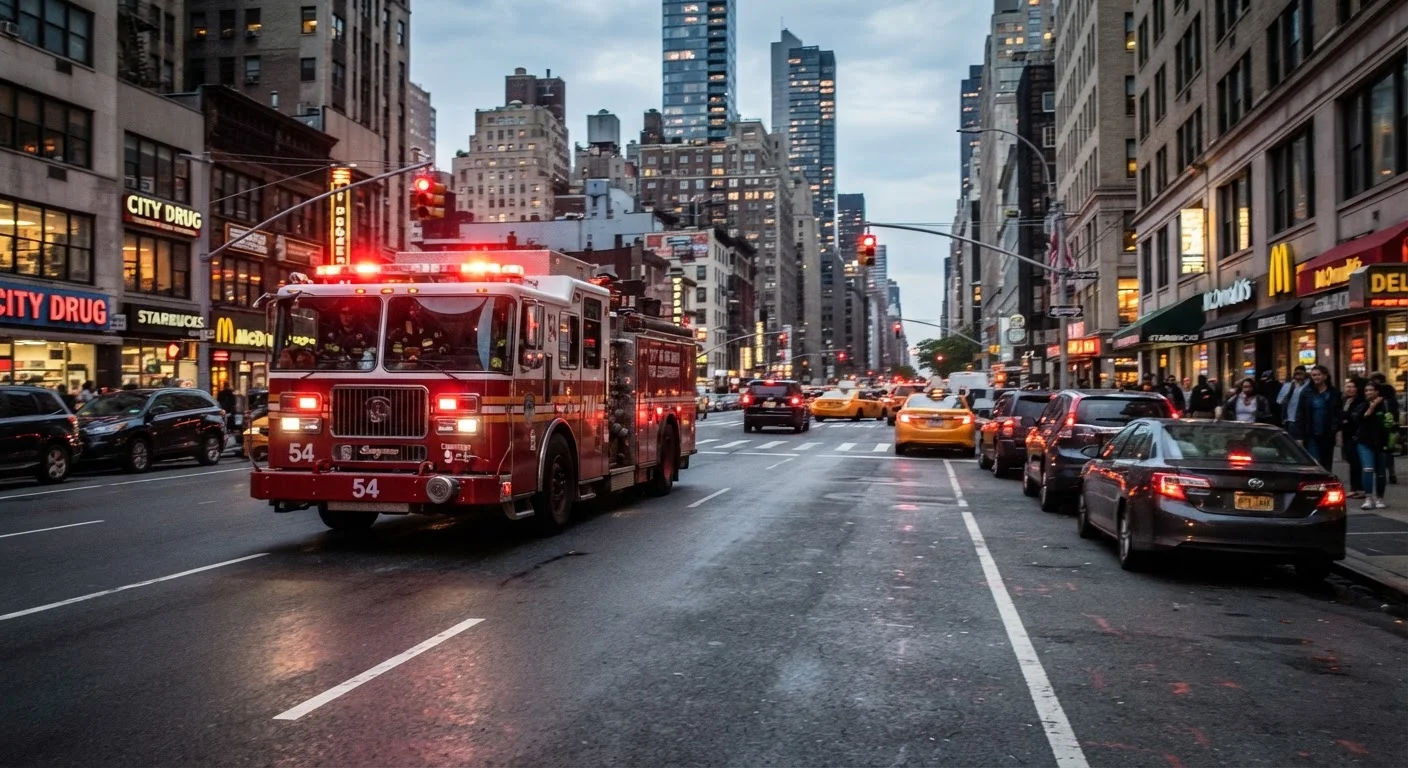
The Core Legal Requirement: Pull Right and Stop
When an authorized emergency vehicle - an ambulance, fire truck, or police car - approaches with its lights and siren active, every US state requires drivers to take immediate, specific action. The standard rule, rooted in Uniform Vehicle Code principles and mirrored in state statutes, is: pull to the right edge of the road and stop until the emergency vehicle has passed.
This applies whether the emergency vehicle is approaching from behind, oncoming, or at an intersection. A few important clarifications:
- Intersections: Do not block the intersection. Pull through it first if you can do so safely, then pull right and stop.
- One-way roads: Pull to whichever curb - right or left - is nearest and stop.
- Divided highways: Oncoming traffic on a physically divided road is generally not required to yield, though state rules vary; when in doubt, slow down and stay alert.
The key is not to brake suddenly in the middle of a lane. Signal, check mirrors, and move right in a controlled manner. For a broader look at how yielding fits into everyday driving, see right-of-way rules every US driver should know.
The Move Over Law: A Separate but Related Requirement
Beyond yielding to moving emergency vehicles, every US state has enacted a Move Over Law - legislation requiring drivers to change lanes away from, or slow down significantly for, stationary emergency vehicles, tow trucks, and roadside workers displaying lights on the shoulder.
The typical requirement works like this: if an emergency vehicle is stopped on the shoulder with lights activated and you are in the nearest travel lane, you must move over one lane if it is safe to do so. If changing lanes is not possible - due to traffic or road configuration - you must reduce speed to a safe level, often defined as well below the posted limit.
State Laws Vary - Check Your State's Specifics
While the pull-right-and-stop rule and Move Over requirements exist nationwide, the precise speed thresholds, applicable vehicle types, and penalty structures differ by state. Consult your state's Department of Motor Vehicles or driver's handbook for the exact requirements in your jurisdiction. When in doubt, the safest action is always to slow down and create as much space as possible.
Penalties for Move Over violations range from fines to license points and, in some states, misdemeanor charges - particularly if the violation results in injury. For a full breakdown of what these laws cover, see what Move Over laws require and why they exist.
Failure to yield to an emergency vehicle is also a recordable moving violation in most states. Understand what failure to yield means on your driving record before assuming it is a minor infraction.
Staying Safe in the Moment
Reacting calmly and correctly depends on situational awareness developed before the lights appear. A few practical habits help:
- Monitor mirrors regularly so you are never surprised by an approaching vehicle.
- Keep a safe following distance so you have room to pull right without cutting off the driver in front. Safe following distance guidance explains the margin most drivers underestimate.
- Never follow an emergency vehicle closely after it passes - other drivers may be pulling back into the lane at the same moment, and some states explicitly prohibit following within 500 feet of an active emergency vehicle.
- Stay stopped until the vehicle has fully passed and traffic conditions are clear. Do not re-enter the lane prematurely.
On highways and multi-lane roads, the same yielding logic applies as in everyday merging situations. Highway merging rules provide useful context for understanding lane-change decisions under pressure.
Authorized Emergency Vehicle
A publicly operated vehicle - such as an ambulance, fire apparatus, or police car - legally permitted to use lights and sirens and to receive traffic priority under state law.
Move Over Law
State legislation requiring drivers to vacate the lane nearest a stopped emergency or roadside-assistance vehicle, or to slow significantly when a lane change is not possible.
Failure to Yield
A moving violation issued when a driver does not give legally required precedence to an emergency vehicle, pedestrian, or other road user with the right of way.
Right-of-Way
The legal entitlement of a driver, pedestrian, or vehicle to proceed before others in a specific traffic situation, as defined by state traffic codes.