

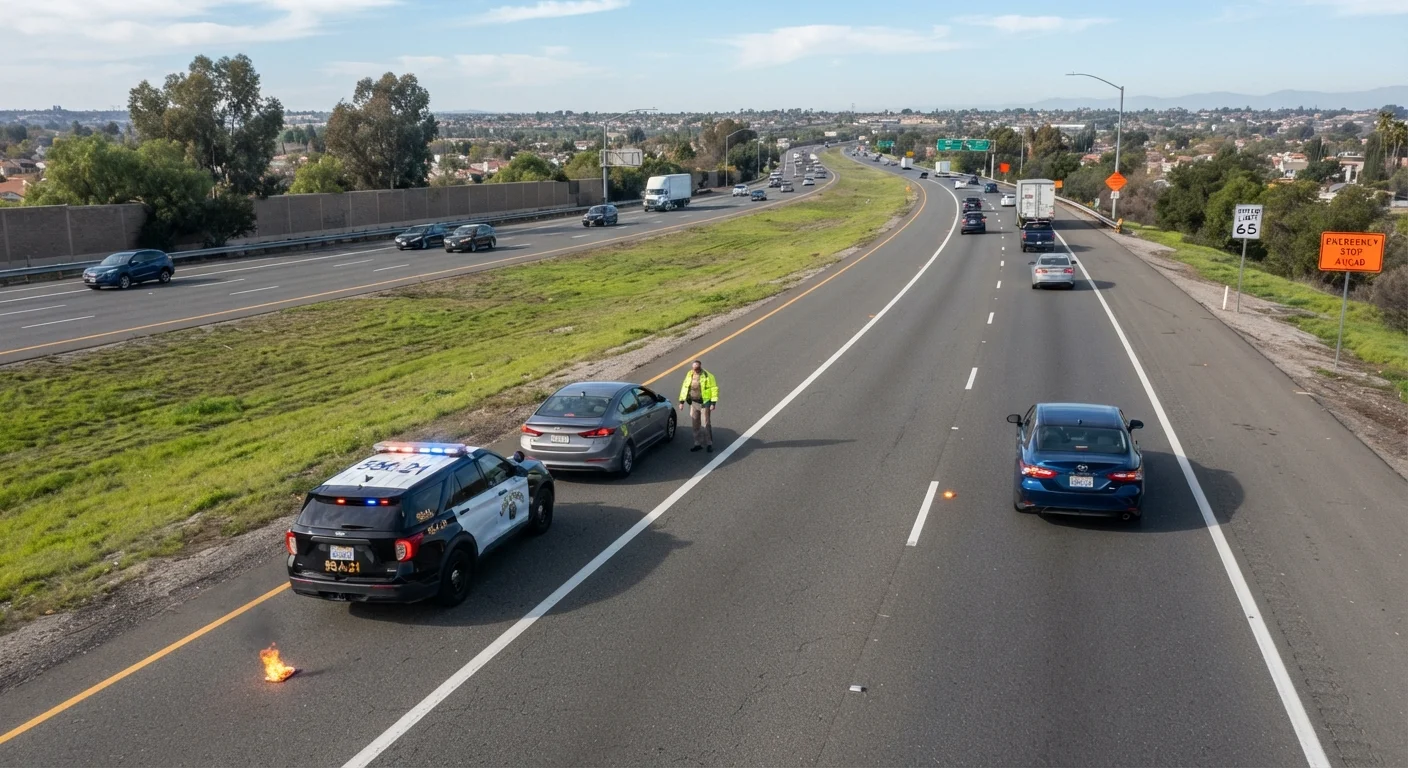
Key Takeaways
- All 50 US states have a Move Over law, though specific requirements differ by state.
- Drivers must either change lanes away from a stopped vehicle or reduce speed - sometimes both.
- Laws now commonly cover tow trucks, road crews, and utility vehicles, not just police and ambulances.
- Violations can result in fines, license points, and in serious cases, criminal charges.
- The law exists because roadside workers and first responders face real danger from passing traffic.
Move Over Law
A Move Over law requires drivers to change lanes - moving away from the shoulder - or slow down significantly when passing any stopped emergency, law enforcement, or roadside service vehicle displaying flashing lights. Every US state has enacted some version of this law. The goal is to create a safety buffer between passing traffic and workers or responders on the roadside.
Coverage varies by state: some laws apply only to law enforcement and emergency vehicles, while others extend to tow trucks, utility vehicles, sanitation trucks, and highway maintenance equipment.
The Origin and Purpose of Move Over Laws
Move Over laws emerged in the late 1990s after a series of preventable fatalities involving law enforcement officers struck by passing vehicles while working roadside stops. South Carolina enacted the first US Move Over law in 1996, and by 2012, all 50 states had followed. The laws address a straightforward but serious problem: when vehicles travel at highway speed just feet from stopped responders and workers, the margin for error is nearly zero.
Roadside environments are inherently unpredictable. An officer conducting a traffic stop, a paramedic treating a patient, or a tow truck operator hooking up a vehicle - all are exposed to traffic in ways ordinary drivers rarely consider. Move Over laws exist to structurally reduce that exposure by pushing passing traffic away from the shoulder.
All 50 States Have a Version of This Law
While the core obligation is consistent - move over or slow down - the vehicles covered, speed thresholds, and penalties differ meaningfully from state to state. Drivers who travel across state lines should be aware that the specifics may vary. Your state's Department of Motor Vehicles or driver's manual is the most reliable reference for local requirements.
What the Law Generally Requires
While specific language varies by state, most Move Over laws share a core requirement: when approaching a stationary vehicle displaying flashing lights on the shoulder or roadside, drivers must:
- Change lanes - move one full lane away from the stopped vehicle if it is safe to do so; or
- Reduce speed - slow down to a safe speed, often defined as below the posted limit or at a speed reasonable for conditions, if a lane change is not safely possible.
Some states specify an exact speed reduction - for example, slowing to 20 mph below the posted limit. Others use a broader "reasonable and prudent" standard. A number of states require both a lane change and a speed reduction when conditions allow.
Understanding these obligations fits naturally alongside other foundational road-sharing rules. Right-of-way rules and Move Over requirements both serve the same underlying purpose: giving vulnerable road users predictable, legally enforceable protection.
When in Doubt, Slow Down and Move Over
Even when you are uncertain whether a specific vehicle is legally covered in your state, slowing down and changing lanes away from the shoulder is always the safest choice. This habit protects roadside workers, avoids potential violations, and reduces your own risk of a collision.
Who Is Covered Under Most State Laws
Early Move Over laws focused almost exclusively on law enforcement vehicles. Coverage has since expanded considerably. In most states today, the law applies to vehicles displaying flashing lights including:
- Police, sheriff, and highway patrol vehicles
- Ambulances and fire trucks
- Tow trucks and recovery vehicles
- Highway maintenance and construction vehicles
- Utility company vehicles
- In some states, stationary vehicles with hazard lights on, broadly defined
This expansion reflects the reality that tow truck operators, for example, face injury rates on par with emergency responders when working on highway shoulders. Yielding to emergency vehicles is a related but distinct obligation - one that applies to approaching moving emergency vehicles rather than stationary ones.
50
US states with a Move Over law
All 50 states enacted Move Over legislation by 2012, according to the National Conference of State Legislatures.
~23%
Law enforcement fatalities that are traffic-related
The National Law Enforcement Officers Memorial Fund has consistently found that traffic incidents - including struck-by events - represent a leading cause of officer deaths in the line of duty.
1996
Year the first US Move Over law was enacted
South Carolina passed the first statewide Move Over law in 1996, establishing the model other states later adopted.
Penalties and Common Misconceptions
Penalties for Move Over violations vary significantly by state. A first offense typically carries a fine ranging from roughly $100 to $500. Repeated violations or violations that result in property damage can trigger larger fines, license points, and potential license suspension. When a Move Over violation causes injury or death, many states allow felony charges.
One common misconception is that the law only applies on interstates or multi-lane highways. In many states, it applies on any road. Another is that slowing down slightly is enough - in practice, a meaningful speed reduction is required, and lane changes are expected unless genuinely unsafe.
Drivers sometimes underestimate how quickly highway situations develop. Driving myths - like the idea that staying in your lane at speed is always acceptable - can contribute to genuine legal and safety risk in these scenarios. Similarly, lane discipline awareness helps drivers anticipate when a safe lane change is possible versus when slowing is the correct response.