

| Typical school zone speed range | 15-25 mph (Varies by state and municipality) |
| National sign standard | Yellow-green fluorescent for school/pedestrian zones (Federal Highway Administration (FHWA)) |
| Common enforcement trigger | Flashing beacon, fixed hours, or children present (Varies by state law) |
| Fine multiplier in many states | 2x standard speeding fine (Common practice; specifics vary by state) |
| States with presence-based rules | Multiple states; exact count subject to legislative change |
Why School Zone Rules Aren't One-Size-Fits-All
School zones are among the most regulated stretches of American roads - and for good reason. But drivers who move between states or travel frequently may be surprised to find that speed limits, enforcement hours, and fine structures differ considerably depending on where you are. While federal guidelines provide a general framework for road safety, states retain authority over most traffic laws, including how school zones are defined and enforced.
Understanding the basics of how these rules vary can help you drive more confidently and avoid unexpected fines. For a broader look at how state-level authority shapes driving rules, see our state-by-state vehicle registration overview, which illustrates just how much varies at the state level.
| Typical school zone speed range | 15-25 mph (Varies by state and municipality) |
| National sign standard | Yellow-green fluorescent for school/pedestrian zones (Federal Highway Administration (FHWA)) |
| Common enforcement trigger | Flashing beacon, fixed hours, or children present (Varies by state law) |
| Fine multiplier in many states | 2x standard speeding fine (Common practice; specifics vary by state) |
| States with presence-based rules | Multiple states; exact count subject to legislative change |
Speed Limits: The Most Visible Difference
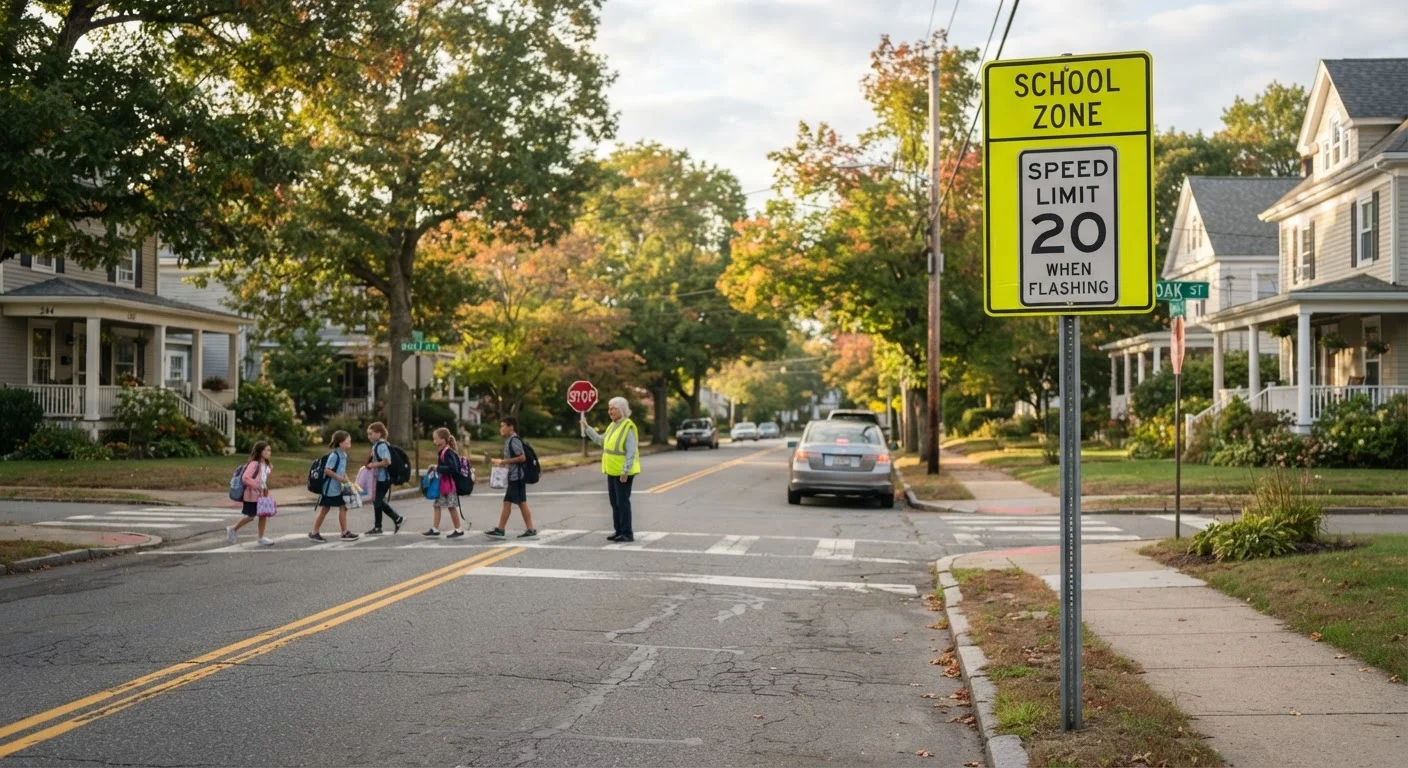
Most states set school zone speed limits between 15 and 25 mph, but the specific number - and when it applies - varies. Some states mandate a uniform 15 mph; others default to 20 or 25 mph unless a lower limit is posted locally. In several states, municipalities have discretion to set their own limits within a defined range.
Many states also use flashing beacons on school zone signs to indicate when the reduced speed limit is active. Without a flashing light, some drivers assume the standard speed applies - but in states where the lower limit is in effect during posted hours, that assumption can lead to a citation even if no beacon is present.
School zone
A designated section of roadway near a school where reduced speed limits and additional traffic rules apply, typically marked with specific signage.
Flashing beacon
A yellow flashing light mounted on or near a school zone sign that activates during school hours to signal when reduced speed limits are in effect.
Children present rule
A state-level rule that makes school zone speed limits applicable any time children are visibly in or near the zone, rather than only during fixed hours.
Moving violation
A traffic infraction committed while a vehicle is in motion, such as speeding. Moving violations typically add points to a driver's license record.
The colors and shapes of signs used in school zones are standardized nationally - yellow-green fluorescent signs for pedestrian and school warnings were introduced by the Federal Highway Administration to improve visibility. For a full breakdown of road sign color meanings, our guide on US road sign colors is a useful reference.
Enforcement Hours and Conditions
One of the trickiest aspects of school zone rules is when they apply. States generally fall into one of three approaches:
- Time-based: The reduced speed limit is active during fixed hours, such as 7-9 a.m. and 2-4 p.m. on school days. Hours vary by state and sometimes by district.
- Beacon-activated: The lower limit only applies when a flashing yellow light is operational, regardless of the time of day.
- When children are present: A handful of states require the reduced limit any time children are visibly in or near the zone, even outside traditional school hours.
Some states combine approaches - using fixed hours as a baseline but extending enforcement whenever children are present. Weekend school events, summer programs, and charter school schedules can also trigger enforcement in states with presence-based rules. When in doubt, slowing down is always the right call.
Summer and Non-Traditional School Schedules
School zone rules don't automatically pause during summer break in all states. Charter schools, summer programs, and year-round schools may keep zones active during months when traditional public schools are closed. If you're unsure whether a school zone is currently active, the safest approach is to observe the posted limit whenever signage is present.
Fines, Penalties, and Double-Fine Zones
Fines for school zone speeding violations are consistently higher than standard speeding tickets - and many states double the standard fine for infractions within a school zone. Some states add mandatory surcharges or court fees on top of the base fine, meaning the total cost of a single citation can range from around $100 to several hundred dollars depending on the state, the speed over the limit, and local fee schedules.
A number of states also assign points to a driver's license for school zone violations, which can affect insurance rates. Repeat violations in certain states may result in license suspension. School zone speeding in some jurisdictions is treated as a moving violation that cannot be dismissed through defensive driving courses.
If you're navigating other high-stakes driving zones, our guide on driving in construction zones covers a similarly regulated category of roadway where fines are also elevated.
15-25 mph
Typical school zone speed limit range across US states
Most states set school zone limits within this range, with local municipalities sometimes authorized to lower them further.
2x
Fine multiplier applied in many school zone violations
A common legislative approach across multiple states is to double the standard speeding fine within an active school zone.
3 types
Distinct enforcement-hour approaches used by states
States generally use time-based, beacon-activated, or children-present rules - and some combine more than one approach.
Practical Tips for Staying Compliant
Because rules change at state lines and sometimes at city limits, the most reliable approach is to treat posted school zone signs as authoritative and slow down whenever you see one - regardless of what you expect based on another state's rules. Key habits that help:
- Watch for flashing beacons and posted time schedules on signs.
- Be aware that school zone rules may apply on days you don't expect, including professional development days when bus routes still run.
- Don't rely solely on GPS navigation apps to flag school zones - they may not reflect the most current local rules.
- In states where "children present" language governs, observe actual road conditions, not just the clock.
For a broader understanding of how state-level driving laws interact - including right-of-way rules that also vary by jurisdiction - see our overview of right-of-way rules every US driver should know.