

Key Takeaways
- Reckless driving typically requires proof that a driver consciously disregarded a known risk to others.
- Careless driving generally involves negligence or inattention - no deliberate disregard is required.
- Reckless driving is often a criminal misdemeanor; careless driving is usually a civil traffic infraction.
- Penalties for reckless driving can include jail time, heavy fines, and license suspension.
- Definitions and penalties vary significantly by state - always check your state's specific statutes.
- Both charges can affect your insurance rates and driving record, but reckless driving carries far greater long-term risk.
Option A
Reckless Driving
The more serious, intent-based criminal charge.
Best for: Understanding when traffic behavior crosses into criminal territory with potential jail time and license consequences.
Option B
Careless Driving
The civil or minor infraction involving a lapse in attention.
Best for: Understanding when inattentive or imprudent driving results in a traffic citation rather than a criminal charge.
If you received a ticket after a fender-bender or minor lapse in attention
Careless Driving
Careless driving typically applies to inattentive or imprudent behavior without deliberate disregard. This is the more likely charge for everyday mistakes like following too closely or drifting lanes briefly.
If you were cited for excessive speeding, racing, or ignoring traffic controls at high speed
Reckless Driving
These behaviors often meet the legal threshold of conscious disregard for safety, which is the hallmark of reckless driving charges in most states.
If you are weighing whether to contest a charge in court
Reckless Driving
The distinction between reckless and careless can hinge on subtle facts. Contesting a reckless charge is often worth exploring given the criminal implications - consult a licensed traffic attorney in your state.
How the Law Draws the Line
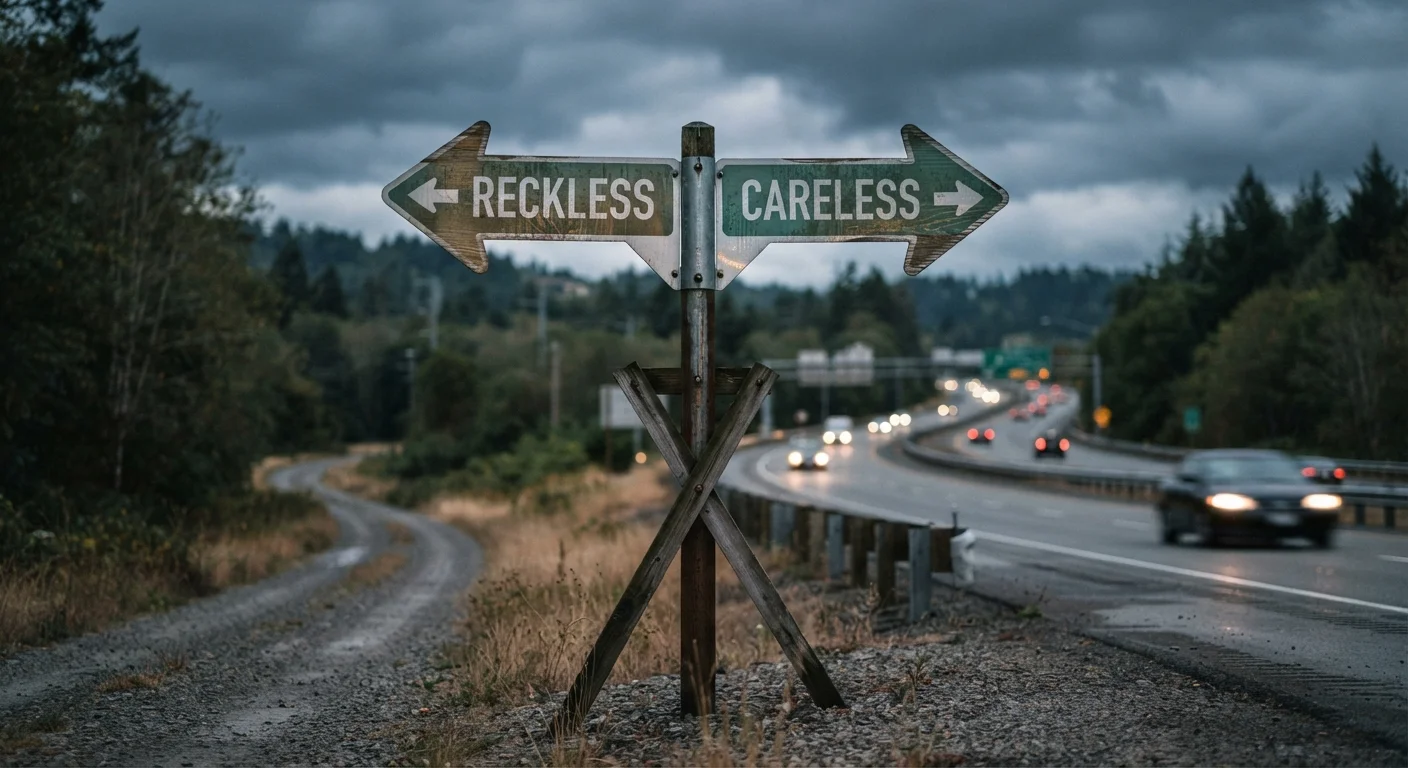
To most drivers, reckless and careless sound interchangeable - both describe bad driving. But under US law, the two terms occupy very different legal categories, and confusing them can lead to serious misunderstandings about what a citation actually means.
The core distinction comes down to mental state, or what lawyers call mens rea. Reckless driving typically requires that the driver knew their behavior posed a significant risk to others and chose to proceed anyway. Careless driving, by contrast, generally requires only that the driver failed to exercise reasonable care - there is no need to prove awareness of the risk.
This difference shapes how each violation is prosecuted, what penalties apply, and how the charge appears on a driving record. As common driving myths about traffic law demonstrate, many drivers underestimate how quickly a moving violation can escalate in legal seriousness.
| Criterion | Reckless Driving | Careless Driving |
|---|---|---|
| Legal category | Criminal offense (typically misdemeanor) | Civil traffic infraction |
| Mental state required | Willful or wanton disregard of risk | Failure to exercise reasonable care |
| Typical penalties | Fines, jail time, license suspension | Fines, driving record points |
| Criminal record impact | Yes - creates criminal record | No - civil infraction only |
| Insurance impact | Significant premium increase or non-renewal | Moderate premium increase |
| Common triggers | Extreme speeding, racing, aggressive weaving | Distraction, tailgating, minor lane errors |
Reckless Driving: A Criminal Standard
Most states define reckless driving as operating a vehicle willfully or wantonly with disregard for the safety of people or property. That standard - willful or wanton - is what elevates this from a traffic ticket to a criminal offense in the majority of jurisdictions.
In practice, reckless driving charges often arise from:
- Excessive speeding (commonly 20-25 mph or more over the posted limit, though thresholds vary by state)
- Street racing or drag racing on public roads
- Aggressive weaving through heavy traffic
- Running red lights or stop signs at high speed
Because reckless driving is frequently classified as a misdemeanor, convictions can mean jail time (often up to 90 days or more), substantial fines, license suspension, and a permanent criminal record entry. The severity scales up if the conduct resulted in injury or property damage.
~40%
Of US traffic fatalities linked to speeding
The National Highway Traffic Safety Administration has consistently reported that speeding is a factor in roughly 40% of annual US traffic deaths, a key reason extreme-speed behavior crosses into reckless driving territory.
50 states
Each with its own reckless driving statute
There is no uniform federal reckless driving law - definitions, thresholds, and penalty ranges are set independently by each state legislature.
Reckless driving charges in construction zones often carry enhanced penalties - a point worth noting given that construction zone rules already impose stricter traffic law standards.
Careless Driving: A Negligence Standard
Careless driving is the law's way of addressing the vast middle ground between perfect driving and deliberate recklessness. Most state statutes define it as driving without the care and attention that a reasonable, prudent person would exercise under similar circumstances.
No conscious disregard is required - the driver may simply have been distracted, failed to check mirrors before changing lanes, or misjudged a gap in traffic. This is why careless driving is typically a civil traffic infraction rather than a criminal charge. Penalties usually include fines and points on a driving record, but not jail time.
That said, careless driving is still a moving violation. Points accumulate on your license, and insurers routinely review driving records at renewal. Even a citation that feels minor can affect your premiums. For context, failure to yield violations follow a similar pattern - modest fines on paper, but meaningful record consequences over time.
Low-speed maneuvers like reversing are a common source of careless driving citations. Backing up safely is a skill many drivers underestimate, and errors in parking lots or driveways can meet the careless driving threshold in some states.
Why State Variation Matters
There is no single federal definition for either charge - each state sets its own statutes, and the terminology, thresholds, and penalties differ considerably. A handful of states use different labels altogether, such as negligent driving or hazardous driving. Some states have tiered reckless driving classifications with different penalty levels depending on speed or outcome.
Check Your State's Exact Statute
Because state definitions vary, the same driving behavior could result in a reckless driving charge in one state and only a careless driving citation in another. Some states set explicit speed thresholds (e.g., 20 mph over the limit) that automatically trigger reckless driving charges, while others leave the determination to officer discretion. Always verify the statute that applies in the state where the incident occurred.
This variation means a driver moving between states cannot assume what applied in one jurisdiction will apply in another. If you receive either type of citation, the most reliable course of action is to review your specific state's motor vehicle statutes - or consult a licensed traffic attorney familiar with local law.
Understanding impairment-related charges follows a similar principle. The legal treatment of drowsy vs. drunk driving also varies by state, underscoring how much jurisdiction shapes traffic law outcomes.
This article provides general legal information for educational purposes only and is not legal advice. Traffic laws vary by state, and specific situations may involve facts that change the analysis. Consult a licensed attorney in your state for guidance on your individual circumstances.