

Key Takeaways
- Regulatory speed limit signs are backed by law - exceeding them can result in a traffic citation.
- Advisory speed signs are recommendations, not legal maximums, but ignoring them can still be used as evidence of negligence.
- Variable speed limit signs are regulatory signs whose displayed number changes based on conditions or time of day.
- Yellow sign color almost always signals an advisory or warning, while white rectangular signs indicate a regulatory requirement.
- Driving safely in hazardous conditions may require speeds well below any posted limit.
Option A
Regulatory Speed Limit Signs
The legally enforceable maximum speed set by law.
Best for: Establishing the hard legal ceiling that drivers must not exceed under normal conditions on that road.
Option B
Advisory Speed Signs
A recommended safe speed for a specific hazard or road feature.
Best for: Warning drivers of a curve, ramp, or intersection where the regulatory limit may be unsafe to maintain.
If you want to know whether you can legally be ticketed
Regulatory Speed Limit Signs
Only regulatory signs establish the enforceable legal maximum. Exceeding the number on a white rectangular speed limit sign is what traffic officers cite.
If you're navigating a sharp curve, ramp, or merge
Advisory Speed Signs
These yellow signs reflect engineering studies on safe negotiation of a specific hazard - treating them as merely optional can lead to loss of control.
If you're driving on an active highway with variable signs
Regulatory Speed Limit Signs
Variable speed limit signs are regulatory, not advisory. The currently displayed number is the legal limit and changes in real time.
The Core Distinction: Legal Force vs. Engineering Recommendation
When US drivers see a speed number on a sign, most assume it means the same thing every time. It doesn't. Two fundamentally different categories of speed signs exist on American roads, and confusing them - or dismissing either - carries real consequences.
Regulatory speed limit signs are white, rectangular, and carry the force of law. They are established through a formal legal process by state or local authorities and set the maximum speed a driver may travel on that road segment under normal conditions. Exceeding this number is a statutory violation, subject to fines, points on a license, and increased insurance exposure.
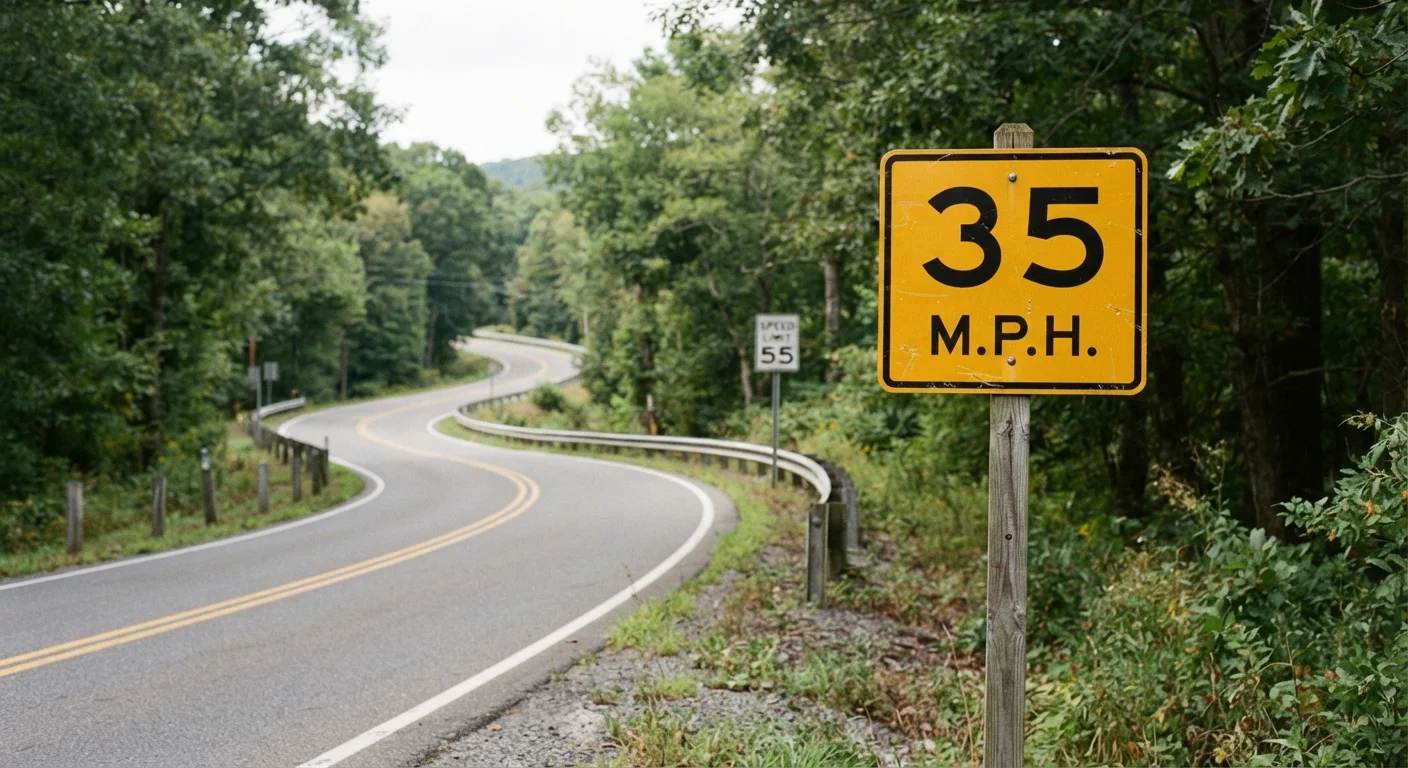
Advisory speed signs are yellow, typically diamond-shaped or rectangular, and appear alongside a specific road feature - a curve, a freeway on-ramp, an intersection, or a steep grade. They communicate the speed at which engineers determined most vehicles can safely navigate that feature. They are not a legal maximum. However, ignoring them is not consequence-free: if a driver exceeds an advisory speed and crashes, that sign's recommendation can be entered as evidence in a negligence determination.
Sign color is one of the fastest ways to distinguish sign type - yellow reliably signals a warning or advisory function, while white signals a regulatory requirement.
| Criterion | Regulatory Speed Limit Signs | Advisory Speed Signs |
|---|---|---|
| Sign color | White | Yellow |
| Sign shape | Rectangular | Diamond or rectangular |
| Legal force | Yes - enforceable by law | No - a recommendation |
| Can result in citation? | Yes, if exceeded | Not directly, but relevant to negligence |
| Set by | State or local government process | Traffic engineering study |
| Applies to | Entire road segment | Specific feature (curve, ramp, etc.) |
| Changes dynamically? | Only on variable-limit signs | No - fixed at installation |
Variable Speed Limits: When the Number Changes
A third category that trips up many drivers is the variable speed limit (VSL) sign. These electronic overhead signs, common on managed freeways in states such as Washington, Oregon, Virginia, and New Jersey, display changing speed numbers based on traffic density, weather, or incidents ahead.
Despite their dynamic appearance, variable speed limit signs are regulatory, not advisory. Whatever number is currently displayed is the legal limit for that moment and that stretch of road. Authorities can and do enforce them. Some VSL systems drop limits during heavy rain or fog precisely to reduce crash severity - a reminder that the posted number and actual safe speed are related but not always identical.
Variable Speed Limits Are Still the Law
Some drivers assume that because a variable speed limit sign is electronic and changing, it must be advisory. It is not. Most VSL deployments in the US are established under the same regulatory authority as static signs. Enforcement cameras are sometimes co-located with VSL gantries, making violations both ticketable and documented.
For deeper guidance on adapting your speed to changing road and weather conditions, see how to drive safely in rain, snow, ice, and fog.
Common Misconceptions Drivers Hold
Several durable myths surround speed signs in the US. One of the most persistent is that advisory speeds are irrelevant suggestions drivers can freely disregard. In practice, insurance adjusters and courts treat advisory signage as evidence of reasonable care - or its absence.
Another misconception is that the regulatory limit defines a safe speed in all conditions. The law in most states includes a basic speed law principle: a driver can be cited for traveling at an unsafe speed even if they're under the posted limit, particularly in adverse weather, heavy traffic, or reduced visibility. Several widely held driving beliefs can create legal and safety exposure beyond what most drivers expect.
School zones illustrate another layer of complexity. Reduced speed limits in school zones are regulatory - but their hours of enforcement vary significantly by state. School zone speed rules differ considerably across US states, and assuming uniformity is a common mistake.
~37%
Fatal crashes involving speeding
The National Highway Traffic Safety Administration (NHTSA) has reported that speeding is a contributing factor in roughly a third or more of all traffic fatalities in the US annually.
50+
US jurisdictions with variable speed limits
According to the Federal Highway Administration, dozens of US states and localities have deployed variable speed limit systems on freeways and expressways.