

Key Takeaways
- Crash risk is highest during the first 6-12 months after a teen receives a full license.
- Inexperience - not immaturity alone - is the primary driver of elevated crash rates.
- Specific high-risk conditions include night driving, carrying passengers, and highway merging.
- Graduated Driver Licensing (GDL) laws reduce teen fatalities by limiting exposure to the riskiest conditions.
- Supervised practice hours before licensure meaningfully improve a new driver's hazard recognition.
Novice Driver Crash Risk
New drivers - especially teenagers - face a significantly higher likelihood of being involved in a crash during their first year of independent driving than at any later point in their driving lives. This elevated risk isn't primarily about recklessness; it's rooted in the gap between basic vehicle control and the complex, automatic hazard recognition that builds only with experience. Research consistently shows this risk drops sharply after the first 6 to 12 months behind the wheel.
Traffic safety researchers distinguish between "licensure risk" (crash rate per licensed driver) and "exposure risk" (crash rate per mile driven). Teen crash rates are disproportionately high on both measures.
The Data Behind the Risk
The numbers on teen driver crashes are stark but well understood. According to the Centers for Disease Control and Prevention (CDC), motor vehicle crashes are a leading cause of death for teenagers in the United States. The IIHS reports that per mile driven, fatal crash rates for 16- and 17-year-old drivers are roughly three times higher than those for drivers aged 20 and older.
Critically, the risk is not spread evenly across all teen drivers at all times. It is sharply concentrated in the first months after licensure - before meaningful experience accumulates - and in specific high-risk conditions: after dark, on unfamiliar roads, and with peer passengers in the vehicle.
3x
Higher fatal crash rate vs. drivers 20+
Per mile driven, 16-17-year-old drivers have roughly three times the fatal crash rate of drivers aged 20 and older, according to IIHS data.
~50%
Crash risk reduction after first year
Traffic safety research indicates crash rates for new drivers drop substantially - often by half or more - after the first 12 months of independent driving.
40-65 hrs
Supervised practice hours required by most states
Most US state GDL programs mandate between 40 and 65 hours of supervised practice before an unrestricted license is issued.
Experience, Not Just Age
A common assumption is that teen crashes result mainly from adolescent risk-taking or impulsivity. While those factors play a role, traffic safety research points to something more fundamental: the gap between vehicle control skills and genuine hazard perception.
Passing a driving test demonstrates that a new driver can execute basic maneuvers. What it cannot confirm is whether that driver can read the road - spotting a gap in traffic closing faster than it appears, recognizing when a pedestrian is about to step off the curb, or anticipating how a wet surface will change braking distance. These skills develop through thousands of miles of varied, real-world driving. Experienced drivers scan the road very differently than beginners, and that gap is measurable.
“The largest reductions in crash risk come not from more rules but from more miles driven in varied, supervised conditions before full licensure.”
— Anne McCartt, Senior Vice President for Research, Insurance Institute for Highway Safety (paraphrased from published IIHS research)
High-Risk Conditions New Drivers Face
Research identifies several conditions that amplify crash risk for novice drivers disproportionately:
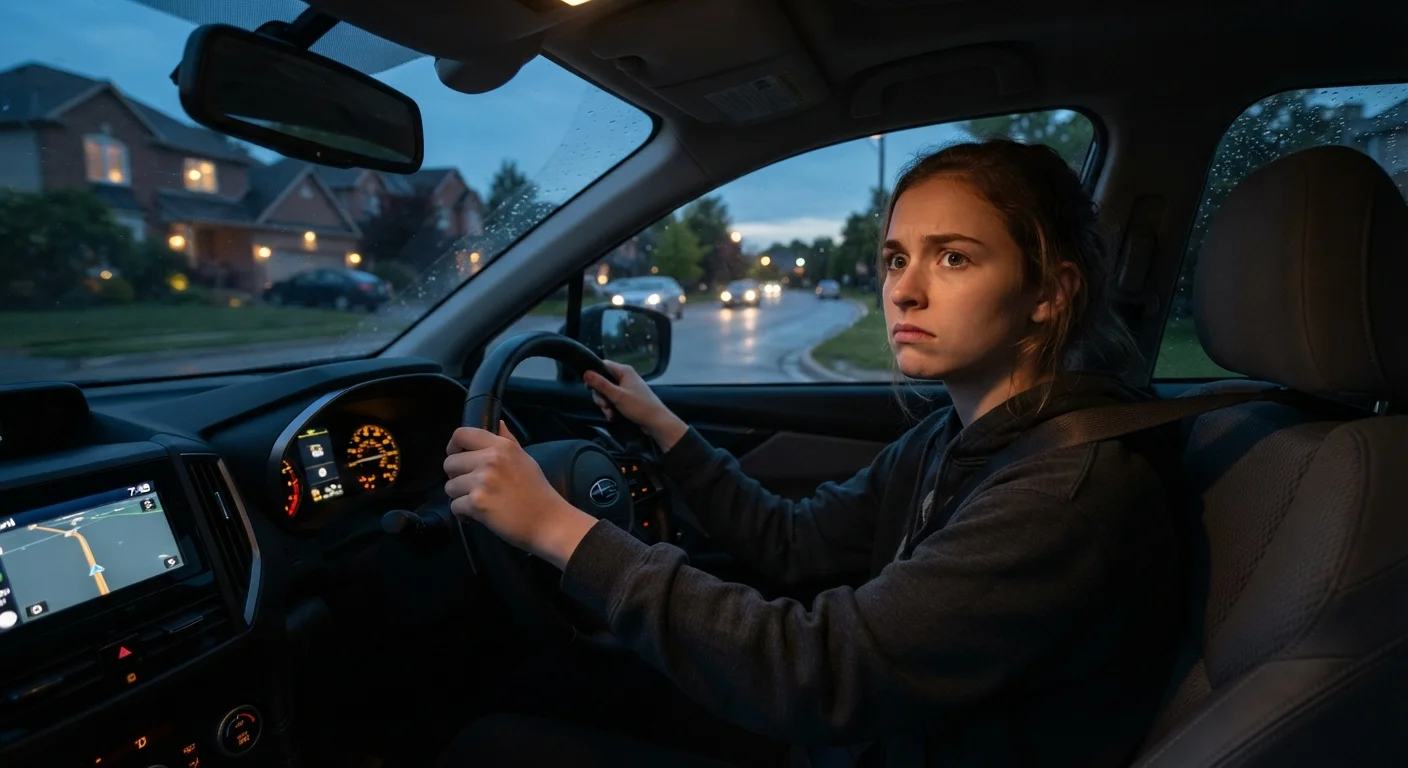
- Night driving: Reduced visibility demands faster hazard identification. New drivers haven't yet developed the scanning habits that compensate for lower light. Adjusting driving habits after dark is a learnable skill, but it requires deliberate attention.
- Peer passengers: Each additional teen passenger statistically increases crash risk. Social demands compete directly with cognitive demands at exactly the wrong moments.
- High-speed roads: Merging onto a highway requires split-second speed and distance judgment. First-time interstate driving is one of the most cognitively demanding tasks for a new driver.
- Low-speed maneuvering: Despite the slower speeds involved, reversing and parking account for a significant share of novice-driver incidents. Backing up safely involves spatial judgment many drivers underestimate.
Build Experience Before Expanding Privileges
Even where GDL restrictions have expired, new drivers benefit from voluntarily limiting nighttime driving and passengers until they have accumulated substantial independent mileage. Seeking out deliberate practice in unfamiliar conditions - rain, highways, parking structures - accelerates the development of real-world hazard perception faster than routine trips alone.
How Graduated Licensing Addresses These Patterns
The Graduated Driver Licensing (GDL) system, now in place across all 50 states in some form, was designed specifically around the data on novice crash risk. Rather than granting full driving privileges immediately, GDL introduces new drivers to complex conditions incrementally - starting with supervised daytime driving and expanding privileges as experience builds.
Understanding how the GDL system works is useful context for both new drivers and the parents or guardians supporting them. States with stronger GDL provisions - including nighttime restrictions and passenger limits - consistently show lower fatal crash rates among 16- and 17-year-olds compared to states with weaker programs.
The underlying logic aligns with the research: limit exposure to the highest-risk conditions until experience has had time to reduce vulnerability. No licensing system eliminates novice risk entirely, but structured exposure meaningfully compresses the steepest part of the learning curve.
This article provides general educational information about teen driver crash risk. It is not a substitute for formal driver education, professional instruction, or guidance from state licensing authorities.