

Key Takeaways
- Most apartment and condo residents cannot install EV chargers without landlord or HOA approval.
- Several states have enacted 'right to charge' laws that limit how much landlords or HOAs can restrict EV charging.
- Level 2 charging (240V) in a designated parking space is the practical gold standard for overnight home charging in MUDs.
- Cost allocation - who pays for electricity used - is one of the most common sticking points in MUD charging negotiations.
- Public charging networks serve as a meaningful backup for MUD residents who lack reliable home charging access.
- Proactive communication with building management and documented requests tend to produce better outcomes than unilateral action.
Multi-Unit Dwelling EV Charging
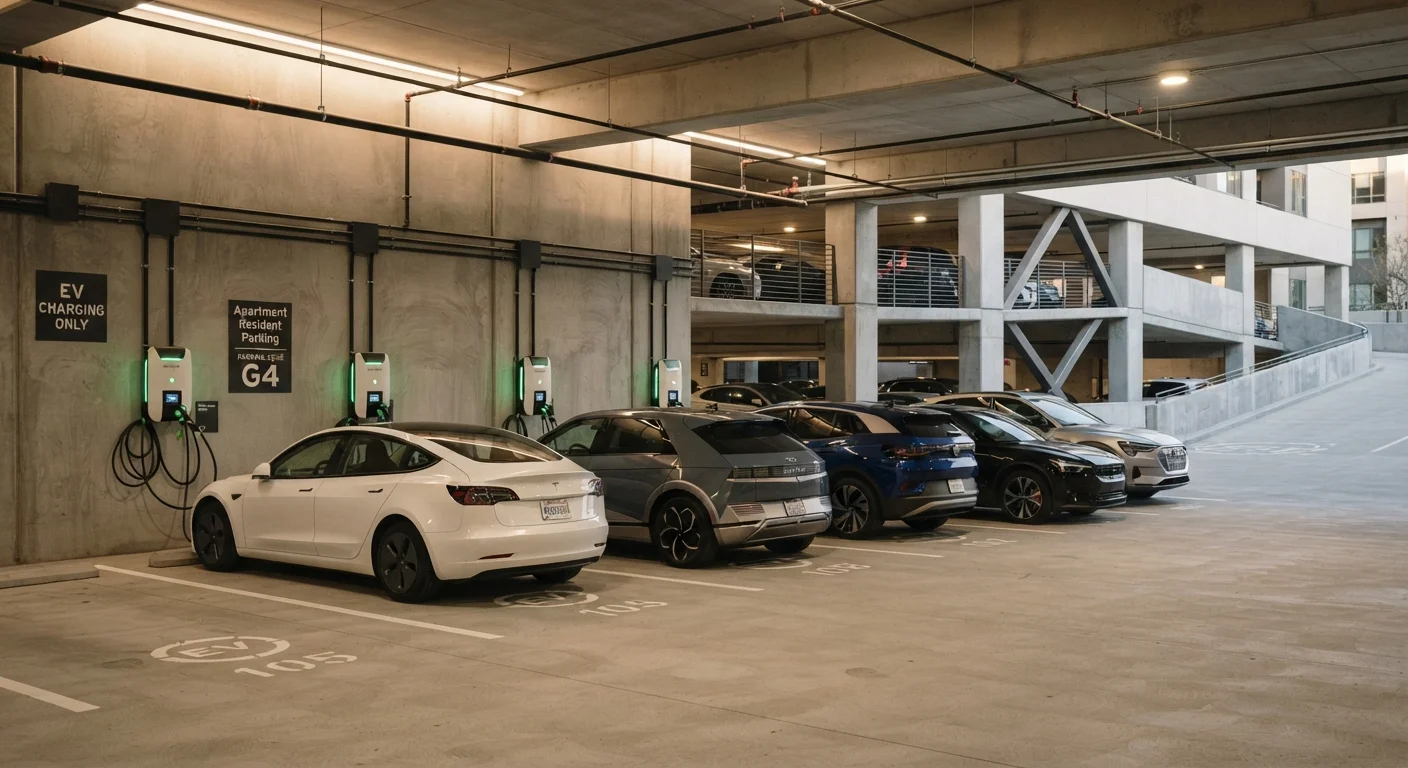
Multi-unit dwelling (MUD) EV charging refers to the process of installing and accessing electric vehicle charging infrastructure in apartments, condominiums, and townhouse communities where residents share common areas, parking, and electrical systems. Unlike homeowners with private garages, MUD residents must navigate shared infrastructure, landlord or HOA approval, and cost-allocation questions. The practical and legal landscape varies widely by state and building type.
In electrical terms, MUD charging often requires load management systems or smart charging hardware to prevent overwhelming a building's shared electrical panel capacity - a concern that single-family home installations rarely face at the same scale.
Why Multi-Unit Living Complicates EV Ownership
For the roughly one-third of American households that rent or live in condominiums, electric vehicle ownership introduces a complication that detached-home owners rarely face: where and how to charge. The conventional advice - install a Level 2 charger in your garage - simply doesn't apply when parking is shared, electrical panels serve entire buildings, and any modification requires layers of approval.
The challenge is structural. Apartment and condo buildings were not designed with per-unit EV charging in mind. Electrical capacity may be limited, parking spaces are often unassigned or shared, and the question of who owns the charging infrastructure - and who pays for the electricity - has no obvious default answer.
Understanding the full day-to-day reality of EV ownership, including how charging habits differ from fueling a gas vehicle, is a useful starting point. Electric vehicle ownership works differently from gas cars in ways that matter especially for MUD residents.
~35%
US households that are renters
According to US Census Bureau data, approximately one-third of American households rent their homes, representing tens of millions of residents who lack control over their property's electrical infrastructure.
30+
States with some form of right-to-charge protection
As of recent legislative sessions, more than 30 US states have enacted statutes or regulations addressing EV charging access in multi-unit or HOA-governed housing, though scope and strength vary widely.
3-5x
Speed advantage of Level 2 over Level 1 charging
A Level 2 (240V) charger typically adds 20-30 miles of range per hour, compared to roughly 4-5 miles per hour for a standard 120V Level 1 outlet, making the voltage choice critical for overnight charging adequacy.
The Legal Landscape: Right to Charge Laws
One of the most consequential developments for apartment and condo EV owners has been the emergence of state-level right to charge legislation. California pioneered this approach, and a number of other states - including Florida, Colorado, Hawaii, and Virginia - have enacted similar statutes. These laws generally prohibit landlords and HOAs from unreasonably denying a resident's request to install EV charging equipment, provided the resident agrees to cover installation costs, carry appropriate insurance, and restore the space upon move-out.
The details matter enormously. Some laws apply only to HOA-governed condos, not rental apartments. Others set caps on what landlords can require as conditions of approval. None create an unconditional right: landlords can still impose reasonable conditions, require licensed electricians, and specify approved equipment types.
State Laws Vary Significantly
Right-to-charge protections are not uniform across the US. Some state laws apply only to condominiums governed by HOAs and do not cover rental apartments. Others cover both but impose different procedural requirements. Residents should look up their specific state statute - or consult a tenant rights organization - before assuming any particular protection applies to their situation.
For renters, the practical step is to make any EV charging request in writing, reference applicable state law by name, and document all communications. Building managers who are unfamiliar with right to charge requirements may default to denial until formally informed of their legal obligations.
Charging Options Within the Building
When a building does allow resident-installed or building-managed EV charging, the options typically fall into a few categories:
- Dedicated outlet in assigned parking: A 240V outlet installed near an assigned space allows a resident to use a portable Level 2 charging unit - the most straightforward and often least expensive approach for a single resident.
- Hardwired Level 2 station: A permanently mounted EVSE (electric vehicle supply equipment) unit provides faster, more reliable charging and is generally preferred for daily use. Understanding panel capacity and outlet types is essential before any installation.
- Shared building charging stations: Some properties install a bank of networked Level 2 stations available to all residents on a reservation or first-come basis. Networked stations can track individual usage and bill accordingly, solving the cost-allocation problem.
- Level 1 access: In limited cases, a standard 120V outlet near a parking space can provide overnight trickle charging sufficient for drivers who cover modest daily distances - typically under 30 miles per day.
Cost allocation is consistently the most contested element of any MUD charging arrangement. A networked charging station with per-session billing, or a dedicated sub-meter tied to an individual unit, removes ambiguity and prevents disputes over shared utility bills. For a detailed breakdown of what charging actually costs, see how home and public charging costs compare.
Document Everything Before Installation
Before any EV charging equipment is installed in a shared building, get written approval from the landlord or HOA specifying what equipment is permitted, who is responsible for maintenance, how electricity costs will be allocated, and what restoration is expected upon move-out. A verbal agreement is difficult to enforce and can create costly disputes later. Consider having any agreement reviewed by a local attorney familiar with tenant or HOA law.
When Home Charging Isn't Available: Public Networks as a Workaround
For MUD residents who cannot secure home charging access - whether due to building restrictions, lease terms, or infrastructure limitations - public charging networks become the primary charging solution rather than a backup. This is a workable arrangement for many drivers, though it requires more deliberate planning than overnight home charging.
DC fast chargers (Level 3) can replenish a significant portion of most EV batteries in 20-45 minutes, making them practical for weekly charging stops rather than daily use. Level 2 public stations at workplaces, retail centers, and parking garages can supplement range during normal daily activity. Navigating public charging networks across the US covers how to locate stations and what to expect.
The key limitation is cost: public charging, particularly DC fast charging, is generally more expensive per kilowatt-hour than home electricity rates. Drivers relying primarily on public charging should factor this into their overall EV cost calculations. The comparison differs meaningfully from what rural drivers face - rural EV ownership presents its own distinct set of challenges around sparse infrastructure and longer distances.