

Key Takeaways
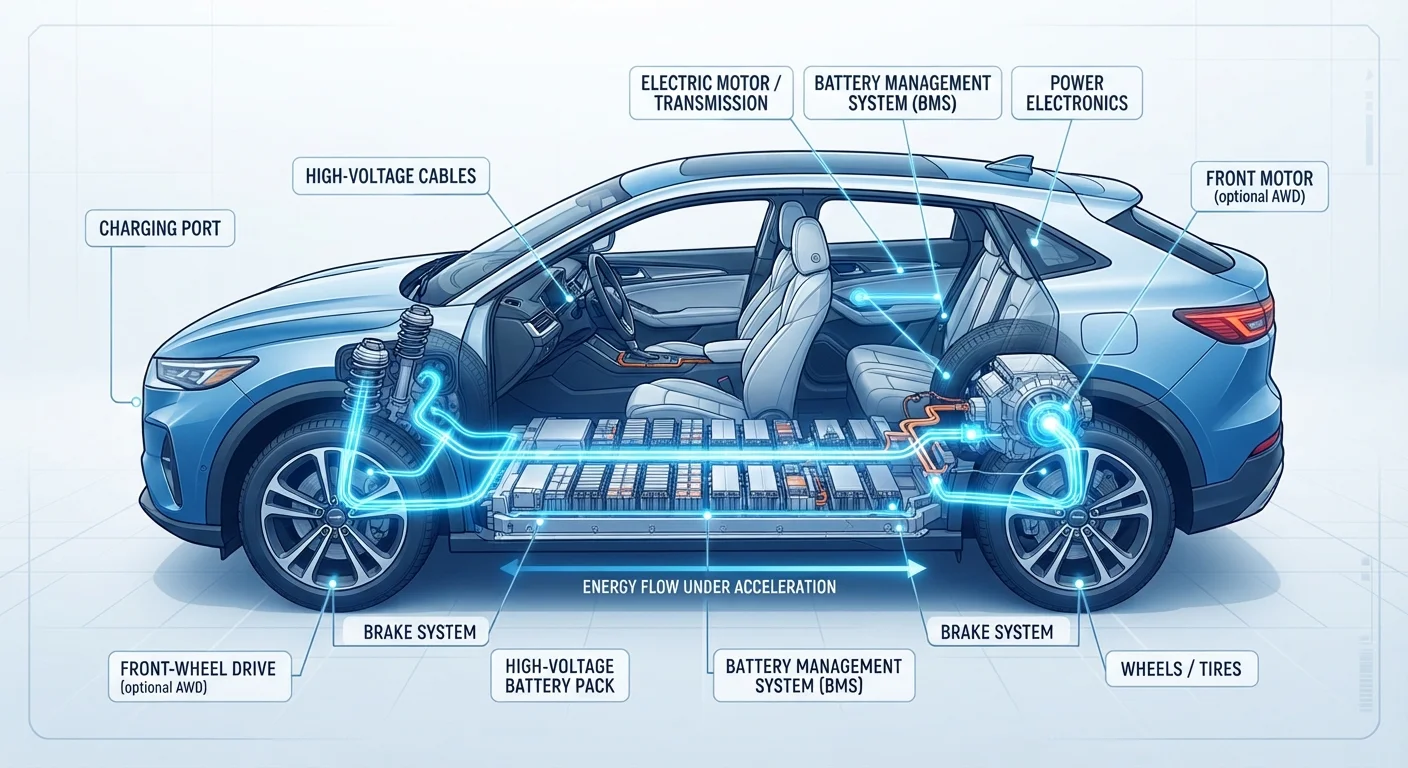
- EVs store energy in large lithium-ion battery packs mounted low in the vehicle floor.
- An inverter converts DC battery power to AC electricity the motor can use.
- Electric motors deliver full torque instantly, which is why EVs accelerate so quickly.
- Regenerative braking recaptures kinetic energy and feeds it back into the battery.
- No multi-speed transmission is needed because electric motors produce usable torque across a wide RPM range.
- Fewer moving parts mean fewer components that wear out compared to internal combustion engines.
Electric Vehicle Drivetrain
An electric vehicle (EV) drivetrain is the system that converts stored electrical energy into motion. Instead of burning fuel in an engine, it draws power from a large battery pack, runs it through an electric motor, and turns the wheels. The result is a mechanically simpler system with fewer moving parts than a conventional gas-powered car.
Most modern EVs use AC induction or permanent magnet synchronous motors paired with a single-speed reduction gearbox, eliminating the need for a traditional multi-speed transmission.
The Battery Pack: Foundation of Every EV
Everything in an electric vehicle begins with the battery pack. Unlike the small 12-volt battery that starts a gas engine, an EV's main battery is a large, high-voltage unit - typically ranging from roughly 40 kWh to over 100 kWh of usable capacity depending on the vehicle. It's made up of thousands of individual lithium-ion cells grouped into modules, then housed in a flat, protective enclosure bolted beneath the passenger floor.
Mounting the pack low and flat is intentional: it keeps the center of gravity close to the ground, which improves handling, and distributes weight evenly across the chassis. A battery management system (BMS) - essentially a sophisticated computer - monitors each cell's temperature, voltage, and state of charge in real time, protecting the pack from overheating, overcharging, or deep discharge, all of which accelerate degradation.
8 yrs / 100K mi
Federal minimum EV battery warranty
U.S. federal regulations require automakers to warranty EV traction batteries for at least 8 years or 100,000 miles, whichever comes first.
~90%
Typical EV drivetrain efficiency
Electric drivetrains convert roughly 85-90% of stored electrical energy into motion, compared to roughly 20-40% for typical internal combustion engines, according to the U.S. Department of Energy.
0 RPM
Motor speed at peak torque delivery
Unlike combustion engines that must rev to reach peak torque, electric motors produce maximum torque from a standstill, enabling immediate acceleration response.
From Battery to Motor: The Inverter's Role
Battery packs store electricity as direct current (DC) - electrons flowing in one direction. But most EV motors run on alternating current (AC), where the flow reverses rapidly. Bridging those two worlds is the inverter.
The inverter is a power electronics unit that converts DC from the battery into precisely controlled AC electricity for the motor. Critically, it also regulates how much power reaches the motor at any moment. When you press the accelerator, the inverter responds in milliseconds, adjusting the current to increase torque. Release the pedal, and the inverter begins managing the regenerative braking cycle. It's one of the most technically demanding components in the drivetrain - and a major area of engineering focus across the industry.
DC Fast Charging Bypasses the Onboard Charger
When using a DC fast charger, high-voltage DC electricity is delivered directly to the battery pack, bypassing the vehicle's onboard AC-to-DC converter. This is why DC fast chargers can replenish a battery far more quickly than Level 2 AC chargers - the speed bottleneck shifts from the charger to the battery's own acceptance rate, managed by the BMS.
The Electric Motor: Instant Torque, No Warm-Up Needed
The electric motor converts electrical energy into rotational force, or torque. Unlike a gasoline engine - which must rev up through its powerband to reach peak torque - an electric motor delivers maximum torque from a near-standstill. That's the physics behind the brisk acceleration that surprises many first-time EV riders.
Two motor types dominate modern EVs. AC induction motors generate a rotating magnetic field in the stator that induces current in the rotor, producing motion. Permanent magnet synchronous motors (PMSMs) embed magnets in the rotor and are generally more efficient at the moderate speeds typical of everyday driving. Many performance-oriented EVs use a combination - one motor per axle - to achieve all-wheel drive without a mechanical driveshaft connecting front and rear.
Because usable torque spans such a wide range of motor speeds, a single fixed-ratio reduction gear is all that's needed to connect the motor to the wheels. There is no clutch, no gear shifting, and no torque converter. For a deeper look at how this changes ownership, see how EV maintenance compares to gas cars.
Regenerative Braking: Turning Slowdowns Into Stored Energy
One of the most distinctive features of an EV drivetrain is regenerative braking. When the driver decelerates, the electric motor reverses its role and operates as a generator. The spinning wheels drive the motor rather than the other way around, creating electrical resistance that slows the vehicle while simultaneously producing electricity that flows back into the battery.
Drivers can often adjust how aggressively this happens. At the strongest setting - sometimes called one-pedal driving - lifting off the accelerator brings the car to a near-complete stop without touching the brake pedal. Because friction brakes are used less frequently, brake pads and rotors on EVs tend to last considerably longer than on comparable gas vehicles.
Maximize Range With Regenerative Braking
Setting your EV to its strongest regenerative braking mode - especially in city driving - can noticeably extend your range on a single charge. Anticipate stops and lift off the accelerator early rather than coasting and then braking hard. Over a full commute, this habit makes a measurable difference.
For a complete picture of what changes - and what disappears - when you switch from a combustion vehicle, day-to-day EV ownership covers charging habits, cost structures, and real-world expectations.
Why the Whole System Works Together
The battery, inverter, and motor form a tightly integrated loop that a vehicle's central control software manages continuously. This software balances competing priorities: maximizing range, protecting battery health, maintaining safe operating temperatures, and responding to driver inputs - all simultaneously.
The practical result for drivers is a smoother, quieter, and more responsive experience than most combustion vehicles can match. There's no engine idle, no transmission hesitation, and no warm-up period. If you're still building familiarity with EV terminology, the EV glossary is a useful reference. And if you're considering making the switch, what first-time EV buyers need to know is a practical starting point.