

Key Takeaways
- ADAS features assist drivers; they do not replace the need for human attention and control.
- Marketing names like 'Autopilot' or 'ProPilot' are branding - not technical capability descriptions.
- Core ADAS features include adaptive cruise control, lane centering, and automatic emergency braking.
- Sensor limitations mean these systems can fail in rain, snow, or unusual road markings.
- Understanding what your vehicle's ADAS can and cannot do is a genuine safety responsibility.
ADAS (Advanced Driver Assistance Systems)
ADAS is the umbrella term for electronic safety and convenience features that help drivers control a vehicle. These systems use cameras, radar, and ultrasonic sensors to monitor the road and can automatically steer, brake, or accelerate under specific conditions. Despite marketing names that sound fully autonomous, all current ADAS technology still requires the driver to stay engaged and in control.
Most vehicles on US roads today operate at SAE Level 1 or Level 2 automation - meaning the car can handle one or two driving tasks simultaneously, but a human must supervise and remain ready to take over at any moment.
What the Marketing Names Actually Mean
Walk into any EV showroom or browse a manufacturer's website and you'll encounter names like "Autopilot," "Super Cruise," "ProPilot Assist," or "BlueCruise." These names suggest a level of independence that the underlying technology does not fully deliver. Each is a branded suite of ADAS features - not a self-driving system. Understanding the gap between the brand name and actual capability is the starting point for safe use.
The industry uses a six-level scale developed by SAE International to classify automation. Level 0 means no automation. Level 5 means full autonomy in all conditions. Nearly every consumer vehicle sold today sits at Level 1 or Level 2. For a deeper breakdown of what each rung on that scale means in practice, see our article on how autonomous vehicle technology progresses through levels.
"Semi-Autonomous" Is Not an Industry Standard Term
You'll see "semi-autonomous" used widely in media and marketing, but it is not part of SAE International's official classification framework. The formal terms are Level 1 through Level 5 automation. "Semi-autonomous" is a loose shorthand that often generates more confusion than clarity - particularly when applied to systems that still require full driver attention at all times.
The Core Features Decoded
Most ADAS suites combine several distinct systems. Here is what each one actually does:
- Adaptive Cruise Control (ACC): Maintains a set speed and automatically adjusts it to keep a safe following distance from the vehicle ahead. Radar or cameras track the lead car; the system decelerates and reaccelerates without driver pedal input.
- Lane Centering Assist (LCA): Applies gentle steering corrections to keep the vehicle positioned in the middle of a detected lane. It works using forward cameras that track lane markings. If markings fade or are obscured, the system typically disengages.
- Automatic Emergency Braking (AEB): Monitors the road ahead and applies the brakes - or supplements driver braking - when an imminent collision is detected. The National Highway Traffic Safety Administration (NHTSA) has moved toward requiring AEB on new passenger vehicles as a standard feature.
- Blind Spot Monitoring: Uses rear-facing radar to detect vehicles in adjacent lanes and alerts the driver, usually through a light in the mirror housing.
- Lane Departure Warning (LDW): Alerts the driver - often through steering vibration or an audible chime - when the vehicle begins to drift across a lane marking without a turn signal active.
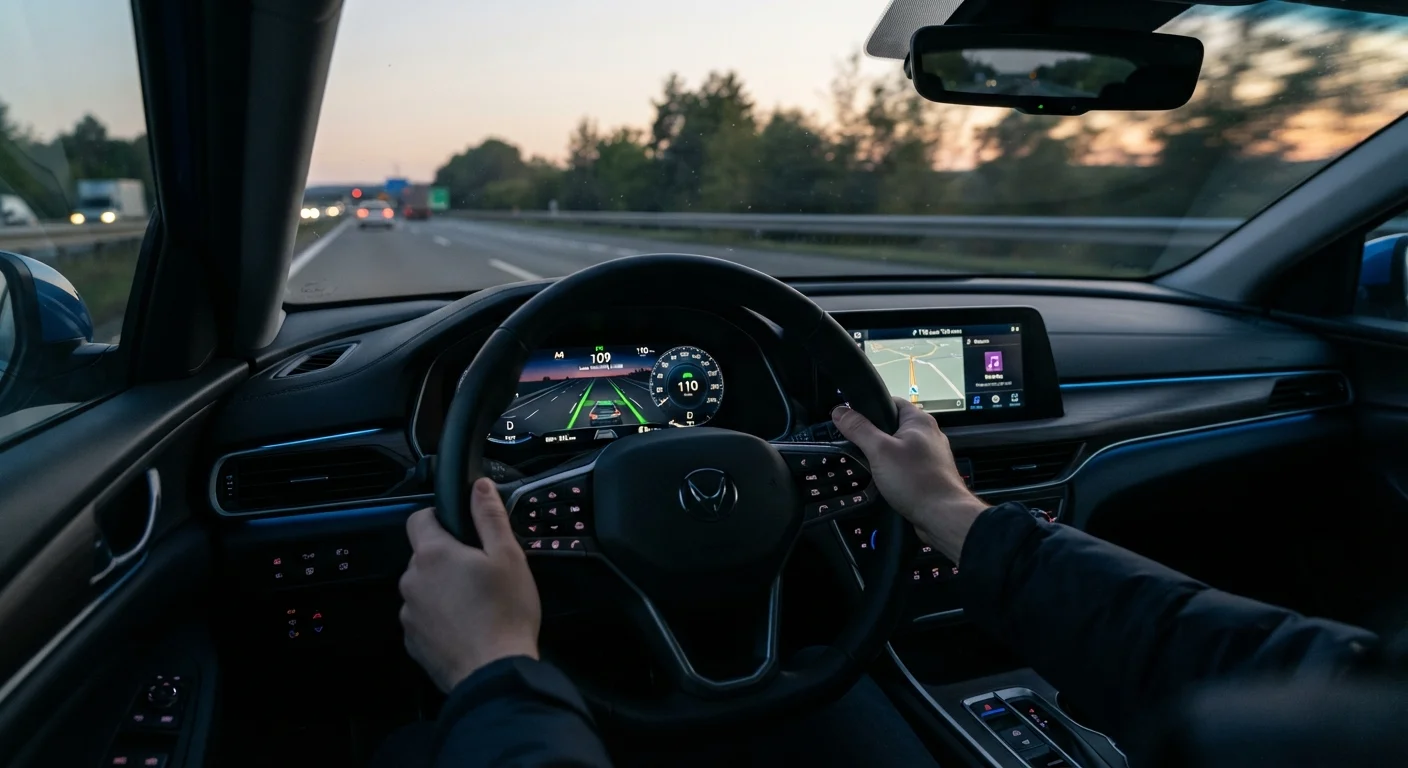
When ACC and LCA operate together, the combined system is typically marketed as a highway driving assist. It handles speed and steering simultaneously but is still classified as Level 2: both hands should remain available to take over instantly.
Level 2
SAE automation level of most new ADAS-equipped vehicles
SAE International's classification system places the vast majority of consumer vehicles with driver assistance at Level 2, requiring constant human supervision.
~360°
Coverage achieved by combined radar, camera, and ultrasonic arrays
Modern ADAS sensor suites aim for full perimeter coverage, though sensor performance varies significantly based on weather, speed, and object type.
2029
NHTSA AEB standard mandate effective date (proposed)
NHTSA has proposed rules that would require automatic emergency braking as standard equipment on virtually all new passenger vehicles - a major shift in baseline safety requirements.
Why EVs Often Have More Advanced Implementations
Electric vehicles tend to offer more sophisticated ADAS implementations for several practical reasons. Their high-voltage architecture supports energy-intensive sensor arrays and onboard processors. Many EV platforms were designed from the ground up with large computing modules in mind, rather than retrofitting electronics into legacy engine compartments.
EVs also benefit from regenerative braking integration with ADAS systems. Adaptive cruise control can use regenerative deceleration - recovering energy while slowing down - rather than purely relying on friction brakes. This makes the system smoother and extends range. For more on how that energy recovery works, see our explainer on regenerative braking.
Additionally, over-the-air (OTA) software updates allow EV manufacturers to refine ADAS behavior without a dealer visit - adjusting braking sensitivity, expanding feature availability, or patching sensor fusion algorithms. This means the system a driver buys today may perform differently - and potentially better - months later.
The Real Limits You Need to Know
ADAS systems share a fundamental constraint: they perceive the world through sensors, and sensors have hard limits. Camera-based systems can struggle with low-contrast lane markings, sun glare, and precipitation. Radar is more weather-resilient but can be blocked by snow or ice accumulation on bumpers where sensors sit. Construction zones with temporary markings or absent lines are a well-documented challenge for lane centering systems.
Driver monitoring is one response to misuse concerns. Many current systems use interior cameras or steering-torque sensors to confirm the driver's hands are on the wheel. If attention lapses, the system escalates alerts and may disengage. This is a recognition that relying too heavily on ADAS without understanding its scope creates risk rather than eliminating it.
ADAS features work alongside - not instead of - active driving awareness. Principles of scanning ahead, managing space, and anticipating hazards remain as relevant as ever. Our article on how defensive driving actually works covers those foundational habits in detail.
Read Your Owner's Manual Before Relying on ADAS
Every manufacturer implements ADAS features differently. Speed thresholds, sensor placement, and disengagement conditions vary by vehicle. Reading the relevant sections of your owner's manual - or the vehicle's in-car help system - is the most reliable way to understand exactly what your car's systems will and won't do before you depend on them.
For a broader reference on EV-specific terminology that appears alongside ADAS in owner manuals and apps, the EV terminology glossary is a practical companion resource.