

Key Takeaways
- V2G allows EVs to discharge stored electricity back to the power grid, not just absorb it.
- Most EVs on US roads today are not V2G-capable; the technology requires specific hardware support.
- V2G could help stabilize the grid during peak demand periods by drawing on idle EV batteries.
- EV owners may eventually earn credits or payments for participating in V2G programs.
- Battery longevity concerns and regulatory gaps remain active areas of development.
- Several US pilot programs are already testing V2G in real-world conditions.
Vehicle-to-Grid (V2G)
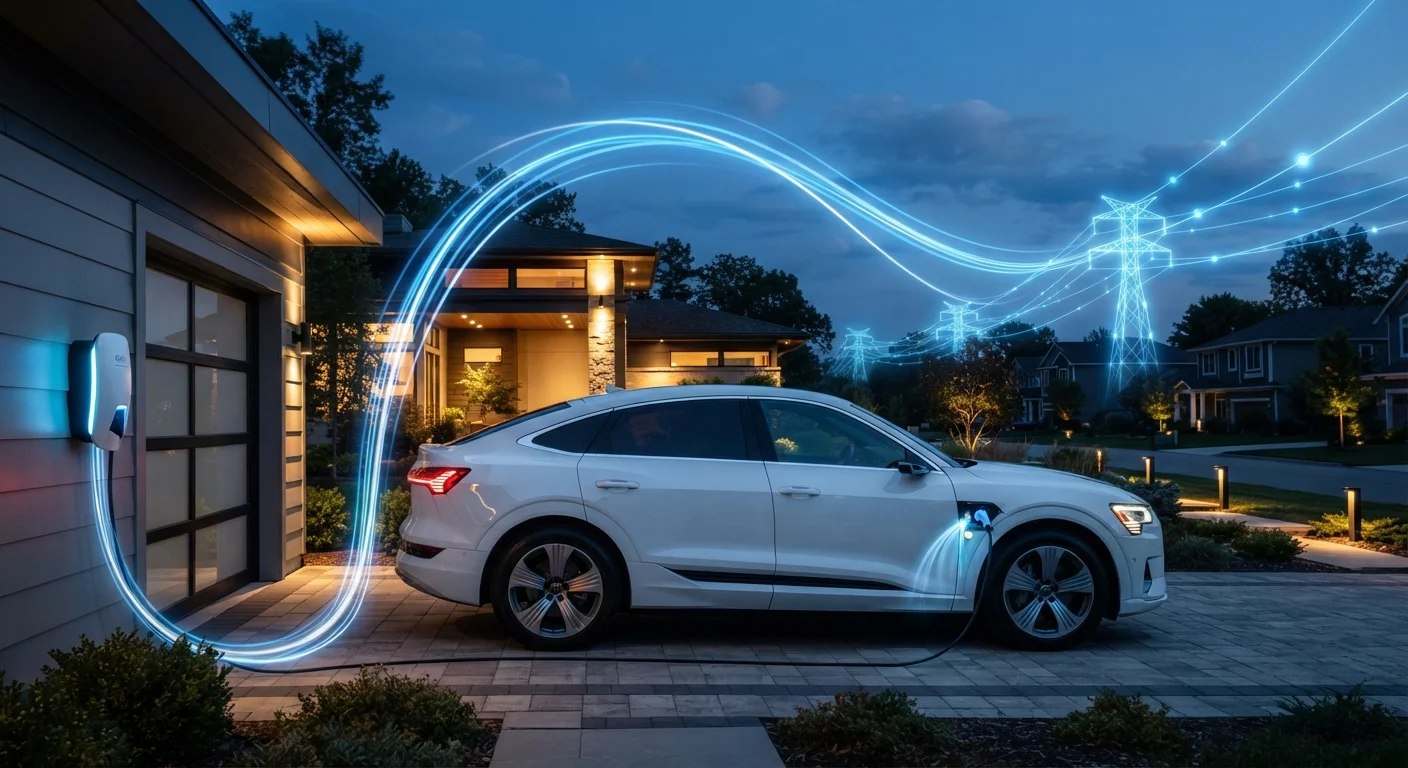
Vehicle-to-grid, or V2G, is a technology that allows an electric vehicle's battery to send stored electricity back to the power grid - not just draw power from it. Instead of functioning purely as a consumer of electricity, a V2G-capable EV can act as a distributed energy resource, releasing power when the grid needs it most. This bidirectional flow is managed through compatible chargers and software that coordinate with grid operators.
V2G relies on bidirectional DC or AC charging hardware and communication protocols (such as ISO 15118) that allow the vehicle, charger, and grid to negotiate energy transfer in real time.
How V2G Actually Works
Standard EV charging is a one-way street: electricity flows from the grid into the vehicle's battery pack. V2G reverses that flow on demand. When the grid signals a need - during a summer heat wave spike in air-conditioning demand, for example - a V2G-enrolled EV can discharge a portion of its stored energy back through a bidirectional charger and into the local grid.
The coordination happens through software and communication protocols that link the vehicle, the charger, and the utility. The system can be programmed to protect a minimum state of charge so the driver always has enough range for their needs. Think of it as the EV quietly acting as a neighborhood battery while it sits parked - which, for most vehicles, is the vast majority of the day.
For a broader look at how EV ownership already differs from conventional driving, see how day-to-day EV ownership compares to gas cars.
~90%
Of the day the average car sits parked
US Department of Transportation data consistently shows personal vehicles are parked the vast majority of hours in a day, making idle battery capacity a significant theoretical resource.
~15-25 kWh
Average US home daily electricity use
The US Energy Information Administration estimates average household consumption at roughly 29 kWh per day, meaning a mid-size EV battery could theoretically supply a meaningful share of daily home needs.
40+
US V2G pilot programs active or completed
Industry tracking by groups including the Rocky Mountain Institute has counted dozens of V2G demonstration projects across North America as of recent years.
Why This Matters for the Power Grid
The US electricity grid was built around predictable, centralized power plants. Renewable energy sources like solar and wind are intermittent - they produce power when the sun shines or wind blows, not necessarily when demand peaks. This mismatch creates a growing management challenge for utilities.
A large fleet of V2G-capable EVs could serve as millions of small, distributed batteries. During low-demand periods - overnight, for example - EVs charge cheaply. During high-demand periods, they discharge stored energy back, smoothing the load curve and reducing the need for expensive peaker plants to fire up. The aggregate potential is significant: researchers estimate that tens of millions of EVs on the road could collectively store and return enormous amounts of energy.
The debate about whether US infrastructure is ready for mass EV adoption is ongoing. The grid readiness question is one worth understanding alongside V2G, since the two conversations are closely intertwined.
“The electric vehicle fleet, if properly coordinated, represents one of the largest potential sources of grid flexibility we have ever had access to. The challenge is building the systems to use it wisely.”
— Lew Fulton, Co-director, STEPS (Sustainable Transportation Energy Pathways) program, UC Davis Institute of Transportation Studies
Where V2G Stands in the US Today
V2G is not yet a mainstream feature. Most EVs currently sold in the US do not have the hardware to support bidirectional charging. The bidirectional chargers required at home or in commercial settings are more expensive than standard units and far less widely deployed. Regulatory frameworks governing how utilities interact with vehicle batteries are still being developed state by state.
That said, meaningful pilots are underway. Utilities in California, New York, and other states have launched V2G demonstration programs in partnership with automakers, fleet operators, and technology companies. School bus fleets have emerged as a particularly promising early use case, since buses sit idle for long stretches during non-school hours - exactly when the grid may need balancing support.
Ask Before You Commit to a Charger
If you are considering installing a home EV charger and want to keep V2G as a future option, ask installers specifically about bidirectional-capable hardware. Standard Level 2 chargers cannot be upgraded to support V2G later. Investing in a compatible unit from the start may save a costly replacement down the road - though consult a licensed electrician to assess your home's electrical panel capacity.
Software also plays a growing role. Over-the-air software updates in modern EVs can adjust charging behavior and lay groundwork for future bidirectional features, though hardware limitations ultimately determine what's possible.
What EV Owners Should Know Now
For most current EV owners, V2G is not yet an option to act on - but it is worth tracking. If you are in the market for an EV and this capability interests you, verify whether a given vehicle supports bidirectional charging before purchase, since retrofitting is generally not feasible after the fact.
Battery health is a reasonable concern. Additional charge cycles do add wear, and this is an active area of research. Automakers and program operators are working on software guardrails that limit V2G discharge to ranges least harmful to battery longevity, but long-term data is still accumulating.
Compensation structures are also evolving. Some pilot participants receive utility bill credits; others participate at no financial benefit during testing phases. No standardized payment model exists across the US yet.
For context on how EV charging works more broadly today - including public network options - see navigating public EV charging networks across the US. And if you've encountered skepticism about whether the grid can handle EVs at all, common EV myths addresses those concerns with the available evidence.
V2G Is Not the Same as Vehicle-to-Home
Vehicle-to-home (V2H) allows an EV to power household appliances directly - useful during outages - without connecting to the broader utility grid. V2G, by contrast, involves two-way interaction with the grid itself and requires utility coordination and compatible infrastructure. Some vehicles support one but not the other; a few support both. Check your vehicle's documentation and local utility policies carefully.