

Key Takeaways
- OTA updates can adjust charging behavior, recalibrate battery management, and patch software bugs wirelessly.
- Driver-assistance features like lane keeping or adaptive cruise may be refined or expanded via OTA updates.
- Software cannot replace worn physical components - hardware limits always apply.
- Not all automakers offer full OTA capability; some updates still require a dealership visit.
- Accepting or deferring OTA updates is generally the owner's choice, but security patches carry real risk if skipped.
Over-the-Air (OTA) Software Update
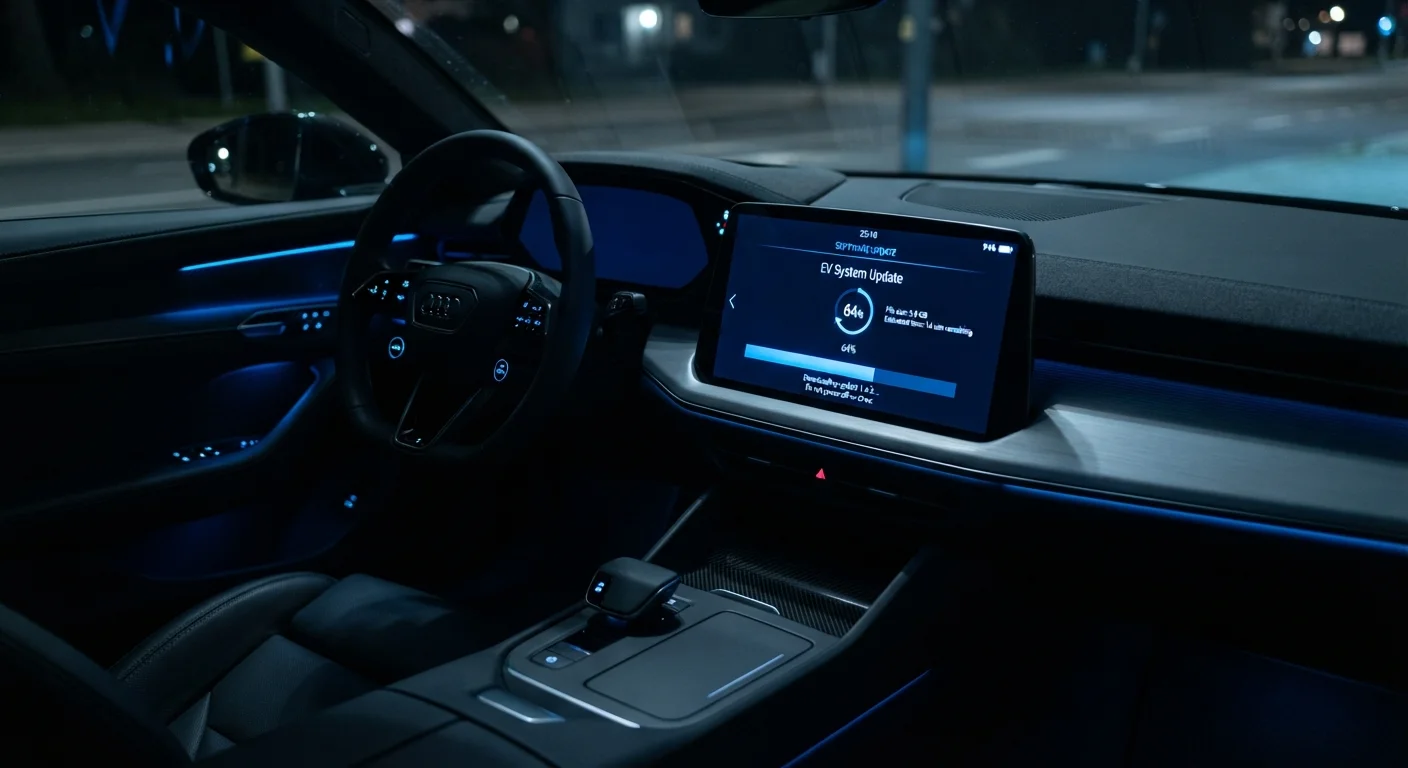
An over-the-air (OTA) software update is a wireless delivery of new code to a vehicle's onboard computer systems - no dealership visit required. Automakers push these updates via cellular or Wi-Fi connections, allowing them to fix bugs, improve performance, or add features after a car has left the factory. The process works similarly to updating an app on your smartphone.
EVs typically run dozens of electronic control units (ECUs); OTA updates can target one or several simultaneously, but hardware-level constraints always set a ceiling on what software alone can achieve.
What OTA Updates Actually Deliver
Over-the-air updates have redefined the relationship between automakers and vehicle owners. Where a gas-powered car was essentially fixed at the factory, a modern EV can evolve over time through software - adding capabilities, correcting errors, and improving efficiency without the owner ever scheduling a service appointment.
Common deliverables include:
- Battery management refinements: Algorithms controlling charge rates, thermal management, and state-of-health estimates can be rewritten to extend battery longevity or optimize real-world range.
- Bug and stability fixes: Infotainment crashes, Bluetooth pairing failures, and instrument cluster glitches are software problems with software solutions.
- Driver-assistance calibration: Systems like lane centering, automatic emergency braking, and adaptive cruise control rely heavily on software logic. Understanding what ADAS systems actually do helps clarify why these updates can meaningfully change how a vehicle behaves on the road.
- Charging behavior: Automakers can push updates that alter DC fast-charging curves - for example, allowing higher peak charge rates on supported hardware, or adjusting charge limits to protect battery health.
- Security patches: Like any networked device, connected vehicles are exposed to cybersecurity vulnerabilities. Skipping security updates carries real risk, and the same principle applies to vehicles.
~30%
Share of new US vehicle recalls addressed via OTA in recent years
NHTSA data indicates a growing proportion of safety recall remedies are being delivered wirelessly, reflecting how central software has become to modern vehicle safety.
Dozens
Electronic control units in a typical modern EV
A contemporary EV can contain 30-100+ ECUs managing everything from braking to climate control, each a potential target for software updates.
Billions
Lines of code in some modern vehicles
Industry estimates suggest premium connected vehicles may run more software code than commercial aircraft, underscoring the scale of ongoing software management.
The Hard Limits: What Software Cannot Fix
It's easy to overstate what OTA updates can accomplish. Software operates within the boundaries set by physical hardware - and no firmware revision changes that fundamental constraint.
Battery capacity is fixed at manufacture. If a vehicle shipped with a 75 kWh pack, software updates cannot expand that to 80 kWh. Range improvements through OTA are incremental efficiency gains, not capacity additions.
Motor and drivetrain hardware is immutable via software. Peak torque, towing capacity, and structural performance are determined by physical components. Software tuning can adjust how power is delivered, but cannot exceed what the hardware supports.
Worn parts don't get patched. Brake pads, tires, suspension components, and thermal management hardware degrade physically. EV maintenance still involves real hands-on work, even if the list of consumables is shorter than a gas vehicle's.
Sensor hardware cannot be upgraded remotely. If a vehicle's cameras or radar hardware lack the resolution or processing power for a more advanced driver-assistance feature, no software update can bridge that gap - regardless of what the automaker's newer models support.
Check Before You Assume a Bug Is Hardware
If your EV is exhibiting odd behavior - unexpected charging limits, infotainment glitches, or sensor alerts - check whether a pending software update exists before assuming a hardware failure. Many issues that appear mechanical are software-rooted and can be resolved wirelessly. Your vehicle's app or touchscreen settings menu is usually the first place to look.
OTA Updates Across the Industry
Not all automakers deliver OTA updates equally. Some manufacturers support full vehicle-wide updates - covering core driving systems, not just infotainment - while others limit wireless updates to the media center and push critical updates only through dealership visits.
The gap matters because OTA capability affects long-term ownership value and how quickly safety improvements reach vehicles already on the road. Post-sale software updates can add, remove, or alter features - a dynamic that's increasingly true for vehicles as well as consumer electronics.
There's also a regulatory dimension. The National Highway Traffic Safety Administration (NHTSA) has been examining how OTA updates interact with existing recall and safety reporting frameworks, since a software deployment can theoretically address a safety defect for millions of vehicles simultaneously - or introduce a new one.
Looking further ahead, technologies like vehicle-to-grid (V2G) integration may depend on OTA infrastructure to roll out and evolve. V2G could eventually let EVs send energy back to the grid, a capability that would require ongoing software coordination between vehicle, charger, and utility systems.