

Key Takeaways
- Estimated arrival charge updates continuously because energy consumption depends on variables that change every mile.
- Elevation changes, speed, temperature, and HVAC use are among the biggest real-time factors affecting the prediction.
- The estimate is a forecast, not a guarantee - treat a low predicted arrival charge as a warning to adjust your plan.
- Routing software improves its accuracy as the trip progresses and uncertainty about future conditions narrows.
- Driving more efficiently - reducing speed or limiting climate control - can measurably raise your predicted arrival charge.
Estimated Arrival Charge
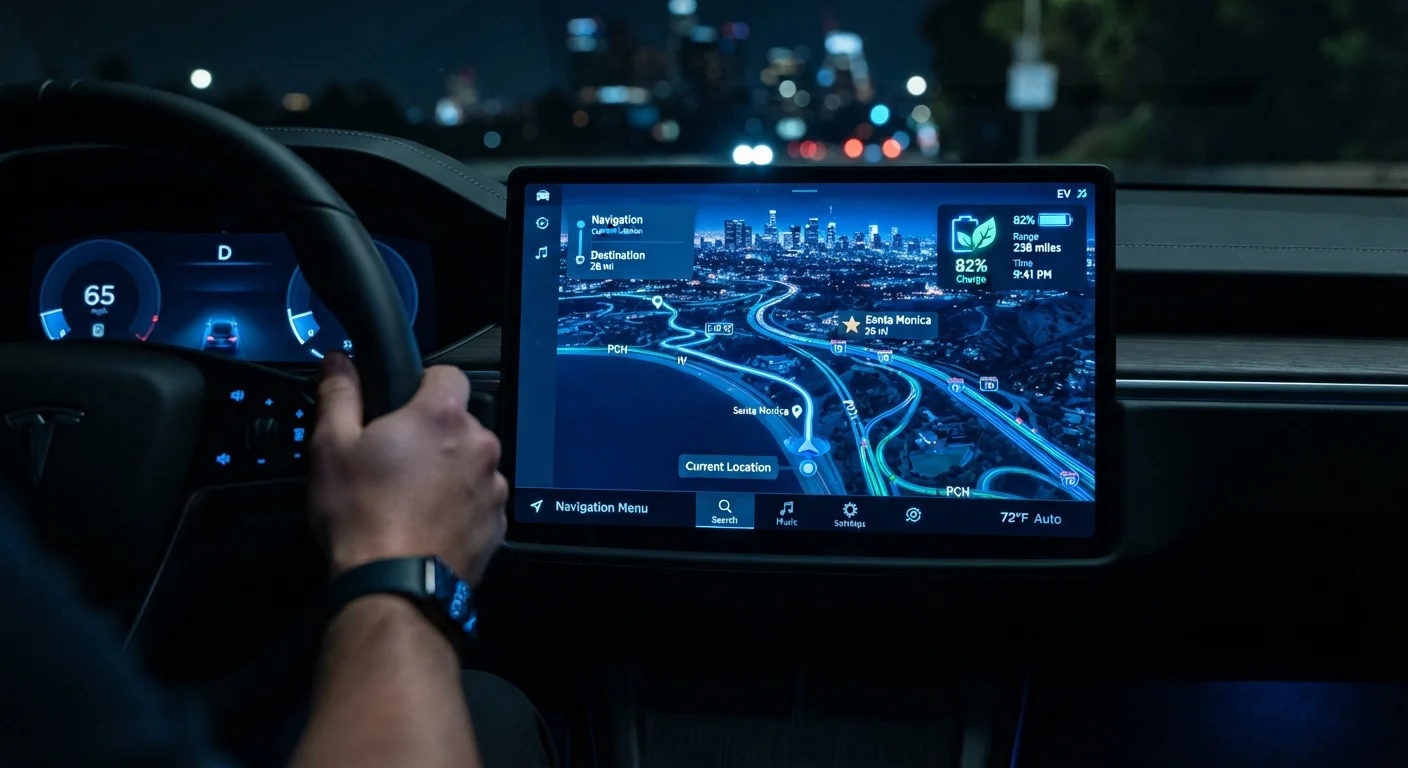
Estimated arrival charge is the battery percentage your electric vehicle's navigation system predicts you will have remaining when you reach your destination. It is calculated in real time by weighing your current state of charge against projected energy consumption for the route ahead. Because that consumption depends on dozens of constantly shifting variables, the figure updates throughout your journey.
Most modern EV routing systems use energy consumption models that combine historical efficiency data for the specific vehicle, real-time sensor inputs, and route topology to generate a continuously refined state-of-charge forecast.
What the System Is Actually Calculating
Your EV's routing system isn't simply dividing remaining battery capacity by average miles per kilowatt-hour. It is running a continuous energy model that accounts for the specific road ahead - including elevation changes, posted speed limits, anticipated traffic, and your vehicle's known efficiency characteristics at various speeds and loads.
This model starts with your current state of charge and works forward, mile by mile, estimating how much energy each segment will consume or recover. The result is a rolling prediction that gets recalculated every few seconds. That constant recalculation is why the number moves.
Understanding how EV range management differs from simply watching a fuel gauge helps set the right expectations before a long drive.
The Variables That Move the Number
Several real-time inputs have an outsized effect on the estimate:
- Speed: Energy consumption rises steeply at higher speeds due to aerodynamic drag. Increasing your cruising speed from 65 to 80 mph can reduce efficiency by 20% or more, causing a visible drop in predicted arrival charge.
- Elevation: Climbing a mountain pass draws heavily on the battery. Descent often recovers some energy through regenerative braking, but the net effect of significant elevation gain is nearly always negative.
- Temperature: Cold weather reduces lithium-ion cell efficiency and dramatically increases cabin heating demands. Heat also stresses the battery, though generally less severely than cold. The system adjusts if it has access to weather data along the route.
- HVAC use: Running the heater or air conditioner at full output can consume several kilowatts continuously - a meaningful draw that the model must account for.
- Traffic: Stop-and-go traffic affects the calculation differently than free-flow driving. Regenerative braking can help in congestion, but the model updates as traffic conditions change ahead of you.
~20%
Efficiency drop at 80 mph vs. 65 mph
Studies of real-world EV energy consumption consistently show aerodynamic drag causes efficiency to fall sharply as highway speed increases above 65 mph.
10-40%
Range reduction in cold weather
The US Department of Energy has noted that EV range can decrease by 10-40% in very cold temperatures depending on vehicle type, heating demands, and battery chemistry.
1-3 kW
Continuous HVAC energy draw
Cabin climate control in electric vehicles typically consumes between one and three kilowatts of continuous power, a significant share of the energy budget on shorter trips.
For a deeper look at how battery chemistry interacts with these conditions over time, see our article on EV battery degradation and what research shows.
Why Estimates Become More Accurate as You Get Closer
Early in a long trip, the system is essentially forecasting conditions it cannot yet observe - weather an hour away, traffic on a pass two states over, your driving behavior on roads you haven't traveled. The further out the forecast window, the more uncertainty is baked in.
As the miles accumulate, the remaining route shrinks and the unknown variables narrow. The software also learns your actual driving style on that particular trip: if you've been driving smoothly at moderate speed, it weights that pattern into the remaining prediction. This is why the estimate often stabilizes and becomes more reliable in the final stretch of a journey.
Build in a Comfortable Buffer
Plan your long-distance routes to arrive at charging stops - and your final destination - with at least 10-15% charge remaining. This cushion protects against estimation errors caused by unexpected headwinds, detours, or a charging station that's out of service. The arrival charge estimate is a guide, not a guarantee.
If your route includes a planned charging stop, see our overview of navigating public charging networks across the US to understand what to expect when you arrive.
How to Respond When the Estimate Drops
A falling arrival charge estimate is an early-warning signal, not a crisis - if you act on it. The most effective adjustments available to most drivers are speed reduction and climate control management. Dropping highway speed by 10 mph can meaningfully extend projected range. Reducing heater or AC output - or using seat heaters instead of cabin air heating - costs less energy for similar comfort.
If the estimate falls below a comfortable buffer (many EV owners and automakers suggest keeping at least 10-15% in reserve), consider adding a charging stop. Most built-in navigation systems will suggest one automatically when the predicted arrival charge dips too low, and they can route you to a compatible station. You can also review how public charging costs compare to home charging if you're weighing whether to top up en route.
The estimate is a sophisticated tool, but it is still a forecast. Building a margin into your planning - and knowing how to respond when conditions push the number down - is the practical skill that separates confident long-distance EV travel from anxious range-watching.