

Key Takeaways
- Higher potential returns almost always come with higher potential losses - this is a foundational investing principle.
- There is no such thing as a completely risk-free investment that also offers meaningful growth.
- Different asset types - cash, bonds, stocks - sit at different points on the risk-return spectrum.
- Understanding your own comfort with uncertainty helps you choose investments suited to your situation.
- Inflation itself is a risk: keeping money idle in cash can erode its purchasing power over time.
Risk-Return Trade-Off
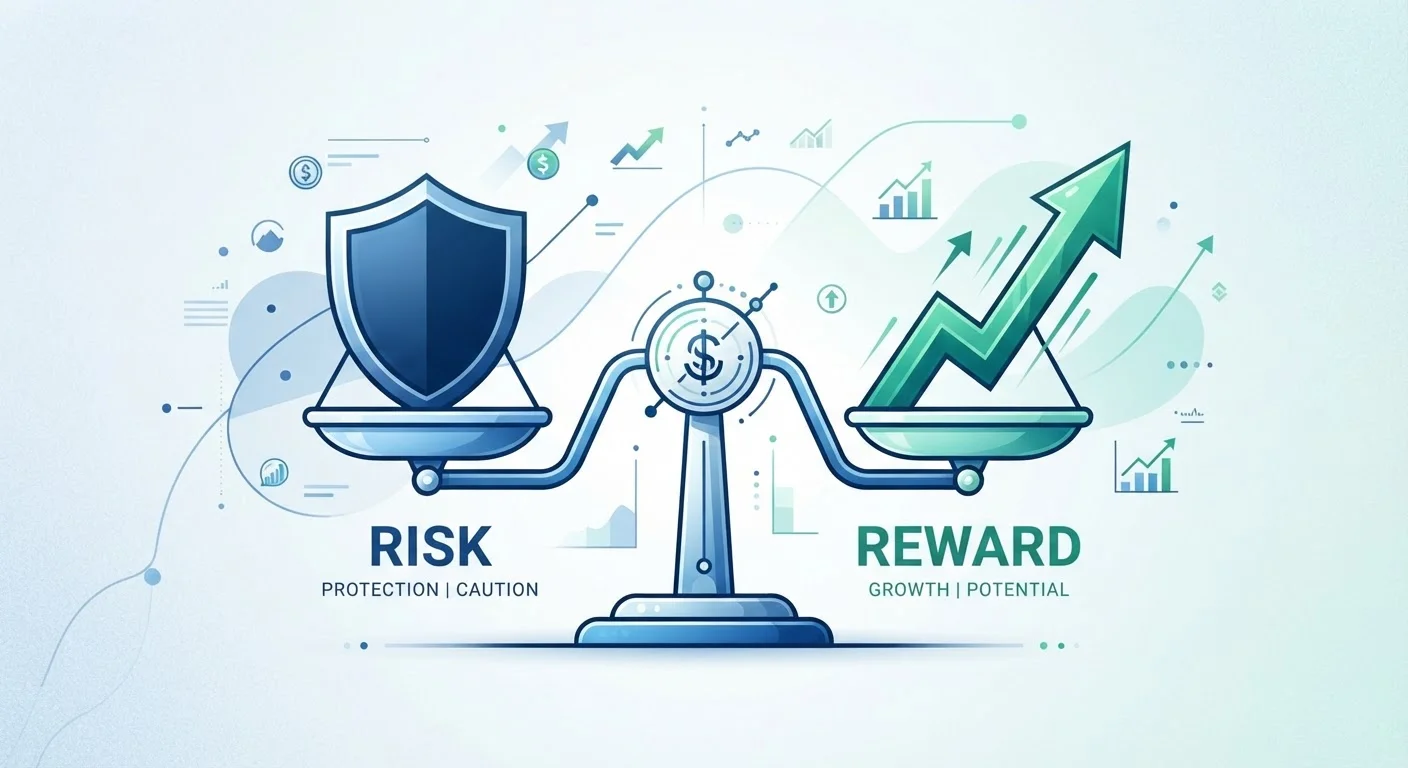
The risk-return trade-off is a core investing principle that states the potential for higher investment gains is directly linked to the possibility of greater losses. In simple terms, safer investments tend to offer lower returns, while investments with more uncertainty have the potential - but not the guarantee - of higher gains. Understanding this relationship is foundational to making informed decisions about where to put your money.
In portfolio theory, this relationship is often illustrated through the 'efficient frontier' - a concept showing the maximum expected return for a given level of risk, based on historical data and asset correlations.
The Core Idea: You Can't Escape the Trade-Off
Every investment decision involves a trade-off between the return you hope to earn and the uncertainty you must accept to earn it. This relationship - often called the risk-return trade-off - is one of the most reliable principles in personal finance.
Think of it this way: a federally insured savings account is about as safe as money gets in the U.S. banking system. Your principal is protected up to FDIC limits, and your return is predictable. But that predictability comes at a cost - the interest rate is modest, and over time, inflation may quietly erode what that money can actually buy. See our explanation of inflation risk for a closer look at why holding only cash carries its own dangers.
At the other end of the spectrum, individual stocks or emerging-market investments can generate significant gains - but they can also lose substantial value in a short period. The higher potential is real, but so is the downside.
~10%
Average annual U.S. stock market return (historical)
The S&P 500 has historically averaged roughly 10% annual returns before inflation, though individual years vary widely and past performance does not guarantee future results.
~4-5%
Typical yield range for U.S. Treasury bonds
Treasury bond yields fluctuate with Federal Reserve policy and market conditions; they generally offer lower returns than equities in exchange for lower default risk.
3%+
Long-run average U.S. inflation rate
According to Federal Reserve historical data, U.S. inflation has averaged around 3% annually over the long run, illustrating why very low-return assets can lose real purchasing power.
Where Different Assets Sit on the Spectrum
Not all investments carry the same level of risk. Here is a general framework - from lower to higher risk - to help visualize how different asset types relate:
- Cash and savings accounts: Very low risk, very low return. Principal is generally stable, but purchasing power can decline with inflation.
- Government bonds: Low to moderate risk. U.S. Treasury securities are backed by the federal government, making default unlikely, but prices fluctuate with interest rates.
- Corporate bonds: Moderate risk. Companies can default, so returns are typically higher than government bonds to compensate investors for that possibility.
- Stocks (large, established companies): Moderate to higher risk. Share prices can drop significantly, but historically equities have offered stronger long-term growth potential than bonds or cash.
- Stocks (small companies or emerging markets): Higher risk. Greater growth potential exists, but these assets can be far more volatile.
Understanding what drives market volatility can help you interpret why prices in higher-risk assets move so dramatically.
Why This Matters for Your Financial Decisions
Knowing the risk-return relationship helps you ask better questions before putting money anywhere. Instead of chasing the highest advertised return, you can ask: What is the realistic downside here, and can I afford it?
Your answer will depend heavily on factors like your time horizon (how long before you need the money), your financial goals, and your personal comfort with uncertainty - a concept known as risk tolerance. Our article on investment risk tolerance walks through how to think about yours.
“Risk comes from not knowing what you're doing. The goal of the investor should be to make investments where the risk is knowable and manageable.”
— Warren Buffett, Chairman and CEO, Berkshire Hathaway
One practical approach many investors use is diversification - spreading money across different types of assets so a loss in one area does not devastate the whole. Diversification does not eliminate risk, but it is a widely recognized strategy for managing it.
Finally, consider the role psychology plays. Fear during market downturns and excitement during rallies can push investors toward poor timing decisions. Understanding the emotional side of investing is just as important as understanding the numbers.
This article is for general informational and educational purposes only and does not constitute personalized financial, investment, tax, or legal advice. Consult a qualified, licensed financial professional before making any investment decisions.