

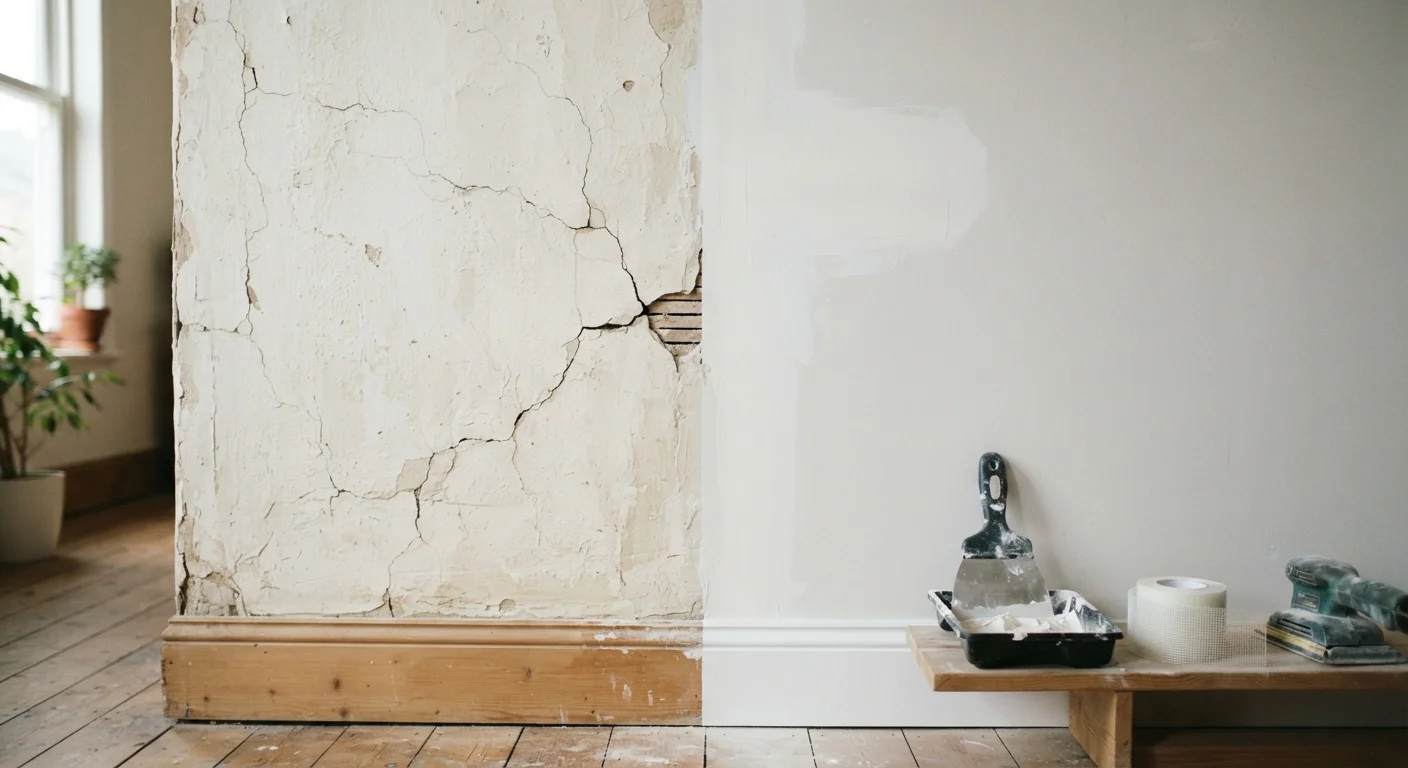
Key Takeaways
- Plaster is a multi-layer system; drywall is a single gypsum panel - each fails and repairs differently.
- Using drywall compound on plaster often results in cracks and poor adhesion over time.
- Identifying your wall type before purchasing materials saves time, money, and frustration.
- Structural cracks in either system may signal a deeper problem requiring professional evaluation.
- Texture matching is often the most visible challenge in any wall repair project.
Option A
Plaster
The older, layered system built for durability.
Best for: Homes built before roughly 1950 with multi-coat wall systems applied over wood or metal lath.
Option B
Drywall
The modern, panel-based wall system designed for speed.
Best for: Homes built or renovated after the mid-20th century using gypsum panels fastened to framing.
If you have a small hole or dent in a post-1960s home
Drywall
Standard joint compound and a mesh patch are well-suited to simple drywall repairs, and matching textures is relatively straightforward with lightweight compound.
If you have hairline cracks in an older home with thick, hard walls
Plaster
Those walls are almost certainly plaster, which requires compatible bonding agents and plaster-specific filler to hold a lasting repair.
If you see large sections of wall bulging or separating from the surface behind it
Plaster
Plaster keys - the material that grips the lath behind - can fail over time, requiring stabilization screws or full section replacement rather than a simple patch.
If cracks are wide, recurring, or follow a stair-step pattern
Plaster
These patterns often suggest movement in the structure beneath, which no surface patch will resolve - a professional inspection is warranted before any cosmetic repair.
How to Tell Which Wall System You Have
Before buying a single tube of filler, confirm what you're working with. The most reliable method is the knock test: tap the wall with your knuckle. Drywall produces a hollow sound and feels slightly flexible; plaster sounds dense and solid. Plaster walls also tend to be thicker - typically ¾ inch or more - compared to the standard ½-inch drywall panel.
Another quick check: look at the edges of any electrical outlet box. In a plaster wall, the box will be recessed behind a noticeably thick, hard surface. In drywall, the box is close to flush with a thinner, softer panel that dents more easily under pressure.
If you live in a home built before approximately 1950, assume plaster until you confirm otherwise. Drywall became the dominant construction method in the United States during the 1950s and 1960s as it offered faster installation. Many homes from that transitional era may have both materials in different rooms.
| Criterion | Plaster | Drywall |
|---|---|---|
| Typical home era | Pre-1950s construction | Post-1950s construction |
| Wall composition | Multi-coat over wood or metal lath | Single gypsum panel on framing |
| Thickness | ¾ inch or more | Typically ½ inch |
| Common failure modes | Key failure, bulging, crumbling | Screw pops, punctures, tape bubbling |
| Repair material | Plaster-compatible or setting compound | Standard or lightweight joint compound |
| DIY difficulty | Moderate to high | Low to moderate |
| Texture matching | Difficult; finish coat skill required | Moderate; aerosol products available |
Why Plaster Repairs Require a Different Approach
Traditional plaster is a three-coat system - a scratch coat, a brown coat, and a finish coat - applied wet over wood or metal lath (thin strips that form the backing). As the plaster cures, it squeezes through the gaps in the lath and forms mechanical anchors called keys. Over decades, those keys can break, causing sections of plaster to crack, bulge, or detach entirely from the wall.
Standard drywall joint compound - the kind sold for everyday drywall use - is too lightweight and shrinks too much to bond reliably with existing plaster. It may look fine for a few weeks, then crack along the edges of the repair. For small cracks, a plaster-compatible filler or patching compound with a bonding agent is a better choice. For larger sections, many contractors use a setting-type compound (which hardens chemically rather than drying) because it shrinks far less.
When a section of plaster has separated from the lath but hasn't fallen, it can sometimes be re-secured using plaster washers and screws before patching - a technique that saves time compared to full removal. If the lath itself is damaged or rotted, however, that section will need to be rebuilt or replaced with a drywall insert, which then requires blending the edges carefully.
See our guide to stucco repair for a related look at how layered exterior systems behave differently from flat panel walls.
Bonding Agent: A Small Step That Matters
When patching plaster, applying a liquid bonding agent to the repair area before adding new material significantly improves adhesion. Without it, new plaster or patching compound may cure against the old surface without truly gripping it, leading to edge cracking within months. Bonding agents are widely available at hardware stores and are applied by brush, then allowed to become tacky before patching begins.
Drywall Repairs: Simpler, but Texture Still Trips People Up
Drywall damage - screw pops, nail holes, small punctures, or larger cutouts - is generally more straightforward to repair than plaster because the panel system is uniform and the materials are purpose-built for patching. Joint compound is readily available, easy to sand, and bonds well to drywall paper and gypsum.
The process for small holes typically involves a self-adhesive mesh patch covered with two or three thin coats of joint compound, feathered out beyond the patch edges so the repair blends gradually into the surrounding wall. For larger holes, a piece of new drywall backed by furring strips or a California patch (a technique that uses the drywall's own paper face as a self-supporting edge) provides a solid base.
Where most homeowners struggle is texture matching. Smooth walls are forgiving if you sand carefully; textured walls - orange peel, knockdown, or skip-trowel - are much harder to replicate without practice. Aerosol texture products help with common patterns, but an exact match often takes experimentation. Our step-by-step drywall patching guide walks through this process in detail.
Also worth understanding: not all drywall cracks are cosmetic. Learn what different crack patterns in drywall actually mean before assuming a patch is all that's needed.
~30%
US homes built before 1950
According to US Census Bureau housing data, a significant portion of the American housing stock predates widespread drywall adoption, meaning plaster walls remain common in older neighborhoods.
3 coats
Layers in traditional plaster
A standard plaster wall consists of a scratch coat, brown coat, and finish coat - each requiring cure time, which is why plaster repairs demand patience and compatible materials.
When a Patch Isn't Enough: Knowing Your Limits
Both plaster and drywall can develop damage that points to something larger - settling foundations, moisture intrusion, or framing movement. Repeating cracks that reappear after patching, cracks wider than about 1/8 inch, or damage that spreads in stair-step patterns along mortar joints or corners all warrant a closer look before you invest time in cosmetic repair.
It's also worth considering whether a repair is meant to last or just hold temporarily. Understanding when a temporary fix is appropriate can save you from overcomplicating a quick stabilization job - or from under-engineering something that needs to last years.
When in doubt about structural integrity, consult a licensed contractor or structural engineer. No surface patch addresses what's happening behind the wall.